 Lynden Exterior
 Why Two Roof Quotes Rarely Match
Ask three contractors to price the same roof and you'll often get three different numbers. That's not always a sign someone's padding the bid or someone else is cutting corners — roofing costs are driven by a long list of variables, and different crews weigh materials, labor, and risk differently. Understanding what actually moves the price lets you compare quotes on substance instead of just the bottom line.
This page walks through the real cost drivers for a roof replacement in Lynden and the rest of Whatcom County, including a few regional factors — moss, driving rain, and salt air off the Sound — that homeowners farther inland don't have to think about.
The Core Cost Drivers
Before you get to material choice, a handful of structural and site factors set the baseline for any roofing bid.
| Factor | Why It Matters |
|---|---|
| Roof size (squares) | Bigger roof, more material and labor hours — the most basic multiplier in any bid. |
| Pitch / steepness | Steep roofs require harnesses, staging, and slower, more careful work — labor cost climbs with pitch. |
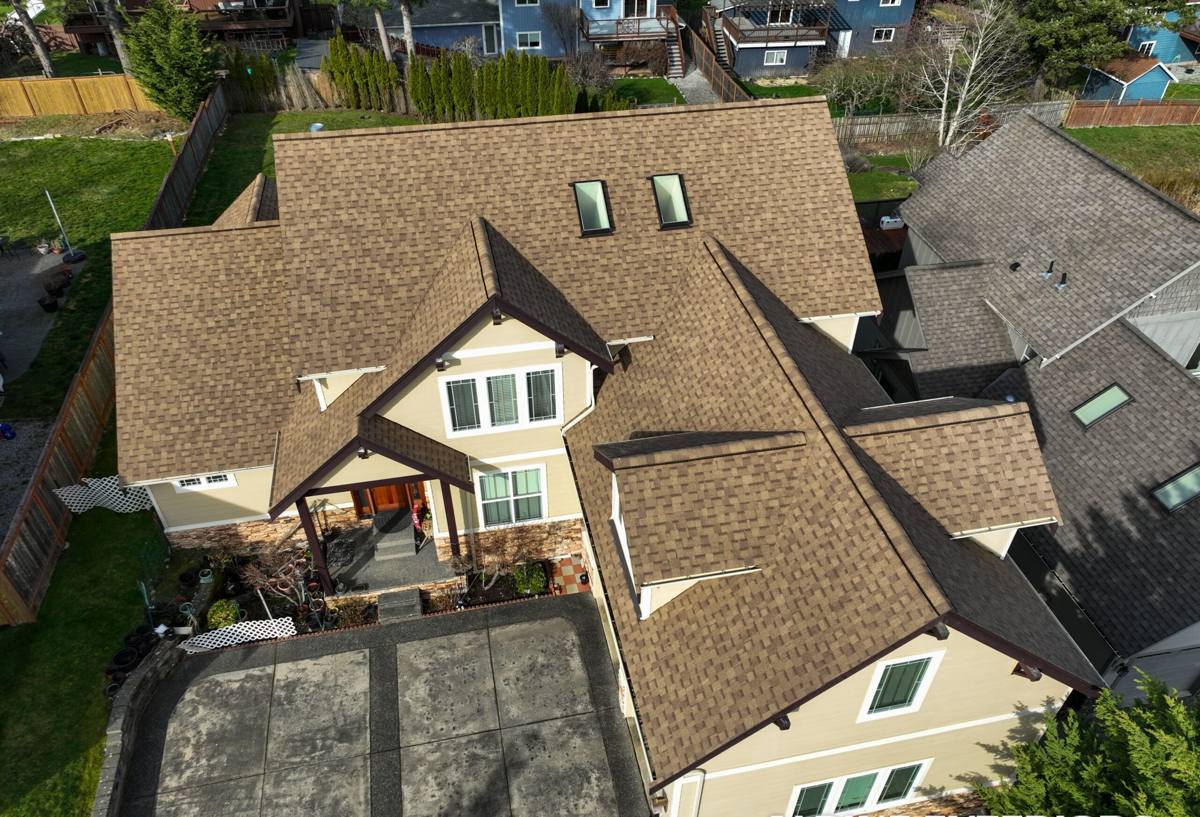
| Roof complexity | Valleys, dormers, chimneys, and multiple roof planes all add flashing work and cut time. |
| Number of existing layers | Tear-off of two layers of old shingles costs more in labor and disposal than a single-layer tear-off. |
| Decking condition | Rotten or delaminated sheathing found underneath has to be replaced before new roofing goes down — this is the most common source of mid-project cost increases. |
| Accessibility | Tight lots, steep driveways, or limited staging area slow down material delivery and disposal. |
| Permits and code upgrades | Local permitting and current code requirements (ice and water shield, ventilation) add cost that older roofs weren't built to. |
The One Homeowners Underestimate Most
Decking condition is the variable that causes the most friction between homeowners and contractors, because it's usually invisible until the old roofing comes off. A roof that looks fine from the ground can be hiding soft, water-damaged sheathing underneath — especially around valleys, chimneys, and skylights where water has been finding its way in slowly for years. A straightforward contractor will price the roof with an allowance for a reasonable amount of deck replacement and explain, before the tear-off starts, how additional damage would be priced if found.
Material Choice and What It Costs Over Time
Material is the most visible cost factor, but the sticker price only tells part of the story. Lifespan, maintenance, and how a material handles the wet Pacific Northwest climate all affect what you actually spend over the life of the roof.
| Material | Typical Lifespan | What to Know |
|---|---|---|
| Asphalt composition shingle | 20-30 years | The most common choice; wide range of quality tiers; performs well when ventilation and flashing are done correctly. |
| Architectural / laminate shingle | 25-30 years | Heavier, more wind- and impact-resistant than standard 3-tab; modest upcharge over basic shingle. |
| Metal roofing | 40-60+ years | Higher upfront cost, sheds moss and moisture well, less frequent maintenance — a longer-horizon investment. |
| Cedar shake | 20-30 years with upkeep | Traditional look but requires regular treatment and cleaning to resist moss and rot in a wet climate. |
There's no universally "right" material — the right choice depends on how long you plan to own the home, your appetite for maintenance, and your budget. What matters is picking a material and installation approach suited to this climate, not just the lowest bid on paper.
What Whatcom County's Climate Adds to the Number
Roofing in Lynden isn't priced the same as roofing in a dry inland climate, and that's not upselling — it's physics. A few regional realities that show up in a fair local estimate:
- Moss season is long. Shade, moisture, and mild winters make Whatcom County roofs prone to moss and algae growth that can lift shingle edges and trap moisture against the deck if left unaddressed for years.
- Driving rain tests every flashing detail. Wind-driven rain off the Sound and the Nooksack valley pushes water sideways, not just down — valleys, chimney flashing, and roof-to-wall transitions need to be detailed for wind-driven moisture, not just gravity drainage.
- Salt air accelerates corrosion. Homes closer to Bellingham Bay and the coast see faster breakdown of unprotected metal fasteners and flashing than homes further inland — fastener and flashing material choice matters more here.
- Freeze-thaw cycles are mild but real. Whatcom County doesn't see brutal winters, but repeated freeze-thaw on a roof that's already retaining moisture from moss or poor ventilation accelerates wear.
None of this means roofing here is dramatically more expensive than elsewhere — it means the details that get skipped in a rushed or underpriced job (proper underlayment, correct flashing, adequate ventilation) matter more here than in a drier climate, because the consequences of skipping them show up faster.
Hidden Costs Homeowners Often Miss
Beyond the shingles and labor, a few line items catch people off guard if they're not asking about them up front:
- Ice and water shield. Current code typically requires this membrane at eaves, valleys, and penetrations — older roofs often didn't have it, and adding it is a real cost, not an upsell.
- Ventilation corrections. Poor attic ventilation shortens roof life and can void material warranties; fixing intake or exhaust venting sometimes means adding vents that weren't there before.
- Disposal and dump fees. Tear-off debris has to go somewhere, and disposal costs scale with the number of layers removed.
- Skylight and chimney flashing replacement. Reusing old flashing to save money often reintroduces the exact leak points the reroof was supposed to fix.
- Gutter and fascia condition. A roof replacement is the easiest time to address rotten fascia boards or worn gutters — deferring it means paying for separate access and labor later.
Repair vs. Replace: How to Tell
Not every roof problem means a full replacement. A few honest markers for which side of the line you're on:
| Signs a Repair Is Reasonable | Signs Full Replacement Makes Sense |
|---|---|
| Isolated leak from one flashing point | Multiple leaks in different areas |
| A handful of damaged or missing shingles | Widespread granule loss or curling shingles |
| Roof is under 15 years old | Roof is near or past its material's expected lifespan |
| Decking is solid where inspected | Soft spots or sagging visible from inside the attic |
A contractor who's willing to tell you a repair will hold for a few more years — instead of pushing a full replacement — is worth paying attention to. That advice costs them a sale today but tells you something about how they'll treat you on bigger decisions.
What a Fair Estimate Should Include
When you're comparing bids, line items matter more than the total. A complete, honest estimate should spell out:
- Exact material and manufacturer, including the specific product line and warranty terms
- Number of existing layers to be torn off and disposal method
- Underlayment type and ice-and-water-shield coverage
- Flashing scope — chimney, valleys, skylights, wall transitions
- Ventilation plan (intake and exhaust) and any changes being made
- An allowance for decking replacement, and the per-sheet rate if more is found
- Timeline, cleanup process, and who pulls the permit
If a bid is missing several of these, it's worth asking why before you compare it on price alone — a lower number that's silent on flashing and ventilation isn't actually a lower price, it's an incomplete one.
Where Roof and Siding Decisions Overlap
A roof replacement is also a natural point to take stock of the rest of the exterior envelope — trim, fascia, and siding all sit right next to the roofline and take similar weather exposure. If your siding is showing the same age-related wear as the roof — moss staining, soft or delaminating panels, paint that won't hold anymore — it's worth having both assessed together rather than as separate projects down the road.
On the siding side, we install James Hardie fiber cement exclusively. It's a decision we've made as a company, not a claim that every other siding product is unfit for this climate — but after years of exterior work in Whatcom County's wet, moss-prone conditions, Hardie's non-combustible composition, factory-baked ColorPlus finish, and climate-engineered HZ product lines are what we're willing to stand behind with a strong transferable warranty. If a roof project uncovers siding that needs attention, that's the standard we'll bring to that conversation too.
Getting an Accurate Number for Your Home
Every roof is a different combination of size, pitch, material, and condition — the only way to get a real number is to look at the actual roof, not average it against a national estimate. If you're weighing a repair versus a full replacement, or just want a straight answer on what your roof needs, we're happy to take a look and walk you through it. Reach out for a free, no-pressure estimate — we'll tell you what we actually see, not just what sells.