 Lynden Exterior
 Board & Batten in a Climate That Doesn't Cut Corners
Board and batten has become one of the most requested siding profiles for homes on both sides of the Whatcom County / Fraser Valley line, and it's easy to see why. The vertical lines read as farmhouse, craftsman, or modern depending on trim details and color, and it works equally well as a full-wall treatment or as an accent over entries, gables, and dormers. But the same bold vertical lines that make board and batten attractive also make it less forgiving of moisture problems than a standard lap profile. Every seam, every batten, and every fastener is a decision point — and in a marine-influenced climate with salt-laden air, long stretches of driving rain, and a moss season that can run half the year, those decisions matter more here than they do in drier parts of the country.
This page is about doing board and batten correctly for homes in the Abbotsford, BC area, a short drive from our Lynden base and inside the same weather system. We install exclusively in James Hardie fiber cement, and we'll explain why below — but first, it's worth understanding what this climate actually does to a wall.
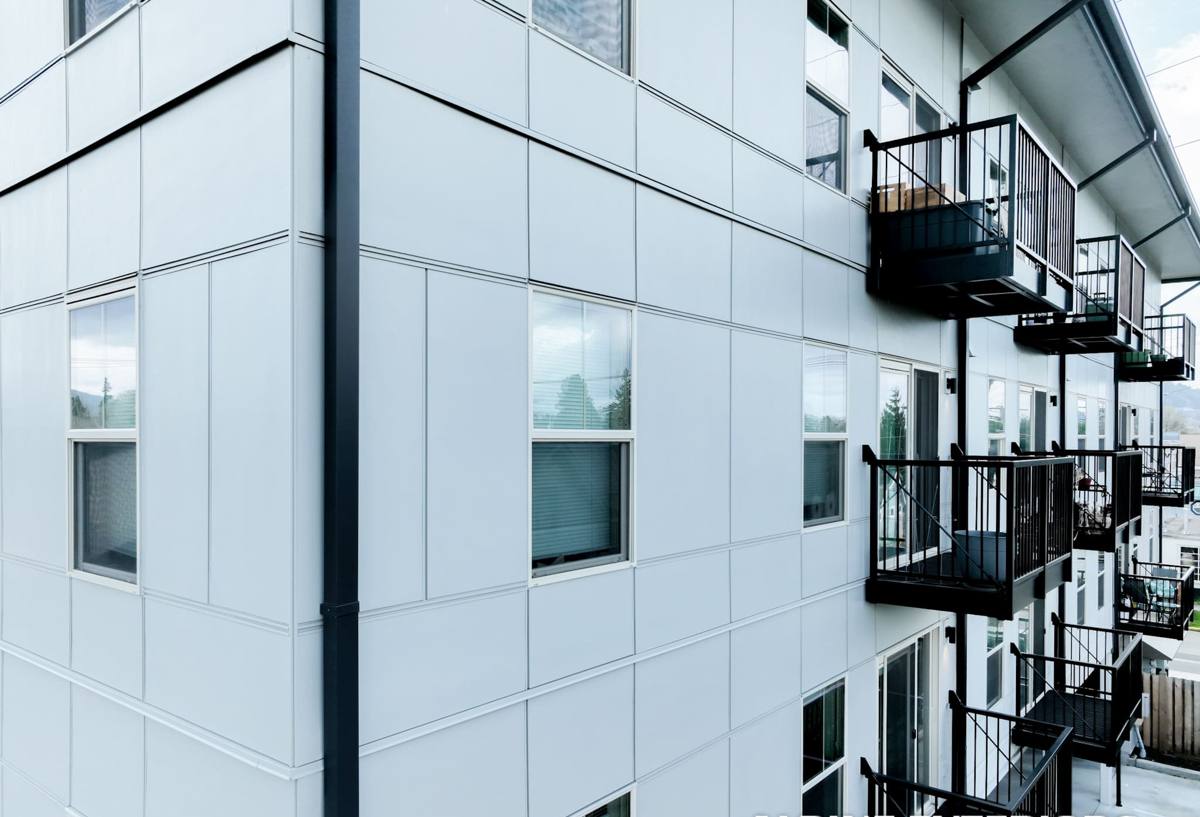
What Salt Air, Driving Rain, and Moss Season Do to Siding
Salt Air
Properties closer to the Strait of Georgia and the broader Salish Sea airshed deal with a fine, persistent salt content in the air that settles on exterior surfaces. Salt is hygroscopic — it pulls moisture out of the air and holds it against whatever surface it lands on. On wood-based sidings, that means the surface stays damp longer between rain events, which accelerates rot at seams and fastener points. On metal fasteners and trim, it accelerates corrosion. Fiber cement doesn't absorb moisture the way wood-based products do, which is one of the reasons it holds up better in this specific environment.
Driving Rain
This region doesn't just get a lot of rain — it gets a lot of wind-driven rain, which behaves very differently than a straight-down shower. Wind-driven rain gets pushed sideways and upward into laps, seams, and butt joints that would stay dry in a calmer climate. Board and batten has more vertical seams per square foot than lap siding, and every one of those seams is a potential entry point if the water-resistive barrier, flashing, and batten spacing aren't detailed correctly.
Moss Season
Shaded, north-facing walls and anything near overhanging trees can carry active moss and algae growth for much of the year in this climate. Moss holds moisture directly against the siding surface and, on a batten profile, tends to establish first at the top edge of each batten where debris and dampness collect. Left alone, that sustained dampness is what eventually causes rot in wood-based products and paint failure on painted surfaces. A factory-cured fiber cement finish resists that kind of surface breakdown far longer than field-applied paint on wood.
What a Correctly Installed Board & Batten Wall Actually Involves
Board and batten looks simple from the curb — vertical boards, battens over the seams — but the assembly behind that look is what determines whether it lasts 10 years or 40. A correct install includes:
- A continuous water-resistive barrier behind the siding, lapped correctly top-to-bottom so water sheds outward rather than tracking behind the wall
- Rainscreen or furring strips creating a drainage gap so any moisture that does get behind the boards can dry out instead of sitting against the sheathing
- Proper batten spacing and fastening — battens fastened independently of the underlying board where the manufacturer's system calls for it, not just face-nailed through both layers
- Correct flashing at every horizontal transition — window and door heads, roof-to-wall intersections, and the base of the wall where it meets foundation or trim
- Fastener patterns and clearances that match the manufacturer's engineering, not just "what looks right"
- Factory-finished or properly primed cut edges, since an exposed raw edge is where moisture intrusion typically starts
Skip any one of these and the wall may still look right for a season or two. The failures that show up in this climate — soft spots at the base of boards, staining under battens, paint or finish breaking down at seams — almost always trace back to one of these details being shortcut during installation, not a flaw in the siding material itself.
Why We Only Install Board & Batten in James Hardie Fiber Cement
Board and batten is traditionally a wood profile, and it's still commonly offered in cedar, engineered wood products like LP SmartSide, and in vinyl. We don't install any of those, and it's worth explaining why rather than just stating it.
Cedar and Primed Spruce
Real wood board and batten can look excellent, and there's nothing wrong with the material in principle. The issue is maintenance and moisture behavior in this specific climate. Wood is hygroscopic — it absorbs and releases moisture with the seasons — and in a climate with this much sustained dampness and salt exposure, that movement accelerates checking, cupping, and rot at end grain and fastener points. Keeping a wood board and batten wall performing well here means a real, ongoing repainting and inspection schedule, not a one-time install.
LP SmartSide and Other Engineered Wood
Engineered wood siding improved on some of solid wood's weaknesses, but it's still a wood-strand product with an engineered resin coating, and its long-term performance depends heavily on that coating staying fully intact — cut edges, fastener penetrations, and any field damage need to be sealed correctly or moisture can wick into the strand core. In a driving-rain, high-moisture climate, that installation sensitivity is a real ongoing risk we'd rather not put our name on.
Vinyl
Vinyl board and batten is inexpensive and low-maintenance in the sense that it doesn't need painting, but it isn't a rigid, fastened-tight assembly — it's designed to expand and contract, which shows on a batten profile as visible waviness over time, especially on longer wall runs. It's also a combustible material with a lower impact resistance than fiber cement, which matters in wildfire-adjacent regions and in general durability terms.
James Hardie
James Hardie fiber cement is engineered specifically to resist the failure modes above: it doesn't absorb water the way wood or wood-strand products do, it's non-combustible, and it carries a factory-applied ColorPlus finish that's baked on and warrantied against fading and flaking — a real advantage over field-applied paint that has to be maintained on a schedule. Hardie's HZ5 product formulation is engineered specifically for cold, wet climates, which describes this region well. That combination — moisture stability, finish durability, and a strong transferable warranty — is why it's the only board and batten material we put on a house.
| Factor | Cedar / Primed Wood | Engineered Wood (LP SmartSide) | Vinyl | James Hardie Fiber Cement |
|---|---|---|---|---|
| Moisture absorption | High | Moderate — depends on coating integrity | Low, but not rigid | Very low |
| Combustibility | Combustible | Combustible | Combustible | Non-combustible |
| Finish maintenance | Repaint every few years | Repaint / recoat on a schedule | None, but fades and can warp | Factory finish, warrantied |
| Long-run appearance on battens | Good if maintained | Good if coating intact | Can wave/oil-can over time | Holds straight lines well |
| Typical warranty | Product only, if any | Manufacturer, install-dependent | Manufacturer, install-dependent | Strong transferable warranty |
Our Process for an Abbotsford-Area Board & Batten Project
- On-site walkthrough. We look at wall orientation, shading, existing moisture damage, and how much of the wall will be full board and batten versus an accent application.
- Detailed measure and product selection. We spec board width, batten spacing, corner treatment, and color, and confirm the correct James Hardie product line for the application.
- Written estimate. No pressure, no gimmick pricing — a clear scope of what's included: tear-off if needed, house wrap or rainscreen, flashing, siding, trim, and finish.
- Removal and inspection of the existing wall. This is where hidden rot or old flashing mistakes get caught before they're sealed behind new siding.
- Weather barrier and drainage plane installation. This layer does more long-term work than the visible siding — we don't rush it.
- Board, batten, and trim installation to manufacturer fastening specs, with flashing detailed at every penetration and transition.
- Final walkthrough with the homeowner before we consider the job finished.
Cost Factors Worth Understanding Before You Get Quotes
| Factor | Why It Moves the Price |
|---|---|
| Full wall vs. accent application | Full board and batten on all elevations costs more than using it as a gable or entry accent over standard lap siding |
| Tear-off and repair | Rot found behind old siding adds sheathing repair before new siding can go on — this is common on north-facing, shaded walls in this climate |
| Board width and batten spacing | Narrower boards and tighter batten spacing mean more material and more labor hours per square foot |
| Trim and corner detailing | Custom corner boards and window/door trim add labor beyond the flat wall area |
| Access and wall height | Multi-story walls and tight side yards slow installation and require additional staging |
Keeping Board & Batten Performing Through the Seasons
James Hardie fiber cement is low-maintenance, not no-maintenance. A short seasonal routine keeps it performing at its best in this climate:
- Rinse the wall annually, especially shaded and north-facing sections where moss and algae establish first
- Keep gutters clear so overflow doesn't run down and pool behind battens
- Trim back vegetation that keeps a wall shaded and damp longer than the rest of the house
- Check caulking at trim joints and penetrations every couple of years and recaulk as needed
- Watch the base of the wall near grade for splashback staining, which signals a drainage or grading issue worth fixing before it becomes a moisture problem
Why a Crew That Already Works This Area Matters
Board and batten performs or fails based on details most homeowners never see once the wall is closed up — batten fastening method, drainage plane continuity, flashing sequencing at every transition. Those details aren't generic; they're a direct response to what this specific climate does to a wall over years, not what a spec sheet says in ideal conditions. A crew that regularly works homes across the Lynden and Abbotsford, BC area has already seen how salt air, driving rain, and moss season play out on real walls here, and builds every detail around that — not around a climate the product was tested for somewhere else.
If you're weighing board and batten for a home in the Abbotsford, BC area, we're happy to walk the property, look at what you're working with, and give you a straight answer on what a correct install involves and what it will cost. There's no pressure and no obligation — just fill out the form below for a free estimate.