 Lynden Exterior
 A Local Crew Working Both Sides of the Border Region
Abbotsford sits just across the international line from Lynden, and the two communities share more than a highway crossing — they share the same weather, the same building challenges, and in a lot of cases, the same architectural styles. Homes here range from older farmhouses on acreage to newer subdivisions built out over the last two decades, and nearly all of them are fighting the same slow battle against moisture. We work this whole corridor regularly, which means when we show up to look at your siding, roof, windows, or deck, we're not guessing at what the climate does to a house out here — we've already seen it play out on dozens of others nearby.
Being a local, regionally based crew matters more than homeowners sometimes expect. Exterior work isn't just about installing a product correctly the day it goes up — it's about knowing how that product will behave through five, ten, twenty winters of the specific weather pattern that hits this part of the Fraser Valley and Whatcom County border. A crew that mostly works drier climates and treats every job the same way will make different assumptions than a crew that lives with this weather every year.
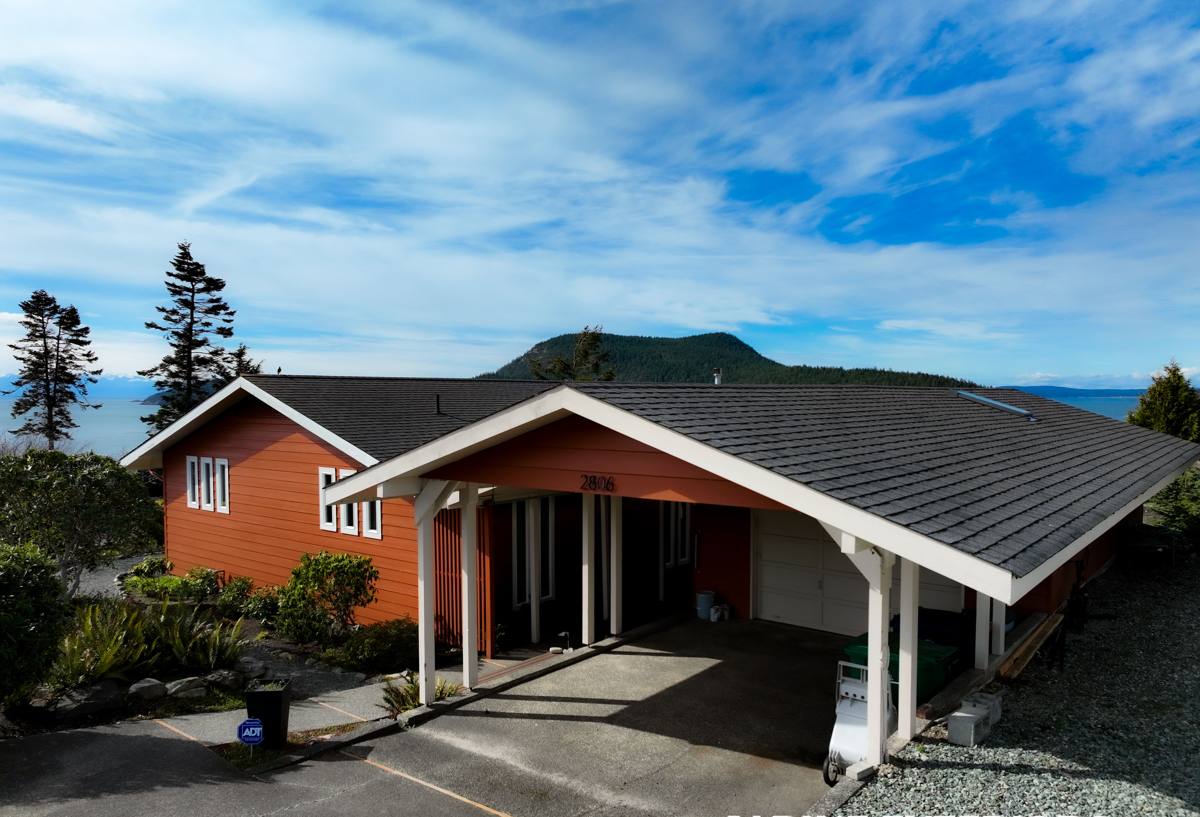
What This Climate Actually Does to a Home's Exterior
The regional mix of salt-tinged marine air moving in off the coast, long stretches of driving rain, and short, low-sun winter days adds up to one of the more demanding climates in North America for exterior building materials. It's not dramatic weather — no hurricanes, no extreme heat — but it's relentless, and relentless is what actually wears a building down.
Moisture That Doesn't Let Up
Driving rain doesn't just fall straight down — wind pushes it sideways into wall assemblies, around window flashing, and under anything that isn't properly lapped or sealed. Over years, materials that absorb water instead of shedding it start to swell, warp, or delaminate. This is the single biggest factor we design around on every exterior we install in this area.
Moss, Algae, and Organic Growth
A long moss season means anything with texture, shade, or a north-facing exposure becomes a growth surface faster than homeowners expect. Roofs are the most visible casualty, but siding, deck boards, and window sills all pick up algae staining if the surface holds moisture and the material doesn't resist it.
Salt Air and Corrosion
Even away from the immediate coastline, salt-laden air carried inland accelerates corrosion on fasteners, flashing, and any exposed metal trim. Cheap or improperly coated hardware fails years before the siding or roofing it's supposed to hold in place.
Siding: Why We Only Install James Hardie Fiber Cement
We get asked fairly often why we don't offer vinyl, LP SmartSide, or some of the other engineered wood and composite siding products on the market. The honest answer is that we looked hard at how those products perform specifically in a wet, moss-prone, salt-exposed climate like this one, and we didn't like the long-term trade-offs enough to put our name behind them.
Engineered wood siding products can look good on day one, and manufacturers have improved their moisture resistance over the years. But wood-based composites still rely on a treated or coated wood substrate, and any breach in that coating — a nail pop, a caulk joint that fails, a corner that wasn't sealed exactly right — gives water a path into a material that swells and deteriorates once it's wet. In a climate with this much sustained rain, that's a bigger gamble than we're willing to make on someone's house. Vinyl siding, for its part, doesn't rot, but it flexes with temperature swings, can crack in cold snaps, and simply doesn't hold up structurally or visually the way fiber cement does over a 30-plus year timeline.
James Hardie fiber cement is a genuinely different material — a cement, sand, and cellulose fiber composite that doesn't have organic wood content for moisture to attack and doesn't expand and contract the way vinyl or wood products do. It's non-combustible, which matters more each year as wildfire smoke and ember exposure become a bigger regional conversation even outside direct fire zones. The ColorPlus factory-applied finish is baked on under controlled conditions rather than sprayed on-site, which gives a more consistent, fade-resistant, and touch-up-resistant finish than field-applied paint. Hardie also engineers regional HZ5 product lines specifically for climates like ours, accounting for moisture cycling rather than using a one-size-fits-all formulation.
None of that means fiber cement is maintenance-free or foolproof — it still depends entirely on correct installation. Improper flashing, wrong fastener spacing, or siding installed too close to grade will cause problems no matter how good the material is. That's exactly why we treat installation detail as seriously as the product choice itself.
How We Install Hardie Siding for This Climate
- Proper rain-screen or drainage plane behind the siding so any incidental moisture has somewhere to go
- Correct fastener type, coating, and spacing to resist the corrosive effects of salt-laden air
- Flashing and kick-out details at every roof-to-wall intersection, not just the obvious spots
- Minimum clearance from grade, decks, and patios to keep splash-back moisture off the bottom course
- Factory-primed cut edges sealed on-site, since a raw cut edge is the one place fiber cement can absorb water
Roofing Built for Long Wet Winters
Roofing in this region has to manage two things at once: shed a high volume of rainfall efficiently, and resist the moss and algae growth that comes with shaded, north-facing, and low-slope sections holding moisture for weeks at a time. We look at underlayment quality, ventilation, and valley detailing as closely as the shingle or roofing material itself, because a roof that traps moisture underneath the surface will fail from the inside regardless of how good the top layer looks. Proper attic and ridge ventilation also matters more here than in drier climates — trapped moisture in an unventilated attic condenses and causes rot and mold problems that have nothing to do with the roof surface itself.
Windows That Actually Stop Wind-Driven Rain
A lot of window failures in this area aren't glass problems — they're installation and flashing problems. Wind-driven rain finds any gap in the water management detailing around a window opening, and once it's behind the exterior cladding, it can travel and cause hidden rot well away from the window itself before anyone notices. We install with proper sill pans, correctly lapped flashing tape, and sealant details matched to the siding system around them, so the window and the wall assembly work together instead of fighting each other.
Decks That Hold Up to Freeze-Thaw and Standing Moisture
Decks in this climate deal with a specific combination of problems: near-constant dampness for months at a time, occasional freeze-thaw cycling, and moss growth on any surface that doesn't drain and dry quickly. Framing that isn't properly spaced or flashed traps water against ledger boards and posts, which is where most structural deck failures actually start — not in the decking surface itself. Good drainage, proper ledger flashing, and decking materials chosen for wet-climate performance make a bigger long-term difference than most homeowners expect.
What Working With Us Actually Looks Like
The process starts with an honest, no-pressure look at what's actually happening with your exterior — not a sales pitch. We walk the property, look at drainage, existing material condition, and any trouble spots, and give you a straight assessment of what needs attention now versus what can wait. From there we scope the work, walk you through material choices with real trade-offs explained, and schedule around the weather windows this climate actually gives us, rather than promising a timeline that ignores it.
Cost Factors to Understand Before You Budget
| Factor | Why It Affects Cost |
|---|---|
| Home size and wall/roof complexity | More corners, valleys, and transitions mean more flashing detail and labor time |
| Existing material removal | Tear-off and disposal of old siding or roofing adds labor and dump fees |
| Substrate condition | Hidden rot or water damage found once old material comes off can add scope |
| Access and site conditions | Steep lots, tight setbacks, or limited equipment access slow the work |
| Product line and finish | Hardie board profiles, colors, and trim packages vary in material cost |
| Window count and configuration | Custom sizes and multi-window units cost more than standard replacements |
A Simple Maintenance Checklist for This Climate
- Rinse moss and algae staining off siding and decking before it builds up a thick, moisture-holding layer
- Keep gutters clear so overflow doesn't run down the face of the siding or pool near the foundation
- Check caulking around windows and trim annually — this is usually the first thing to fail
- Trim back vegetation that keeps a wall or roof section shaded and slow to dry
- Have flashing and roof valleys visually checked before the heavy rain season sets in each fall
Why Local Experience Matters More Than a Big Brand Name
Plenty of larger companies can sell you a siding job or a new roof. Fewer of them are making installation decisions with this specific stretch of border-region weather in mind — the salt exposure, the driving rain angles, the moss season length. We're not the biggest operation around, but we're a crew that treats this climate as the starting point for every material and installation decision, not an afterthought. That's the difference between an exterior that looks fine for a couple of years and one that's still performing correctly two decades from now.
If you're weighing a siding replacement, a roof that's showing its age, windows that let in drafts or moisture, or a deck that needs more than a coat of stain, we're happy to come take an honest look. There's no pressure and no obligation — just a straightforward estimate and a clear explanation of what we'd recommend and why. Use the form below to get started.