 Lynden Exterior
 Blaine's Climate Is Harder on Siding Than Most Homeowners Realize
Blaine sits right on the water at the top corner of Whatcom County, and that location comes with a specific set of siding problems that inland homes simply don't deal with as often. Salt-laden air off the Salish Sea works on fasteners, trim, and any exposed wood over time. Wind-driven rain off the water doesn't just fall on a wall, it gets pushed into every seam, lap, and penetration under pressure. And because the marine layer keeps humidity high for long stretches of the year, moss and algae get a real head start on north- and west-facing walls that don't dry out quickly between storms.
None of that means siding fails fast in Blaine. It means siding fails wrong when it's not detailed for this climate — hidden moisture behind the cladding, rot at the bottom courses, corroded fasteners bleeding rust streaks, or paint that won't hold no matter how often it's redone. A siding replacement done for Blaine's conditions looks different from one done for a dry inland lot, and that difference shows up ten and twenty years later, not on install day.
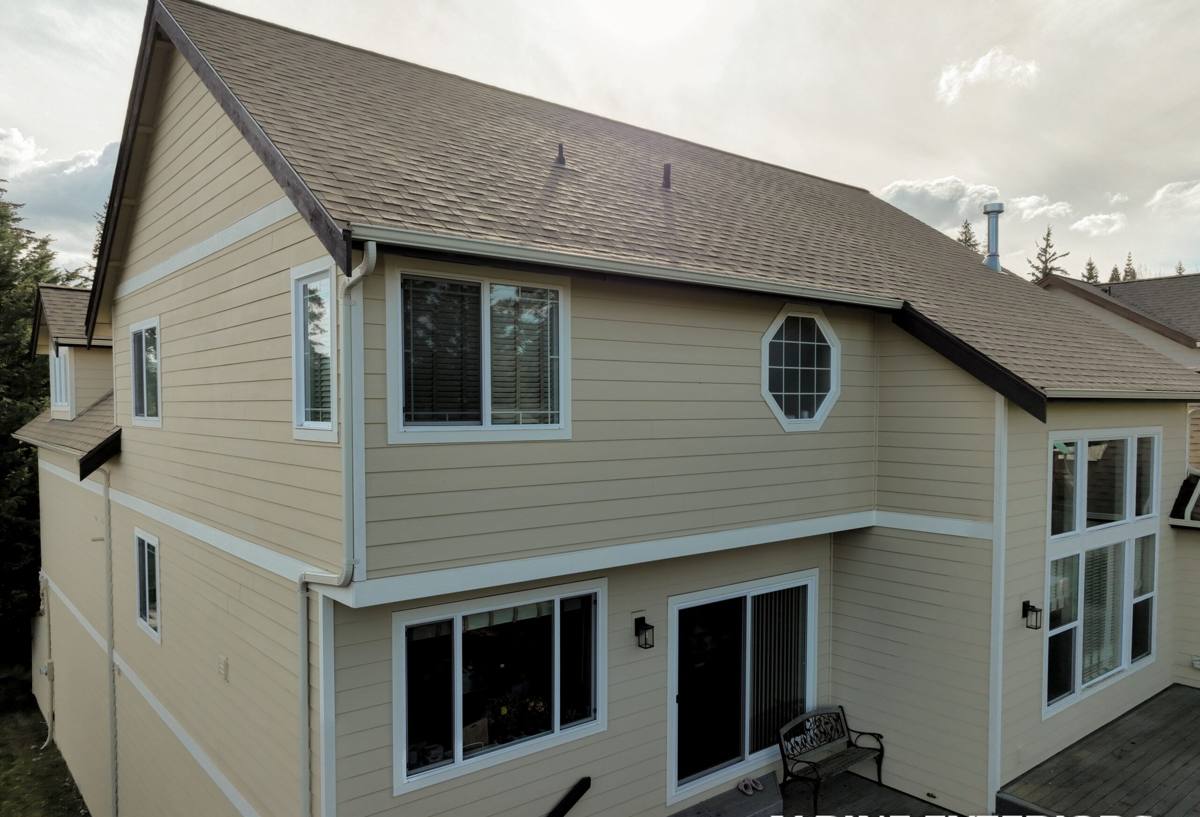
What Blaine Homes Specifically Need From a Siding Replacement
Salt-Air Resistance in Fasteners and Trim
Standard fasteners and untreated trim corrode faster this close to salt water. A correct replacement uses fastener types and trim materials rated to hold up in a marine-influenced environment, not whatever happens to be cheapest at the yard. This is one of the first things we check when we're re-siding a Blaine property — what's holding the panels on matters as much as the panels themselves.
Water Management Behind the Cladding, Not Just On Top of It
Wind-driven rain finds every gap. A weather-resistive barrier installed and lapped correctly, proper flashing at every window, door, and roof-to-wall intersection, and a drainage path for any water that does get behind the siding are what actually keep a Blaine home dry — the visible siding is really the last line of defense, not the only one.
Airflow and Drying Capacity for Shaded, Damp Walls
Walls that stay shaded and damp for days after a storm need to be able to dry out. That means the assembly behind the siding, the spacing of the material itself, and the choice of a product that doesn't hold moisture all factor into whether a wall dries between rain events or slowly stays wet.
How Common Siding Materials Hold Up in Blaine's Conditions
We get asked a lot why we standardized on one product instead of offering several. Here's the honest comparison for this specific climate:
| Material | Salt Air / Moisture Behavior | Moss & Algae Resistance | Fire Rating |
|---|---|---|---|
| Vinyl | Doesn't rot, but seams and J-channels can let wind-driven rain track behind it; warps and becomes brittle over time | Grows on the surface like any plastic; needs regular washing | Combustible, can deform in heat |
| Cedar / Primed Wood | Absorbs moisture, prone to swelling, cupping, and rot in a wet marine climate without diligent upkeep | Very susceptible without frequent treatment | Combustible |
| LP SmartSide | Engineered wood strand product with treated surfaces, but any breach in the coating exposes wood substrate to moisture | Coating helps, but edge cuts and fastener penetrations are vulnerable points | Combustible |
| James Hardie Fiber Cement | Cement-based core doesn't absorb and swell the way wood does; engineered for wet, coastal-influenced climates | Factory finish resists staining and holds up to washing | Non-combustible |
Every one of these products has a place somewhere in the country. In Blaine specifically, the combination of salt air, sustained rain, and shaded, slow-drying walls is exactly the set of conditions that wears on wood-based and vinyl products fastest. That's the trade-off we made a professional call on, not a marketing claim.
Why We Install Only James Hardie Fiber Cement
James Hardie's HZ product lines are engineered specifically around climate zones, including the wetter Pacific Northwest profile Blaine falls into. The fiber cement core doesn't swell, cup, or rot the way wood-based sidings can when they take on moisture, and the ColorPlus factory finish is baked on under controlled conditions rather than site-applied, which means better, more even coverage and a warranty that actually backs the finish, not just the substrate. It's also non-combustible, which matters for insurance conversations as much as it does for peace of mind.
We're not going to tell you every other product on the market is junk — vinyl, wood, and engineered wood siding all have legitimate uses. But we install exclusively James Hardie because, after years of working on homes in this exact climate, it's the product we're comfortable standing behind with a straight face for the long haul.
What a Correct Siding Replacement Job Actually Involves
A siding replacement is more than pulling off old panels and nailing up new ones. Done right, on a Blaine home, it includes:
- Full tear-off of the old siding and a real inspection of the sheathing underneath — not a guess from the ground
- Repair or replacement of any rotted or water-damaged sheathing and framing found during tear-off
- Installation of a code-compliant weather-resistive barrier, properly lapped from the bottom up
- Correct flashing at every window, door, deck ledger, and roof-to-wall transition
- Fastening per James Hardie's published installation specs — right fastener type, spacing, and depth, adjusted for this coastal environment
- Proper clearance at grade, decks, and patios so the bottom edge of the siding isn't sitting in standing water or constant splash-back
- Caulking only where Hardie's instructions call for it — over-caulking traps moisture just as badly as under-caulking lets it in
- Trim, corners, and butt joints detailed to shed water rather than collect it
Skip any one of these steps and the siding can still look fine for a few years. It's what's happening behind it that determines whether it looks fine at year fifteen.
Our Siding Replacement Process
- On-site inspection and estimate. We look at the current siding, the sheathing where we can access it, trim condition, and any trouble spots — north walls, areas near grade, anywhere moss or staining shows up.
- Tear-off and sheathing assessment. Old material comes off and we evaluate what's underneath before anything new goes up. Any rot or damage gets addressed before we move forward, not covered over.
- Weather barrier and flashing installation. This is the step that determines how the wall performs in a wind-driven rain event, and it's the one that's invisible once the job is done.
- James Hardie installation to manufacturer spec. Panels, fasteners, and spacing installed per Hardie's published requirements for this climate zone.
- Trim, caulking, and finish work. Corners, casings, and joints detailed to shed water and hold the ColorPlus finish cleanly.
- Cleanup and final walkthrough. We walk the job with you before calling it done.
Signs a Blaine Home Needs Replacement, Not Just Repair
Repair makes sense for isolated damage. Replacement becomes the right call when the problems are systemic. Watch for:
- Soft or spongy spots when you press on the siding, especially near the bottom courses
- Paint that won't hold anymore no matter how recently it was redone
- Persistent moss or dark staining on shaded walls that comes back after cleaning
- Visible warping, cupping, or gaps opening up between boards
- Rust streaking from fasteners or corroded trim
- A noticeable draft or rising heating costs that point to a compromised wall assembly
What Drives the Cost of a Siding Replacement in Blaine
| Factor | Why It Matters |
|---|---|
| Square footage and home height | More surface area and multi-story access both add labor time |
| Condition of the sheathing underneath | Hidden rot found during tear-off adds repair scope before new siding goes up |
| Trim and architectural detail | Corners, dormers, and multiple trim profiles take more time than a simple rectangular wall |
| Siding profile chosen | Lap siding, panel siding, and shingle-style Hardie products carry different material and labor costs |
| Site access | Tight lots, fencing, or limited staging area near the water can slow tear-off and material handling |
We give a real number after we've actually looked at the house, not a phone estimate — sheathing condition especially can't be judged from the street.
Why Hiring a Crew That Already Works in Blaine Matters
Coastal exteriors work isn't the same as inland work. A crew that's used to working in Blaine already knows to expect wind-driven rain events that can shut down an install day, understands which walls typically show moisture problems first, and doesn't need a learning curve on fastening and flashing choices for a marine-influenced environment. That familiarity shows up in fewer surprises during tear-off and a finished wall that's actually built for what Whatcom County's coastline throws at it — not a generic install that happened to land in Blaine.
If your siding is showing its age, or you just want a straight answer on whether you're looking at repair or replacement, we're glad to come take a look. The estimate is free, there's no pressure, and you'll get a clear explanation of what we see and why — use the form below to get started.