 Lynden Exterior
 Why Decks Near Wiser Lake Wear Out Faster
Homes around Wiser Lake deal with a different set of conditions than a deck sitting out in the open sun on a dry lot. Mature trees, shoreline vegetation, and the lake itself keep the air around these properties damp for more hours of the day than you'd find just a few miles away. Add in Whatcom County's long wet season, driving rain that comes in sideways off the marine air moving through the region, and shade patterns that never quite let a deck surface dry out completely, and you get a recipe for wood that stays wet longer than it should. That's the root cause behind most of the failures we see: not bad luck, but moisture that never gets a chance to leave.
Moss and algae growth is the most visible symptom. Given shade and standing moisture, moss doesn't just sit on the surface — it holds water against the decking and framing underneath, and it makes boards slick and dangerous long before they look structurally bad. A deck near the lake can look fine from a distance and still have soft joists, corroded fasteners, or a ledger connection that's been slowly failing for years.
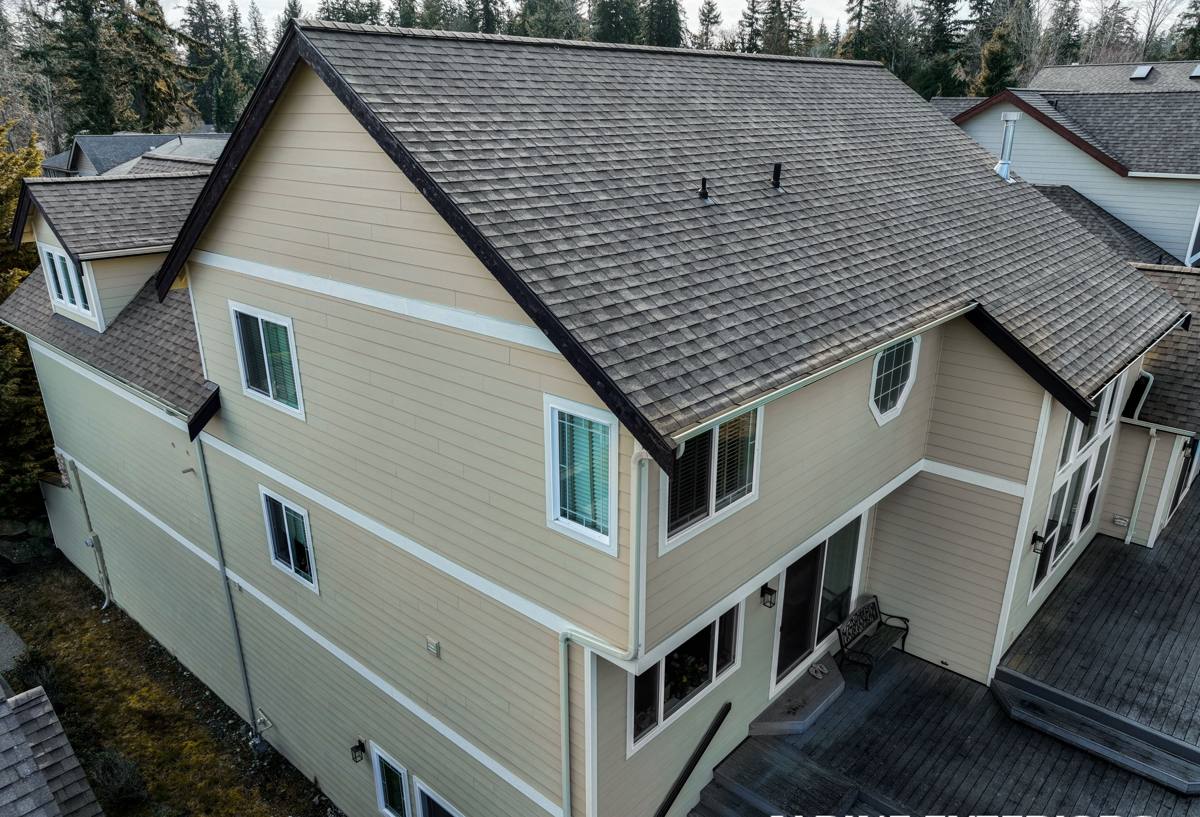
Repair or Replace? How to Tell
Not every tired-looking deck needs a full teardown. But there's a point where patching individual boards is just delaying an honest conversation about the structure underneath. Here's how we sort it out on a walk-through:
- Soft or spongy decking in more than a few isolated spots usually means moisture has gotten into the wood fibers, not just the surface finish.
- Rust streaks around fasteners tell us the hardware is corroding, which is common on older decks that used fasteners not rated for damp, shaded exposure.
- Movement at the ledger board — any bounce or gap where the deck meets the house — is a structural red flag, not a cosmetic one.
- Posts or footings that have shifted or show rot at the base mean the foundation of the deck is compromised, and no amount of surface repair fixes that.
- Persistent moss regrowth within weeks of cleaning, even after treatment, tells us the deck's drainage and airflow were never right to begin with.
If a deck shows one of these signs, targeted repair can make sense. If it shows several, replacement is almost always the more honest recommendation — patched framing on a shaded, moisture-heavy lot rarely buys you more than a season or two.
What a Correct Deck Replacement Actually Involves
A deck replacement done right is mostly about what you can't see once the decking boards go down. We treat the following as non-negotiable on every rebuild, lake-adjacent or not:
Ledger and Flashing
The ledger board — where the deck attaches to the house — is the single most common failure point on decks anywhere in Western Washington, and it's worse in shaded, high-moisture settings like Wiser Lake. We flash it properly against the house wall so water is directed out and away, not trapped behind the ledger where it will quietly rot the rim joist and sheathing for years before anyone notices.
Footings Sized for the Ground They're In
Soil near a lake can hold more moisture and behave differently than soil on higher, drier ground. We size and set footings below frost depth and confirm they land on undisturbed, stable soil — not fill or organic material that will settle over time.
Framing and Hardware Rated for Damp Exposure
Every joist hanger, hurricane tie, and structural fastener we use is rated for exterior, damp-service use, and matched to whatever wood treatment or metal type is going into that specific deck. Mixing incompatible metals is a common shortcut that leads to galvanic corrosion — it's a detail that's invisible on install day and expensive to ignore later.
Airflow and Drainage Underneath
On shaded lots, what happens under the deck matters as much as what's on top. We grade for drainage, keep joist spacing and ventilation gaps consistent, and avoid design choices that trap standing water or leaf litter against framing members.
Choosing Materials for a Shaded, Lake-Adjacent Lot
There's no single "best" decking material — there's the material that fits your maintenance appetite, your budget, and the specific conditions of your lot. For homes with heavy shade and moss exposure near Wiser Lake, the trade-offs look like this:
| Material | How It Handles Shade & Moisture | Maintenance | Typical Lifespan |
|---|---|---|---|
| Pressure-treated wood | Good rot resistance when installed with proper flashing and drainage; still needs airflow to shed moisture | Periodic cleaning, sealing every 1-2 years | 15-20 years with upkeep |
| Cedar | Naturally moisture- and insect-resistant, but appearance greys faster in constant shade | Regular cleaning and refinishing to hold color | 15-20 years |
| Composite decking | Resists rot outright; still needs cleaning where moss and algae can grow on the surface film | Occasional washing, no sealing or staining | 25-30+ years |
| PVC/capped boards | Fully moisture-resistant surface, best option for constant-shade lots | Lowest — occasional rinse | 25-30+ years |
We're honest with clients that composite and capped boards cost more up front but usually make the most sense on lots like these, simply because the maintenance burden of a natural wood surface in near-constant shade is real — it's not a knock on wood, it's a matter of how much time you want to spend scrubbing moss off a deck every spring.
Our Deck Replacement Process
- On-site assessment. We inspect the existing deck, ledger connection, footings, and framing to confirm replacement is the right call and identify anything the original build got wrong.
- Design and material selection. We walk through layout, decking material, railing, and any structural changes, with straightforward pricing for each option.
- Permitting. We handle the permit application and inspections required for the scope of work.
- Demolition and disposal. Old decking, framing, and footings are removed and hauled off — we don't leave debris behind for the client to deal with.
- Structural rebuild. New footings, framing, ledger flashing, and hardware go in to current code, sized for the actual conditions of the lot.
- Decking, railing, and finish work. Final surface material and railing system are installed and detailed.
- Final walk-through. We review the completed deck with the homeowner and cover basic care specific to the material chosen.
Permits and Code Considerations
Most deck replacements in and around Lynden require a building permit, particularly when the deck is attached to the house, elevated, or being rebuilt with a different footprint or railing height than the original. Requirements can shift depending on deck height, guardrail specifications, and stairs, so we handle the application and inspection scheduling as part of the job rather than leaving it to the homeowner to sort out with the county. Skipping this step is a shortcut some contractors take to move faster — it isn't one we take, because it puts the homeowner at risk if the work ever needs to be verified for insurance or resale.
Why Local Experience in Wiser Lake Matters
A deck built to a generic spec sheet doesn't account for what's actually happening on a specific lot — how much sun it gets through the tree canopy, which direction the driving rain hits it, how close the water table sits to the surface near the lake. Crews who've worked this specific area repeatedly know which details tend to get skipped on older builds around here, because we've torn enough of them out to see the pattern: under-flashed ledgers, undersized footings, and fasteners that weren't rated for how damp these lots stay for months at a time. That familiarity means fewer surprises once demolition starts, and a rebuild that's actually sized for the conditions instead of a one-size-fits-all approach.
Keeping a New Deck in Good Shape
Whatever material you choose, a little seasonal attention goes a long way on a shaded, lake-adjacent lot:
- Sweep leaves and debris off the surface regularly — trapped organic matter is what feeds moss and algae growth.
- Clean the deck surface at least once a year, more often if moss returns quickly in heavy shade.
- Check that gaps between boards stay clear so water can drain through rather than pooling.
- Inspect railings and stair connections annually for movement or loosening hardware.
- Keep gutters and downspouts near the deck clear so roof runoff isn't dumping extra water onto or under the structure.
- For wood decks, reseal on the schedule appropriate to the product — don't wait until graying and cracking show up.
If your deck near Wiser Lake is showing soft spots, persistent moss, or just feels tired, we're happy to take a look and give you a straight answer on repair versus replacement. Reach out for a free, no-pressure estimate — the form below gets you started.