 Lynden Exterior
 Custer's Climate Is Harder on Siding Than Most Homeowners Realize
Custer sits close enough to the water that salt air is a daily fact of life, not an occasional nuisance. Add in the driving rain that comes off Whatcom County's marine weather pattern and the long, damp moss season that stretches from fall through spring, and you have a combination that wears down exterior siding faster than almost anywhere inland. Salt-laden air corrodes unprotected metal fasteners and trim, driving rain finds every gap in a poorly flashed wall, and moss holds moisture against a house for months at a time. None of this is dramatic on its own, but stacked together year after year, it's exactly the kind of exposure that separates siding systems that hold up from ones that don't.
This is the environment we design every installation around when we're working a Custer property. It's also why we've standardized on one siding material instead of offering a menu of options.
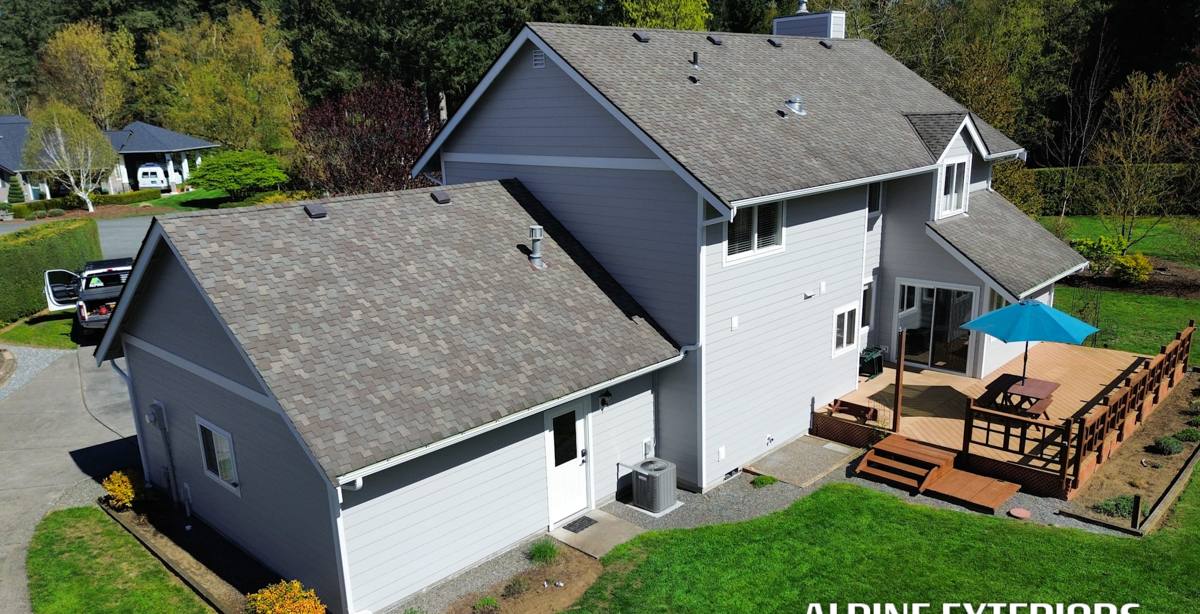
Why We Install Only James Hardie Fiber Cement
We don't install vinyl, LP SmartSide, Cemplank, Allura, primed spruce, or cedar. That's a deliberate standard, not a lack of options. Vinyl expands and contracts with temperature swings and can crack or warp under sustained wind-driven rain. Engineered wood products and untreated cedar depend on flawless caulking and paint maintenance to keep moisture out — miss a cycle in a wet climate like this one, and rot can start behind the surface before it's visible. Near the water, those maintenance windows get shorter, not longer.
James Hardie fiber cement is non-combustible, dimensionally stable, and engineered specifically for wet, coastal-influenced climates like ours. It doesn't feed moss the way wood-based products can, it holds paint and factory finish far longer than wood or vinyl, and it's backed by a strong transferable warranty when installed to Hardie's specifications. That combination is why it's the only product we put on a home.
What Hardie Gets Right
To be fair to the alternatives: vinyl is inexpensive and low-maintenance in mild climates, and cedar has a natural look some homeowners love. We're not claiming those products fail outright. We're saying that for Custer's specific mix of salt exposure, driving rain, and moss pressure, fiber cement's stability and moisture resistance make it the product we're willing to stand behind.
The Right Hardie Product Line for This Area
James Hardie makes climate-specific product lines, and homes in this part of Whatcom County fall into the HZ5 engineering zone — built for regions with real freeze-thaw cycles and sustained moisture, which matches Custer's weather closely. Within that line, the profile we recommend depends on the home's style and exposure.
HardiePlank Lap Siding
The most common choice for Custer homes, HardiePlank gives a traditional horizontal lap look and performs well on walls that take direct rain and wind off open exposures. It's available in several widths and textures, from smooth to a wood-grain finish.
HardieShingle Siding
For homes with a cottage or craftsman look — common on some of the older properties in and around Custer — HardieShingle gives that staggered, textured appearance without the maintenance burden of real wood shakes, which are especially vulnerable to moss and rot in this climate.
ColorPlus Factory Finish
We steer most Custer homeowners toward ColorPlus rather than field-painted siding. The finish is baked on at the factory under controlled conditions, which gives better adhesion and UV resistance than paint applied on-site — a real advantage when the house is going to spend the next several decades absorbing salt air and rain.
What a Correct Installation Involves
Fiber cement siding is only as good as the installation behind it. In a salt-air, high-rain environment, a few details matter more than they would somewhere drier:
- A properly lapped weather-resistive barrier behind the siding, not just a single layer of housewrap taped at the seams
- Correct flashing at every window, door, and roof intersection — the majority of siding failures we see start at a missed or undersized flashing detail
- Stainless or hot-dip galvanized fasteners rated for coastal exposure, since standard fasteners corrode faster this close to salt air
- Proper clearance between the bottom of the siding and grade, decks, and roof lines so water has somewhere to go instead of wicking upward
- Correct nailing pattern and fastener depth per Hardie's install specs — over-driven nails are a common cause of premature cracking
- Caulking only where Hardie's guidelines call for it, and leaving butt joints and other spots un-caulked where they're designed to breathe
Skipping any one of these doesn't show up on day one. It shows up two or three winters later, after enough driving rain has found the gap.
Our Process
- Assessment: We walk the exterior, check the condition of the existing siding and sheathing, and look specifically for moisture damage around windows, corners, and roof lines — common trouble spots in this climate.
- Tear-off and inspection: Once the old siding is off, we inspect the sheathing underneath. Any rot or soft spots get repaired before anything new goes up — covering damaged sheathing with new siding just hides the problem.
- Weather barrier and flashing: We install the water-resistive barrier and flashing system correctly the first time, since this layer does more long-term work than the siding itself.
- Installation: Hardie panels or planks go up per manufacturer spec — correct fastener type, spacing, and clearances throughout.
- Trim and finish work: Corner boards, trim, and any field touch-up are completed and inspected for consistent, correct caulking.
- Final walkthrough: We go over the finished job with the homeowner before calling it done.
How Siding Materials Compare Under Custer's Conditions
| Material | Salt Air Resistance | Moisture/Rot Resistance | Moss & Mildew Resistance | Typical Maintenance |
|---|---|---|---|---|
| James Hardie Fiber Cement | Strong | Strong | Strong | Low — occasional rinse and caulk check |
| Vinyl | Moderate | Moderate | Moderate | Low, but prone to warping under sustained wind-driven rain |
| LP SmartSide (engineered wood) | Moderate | Depends heavily on maintained caulk/paint | Moderate | Regular paint and caulk upkeep required |
| Cedar | Weak without diligent upkeep | Weak in sustained damp conditions | Weak — feeds moss and mildew | High — refinishing on a recurring cycle |
What Drives Cost on a Siding Job
We don't quote pricing without seeing the house, but the factors that move cost up or down are consistent from job to job:
| Factor | Cost Impact |
|---|---|
| Home size and number of stories | More surface area and access complexity raise labor time |
| Condition of existing sheathing | Hidden rot or moisture damage adds repair scope once tear-off begins |
| Trim, corner, and detail work | Homes with more architectural detail take more labor per square foot |
| Product line and finish choice | HardieShingle and custom ColorPlus colors cost more than standard HardiePlank |
| Site access | Tight lots, landscaping, or difficult staging add time |
We walk every Custer home in person before giving a number, because the sheathing condition alone can change the scope significantly once we're past the tear-off stage.
Maintaining Hardie Siding in a Salt-Air, High-Moss Climate
Fiber cement is low-maintenance compared to wood or vinyl, but "low" isn't "zero" this close to the water. A short seasonal routine keeps a Hardie installation performing the way it's designed to for decades:
- Rinse the siding periodically to clear salt residue, especially on walls facing open exposure
- Check caulking at trim, window, and door joints once a year and re-caulk any cracked or separated sections
- Keep gutters and roof valleys clear of moss and debris so runoff doesn't sheet down the siding face
- Trim back vegetation that holds moisture against the wall or blocks sun and airflow
- Watch for any soft or discolored trim boards, which usually signal a flashing issue worth catching early
Why a Crew That Already Works Custer Matters
Siding installation isn't just following a manufacturer's manual — it's applying that manual correctly to the specific conditions of a specific site. A crew that regularly works Custer and the surrounding Whatcom County communities already knows which walls take the worst of the wind-driven rain, how far moss pressure extends inland from the water, and what kind of flashing detail actually holds up here versus what merely meets minimum code. That local pattern recognition is hard to replace with a crew that's never worked this specific stretch of coastline.
If you're weighing a siding replacement or repair on a Custer home, we're glad to take a look and give you a straightforward, no-pressure estimate — no obligation, just an honest read on what your home needs.