 Lynden Exterior
 Decks Built for Maple Falls, Not for a Catalog Photo
Maple Falls sits in a different world than a lot in downtown Lynden. The tree cover is heavier, the ground stays damp longer into the season, and a lot of homes here get less direct sun on at least part of the yard. That changes how a deck should be framed, what it should be built from, and how often it needs attention. A deck design that works fine on an open, sunny lot closer to town can struggle in a shaded, wooded setting where moss, standing moisture, and slow-drying wood are the norm rather than the exception.
We build and repair decks throughout Whatcom County, and Maple Falls properties get treated as their own category — not a smaller version of a Lynden job. The marine air that moves in off the Sound, combined with driving rain and the extra dampness that shade and elevation bring, means the deck has to manage water and debris better than a standard build, from the footings up through the final board.
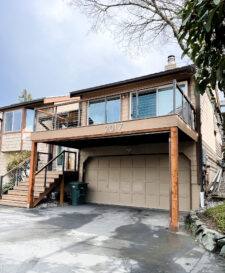
What Local Conditions Actually Do to a Deck
Before we talk about materials or process, it helps to understand what's working against a deck out here over time.
Moisture That Doesn't Leave
Driving rain angled by wind gets under railings and against ledger boards in a way that straight-down rain doesn't. On a shaded lot, that moisture doesn't evaporate quickly. Wood stays wet longer, fasteners corrode faster, and any spot where water can pool becomes a weak point months or years before it would fail on a drier, sunnier site.
A Long Moss Season
Moss needs shade and moisture, and Maple Falls has both for a large part of the year. Moss on deck boards isn't just cosmetic — it holds water against the surface, and on wood decking it accelerates rot in exactly the boards you walk on most. Moss between boards or in fastener heads also traps organic debris that keeps the whole surface wetter than it should be.
Salt-Bearing Air on Hardware
Air moving inland off the Sound still carries enough salt to matter for exposed metal. Cheap or mismatched fasteners, brackets, and railing hardware corrode faster than the wood around them, and a rusted fastener failing quietly inside a joist connection is a much bigger problem than a stained board.
Framing and Structure: Getting the Bones Right
The part of a deck nobody sees is the part that determines how long it lasts. On a Maple Falls lot, we pay particular attention to a few structural details that are easy to shortcut and expensive to fix later.
- Footings sized and set below frost depth, with attention to drainage around the base so water doesn't sit against concrete or posts
- A ledger board attachment with proper flashing where the deck meets the house, since this is the single most common source of hidden rot on any deck
- Joist tape or a comparable moisture barrier on top of every joist, so fasteners don't create a wick point straight into the wood
- Corrosion-resistant structural hardware rated for the fastener type and lumber treatment being used, not just whatever is on the shelf
- Airflow underneath the deck, since a low, boxed-in deck on a shaded lot traps moisture instead of letting it dry out between rains
None of this shows up in a finished photo, but it's the difference between a deck that's solid at year fifteen and one that's spongy at the ledger by year six.
Choosing Decking Material for This Climate
There's no single "best" decking material — there's a best fit for the site, the budget, and how much upkeep the owner actually wants to do. On a damp, shaded Maple Falls lot, the trade-offs shift compared to a sunnier location.
| Material | How It Handles This Climate | Maintenance Reality |
|---|---|---|
| Pressure-treated wood | Affordable and strong, but absorbs moisture readily and stays wet longer in shade | Needs regular cleaning, sealing, and moss removal to reach full lifespan |
| Cedar | Naturally resists some decay and looks the part locally, but still needs to dry out between rains | Periodic cleaning and refinishing; moss growth still needs active management |
| Composite decking | Doesn't absorb water like wood and resists rot at the board level | Lower upkeep, but moss and mildew can still grow on the surface and need occasional washing |
| PVC decking | Fully synthetic, sheds water well, performs consistently in shaded, damp spots | Easiest to keep clean; higher upfront cost than wood |
We'll walk through these trade-offs honestly during an estimate — moisture behavior, upfront cost, and how much maintenance you're actually willing to keep up with, since a low-maintenance material that never gets cleaned still grows moss.
Railings and Fasteners That Match the Decking
A deck is only as good as its weakest connection. We match fastener and bracket coatings to the lumber and decking type being used, and we treat railing posts and connections as structural, not decorative — a loose or corroding railing post is a safety issue on a sloped or elevated Maple Falls lot in a way it might not be on flat ground closer to town.
How We Approach a Maple Falls Deck Project
Every deck starts with actually looking at the site, not just the square footage.
- Site walk: We look at sun exposure, tree cover, drainage patterns, and how water moves across the yard, since that tells us where a deck will hold moisture and where it won't.
- Design and material discussion: We talk through decking material, railing style, and layout based on how the space will actually be used and how much maintenance the owner wants long-term.
- Permitting: Deck projects in Whatcom County typically require a permit depending on height and size, and we handle that process rather than leaving it to the homeowner.
- Structural build: Footings, framing, flashing, and moisture barriers go in first, with inspections at the appropriate stages.
- Decking, railings, and finish work: Boards, railings, and any stairs or fascia go in last, with attention to gaps and fastening that account for wood movement and seasonal moisture.
- Walkthrough: We go over basic care specific to the material chosen, so the deck actually gets the upkeep it needs to hit its expected lifespan.
Living With a Deck in a Shaded, Damp Setting
No deck out here is maintenance-free, even the low-upkeep materials. What changes by material is how much and how often.
- Sweep debris — needles, leaves, and moss fragments — off the surface regularly, especially in fall and winter when it accumulates fastest
- Keep gutters and downspouts near the deck clear so runoff isn't dumping extra water directly onto or under the structure
- Wash the decking surface at least once or twice a year to knock back moss and mildew before it takes hold
- Check railing posts and stair connections periodically for looseness, especially after a hard winter
- Trim back overhanging branches where practical to get a little more sun and airflow onto the deck surface
- Re-seal or refinish wood decking on the schedule the material actually needs, not just when it looks bad
Permits and Practical Considerations
Whatcom County and local jurisdictions generally require permits for decks above a certain height or attached to the home, and setback rules can matter more on wooded or sloped Maple Falls lots than on a standard in-town parcel. We handle the permitting conversation as part of the project rather than treating it as an afterthought, since a deck built without the right permit can become a real problem at resale.
Why Hire a Crew That Already Works This Area
A contractor who mostly builds decks on flat, sunny, in-town lots will make reasonable but generic decisions about drainage, material, and hardware. A crew that regularly works Maple Falls and similar wooded, damp parts of Whatcom County already knows where water collects on a sloped lot, which fastener grades hold up to the local air, and how much airflow a deck actually needs underneath to avoid trapping moisture. That local pattern recognition shows up in fewer callbacks and a deck that ages the way it's supposed to, not the way a generic build sheet assumes it will.
We also know what a realistic maintenance conversation sounds like for this specific setting — not a one-size-fits-all care sheet, but what actually applies when a deck sits under trees for half the year.
Get a Straight Answer on Your Deck Project
If you're planning a new deck or need an honest look at an existing one in Maple Falls, we're glad to come take a look and talk through what makes sense for your lot's shade, drainage, and slope. There's no pressure and no sales script — just a straight assessment and a written estimate. Use the form below to request a free estimate.