 Lynden Exterior
 Composite Decking in Nooksack: Building for a Wet, Green Corner of Whatcom County
Nooksack sits along the river valley northeast of Lynden, close enough to the foothills to pick up extra rainfall and shade that the flatter parts of Whatcom County don't see as much. Homes here deal with the same salt-tinged marine air that moves through the whole region, driving rain that comes in sideways more often than straight down, and a moss season that can run nine or ten months on a deck that doesn't get much sun. A deck built without those conditions in mind doesn't fail because the homeowner did anything wrong — it fails because the material and the installation details weren't matched to what this climate actually does to a horizontal wood or wood-composite surface, year after year.
Composite decking has become the default choice for a lot of homeowners in this area, and for good reason, but "composite" covers a wide range of products and an even wider range of installation quality. This page is about what a composite deck actually needs to hold up in Nooksack specifically, not a generic pitch for the material.
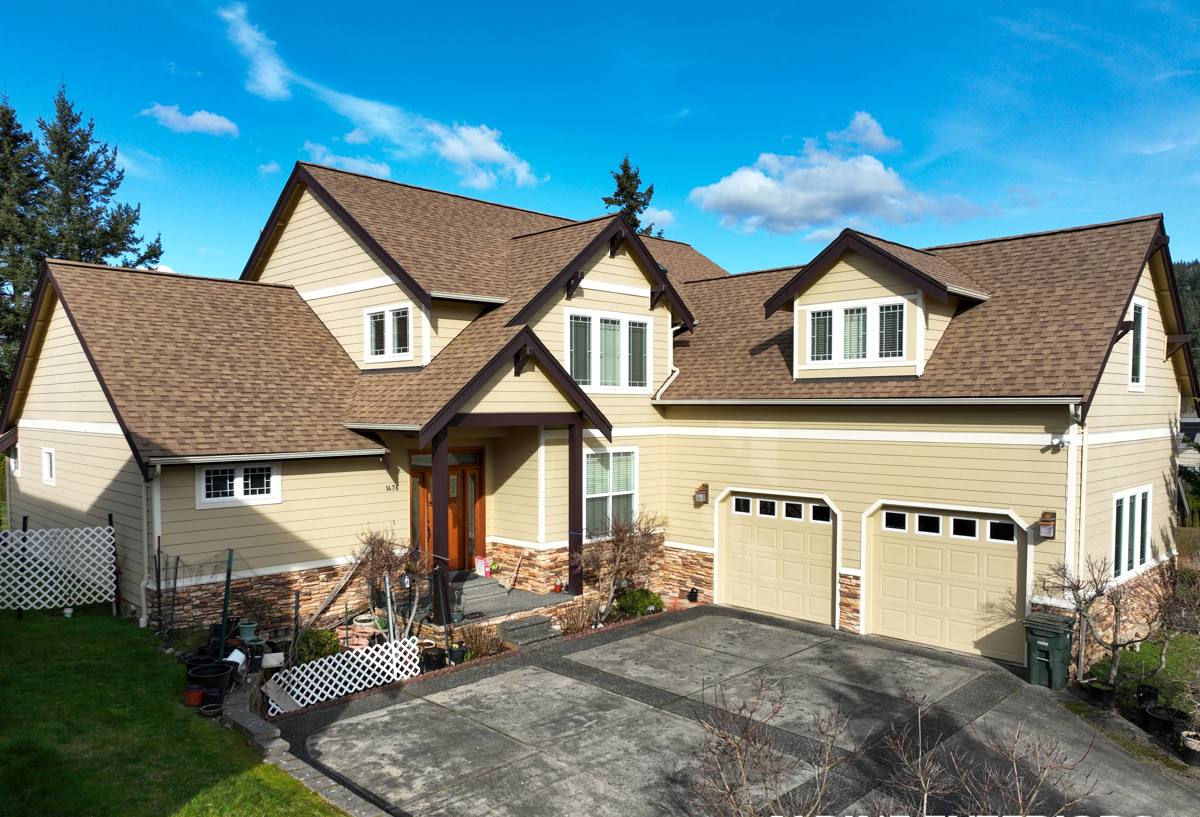
What This Climate Does to a Deck
Salt Air and Metal Fatigue
Even away from the immediate coastline, Whatcom County gets a steady dose of salt-laden air moving in off the Sound. On a deck, that shows up first at the fasteners, joist hangers, and any exposed metal hardware. Cheap or mismatched fasteners corrode faster here than they would in a drier inland climate, and once a fastener starts rusting it can streak the decking around it and weaken the connection underneath. Hardware choice on a Nooksack deck isn't a place to save money.
Driving Rain and Standing Moisture
Wind-driven rain doesn't just fall on a deck surface — it gets pushed into board gaps, ledger connections, and anywhere framing meets the house. Horizontal surfaces hold water longer than vertical walls because gravity and drainage have to do more work to clear it. A deck that isn't sloped correctly, or that lacks a way for water to get out from under the boards, ends up with standing moisture against the framing long after the rain stops.
A Long Moss and Mildew Season
Shade from mature trees along the river valley, combined with mild temperatures and near-constant moisture for much of the year, gives moss and algae plenty of time to establish on any surface that stays damp. Composite decking resists rot in a way wood can't, but it isn't immune to surface growth — moss and mildew will still colonize a capped composite board if the surface stays wet and shaded long enough, especially in board gaps and along the north side of a house.
Why Composite Fits This Climate — and Where It Doesn't Solve Everything
Composite decking's main advantage in a climate like this is that the board itself doesn't rot, splinter, or need refinishing the way a wood deck does. Modern capped composite boards shed water at the surface and resist the freeze-thaw and moisture-cycling damage that eventually splits and cups wood decking left outside in the Pacific Northwest for a decade or more.
That said, composite decking is only as good as what's underneath it. The board doesn't rot, but the framing beneath it still can if it's not built and vented correctly. We treat composite decking as a system — framing, fasteners, hidden fastening or hardware, drainage, and the board itself — not just a board swap on top of whatever structure is already there.
Composite vs. Wood vs. PVC: An Honest Comparison
| Material | How It Handles This Climate | Ongoing Maintenance |
|---|---|---|
| Pressure-treated wood | Absorbs moisture readily; prone to cupping, splintering, and mold in shaded, wet spots | Annual sealing/staining to slow damage |
| Capped composite | Resists rot and moisture absorption at the board; needs correct substructure to perform | Periodic cleaning to clear moss/mildew from gaps and grain texture |
| PVC decking | Fully synthetic, very moisture-resistant; can look less natural and cost more up front | Low; mainly surface cleaning |
| Uncapped composite (older-style) | Can absorb moisture at the surface over time, especially in shaded, wet conditions | More frequent cleaning; more prone to staining and mold than capped products |
We install capped composite as our standard for Nooksack projects. The cap layer is what actually keeps moisture and organic growth from working into the board itself, and in a climate with this much sustained dampness, that difference matters more than it would somewhere drier.
What a Correct Composite Deck Installation Involves
A composite deck that's installed correctly and one that isn't can look identical on day one. The difference shows up in year three, five, and ten. Here's what we consider non-negotiable on every Nooksack composite deck we build:
- Ledger board flashing: Where the deck attaches to the house, proper flashing keeps wind-driven rain from tracking behind the ledger and into the wall or rim joist — one of the most common sources of hidden rot on older decks.
- Joist protection tape: A moisture barrier over the top of each joist keeps rain that gets between the boards from soaking directly into the framing lumber, which is still real wood even under a composite deck.
- Correct board spacing and fastening: Composite boards expand and contract with temperature more than people expect. Gaps and fastener spacing that ignore that will show up as buckling or popped fasteners within a few seasons.
- Slope and drainage: The deck surface needs a slight pitch away from the house so water actually sheds instead of pooling, especially under a long rainy season.
- Airflow underneath: Framing needs enough clearance and ventilation below the deck surface so the structure can dry out between storms rather than staying damp indefinitely.
- Corrosion-resistant hardware throughout: Every hanger, screw, and bracket should be rated for the moisture and salt exposure this region sees, not just whatever came with a standard hardware kit.
Our Process on a Nooksack Deck Project
We start with a site walk, not a phone quote. That means looking at the existing structure if there's a deck to replace, checking how the ledger connects to the house, assessing drainage and slope, and talking through which composite product and railing system make sense for how the space is used and how much sun or shade it gets.
From there, a typical project runs through: demolition of the old deck (if applicable) with an inspection of the ledger and rim joist for hidden moisture damage; framing repair or rebuild using pressure-treated lumber sized correctly for the span and load; joist tape and flashing installed before a single composite board goes down; composite decking installed with manufacturer-spec fastening and expansion gaps; and railing, stairs, and trim finished to match. We walk the finished deck with the homeowner before calling the job done, not just handing over an invoice.
Cost Factors for a Nooksack Composite Deck
| Factor | What Drives It | Local Consideration |
|---|---|---|
| Deck size and shape | Square footage, number of angles or levels | Sloped or river-adjacent lots may need extra footing work |
| Framing condition | New build vs. tear-off with hidden rot repair | Older decks in shaded, moist yards often need more framing replacement than expected |
| Composite product tier | Capped vs. higher-end capped composite, color and texture options | Capped product is our standard given the moss and moisture exposure here |
| Railing and stairs | Material choice, code-required height and spacing | Corrosion-resistant hardware for salt air exposure |
| Site access | Grade, tree cover, distance from driveway | Tighter or shaded lots along the river valley can add labor time |
We don't quote off a price-per-square-foot list because the framing condition alone can swing a project significantly. A walk-through gives an honest number instead of a guess that changes once we open things up.
Keeping a Composite Deck Looking Right in This Climate
Composite decking is genuinely lower-maintenance than wood, but "low-maintenance" isn't "no-maintenance," especially with this much moss pressure. A simple seasonal routine keeps a Nooksack composite deck performing the way it's supposed to:
- Sweep debris out of board gaps regularly — trapped leaves and needles hold moisture against the surface and feed moss growth
- Rinse and lightly scrub the deck surface a few times a year, more often on shaded sections
- Check railing posts and stair connections annually for any looseness at the hardware
- Keep gutters and downspouts near the deck clear so runoff isn't dumping extra water onto the surface
- Trim back overhanging branches where practical to reduce shade and speed up drying time
- Watch for any soft spots, unusual gaps, or fastener movement, which can signal a framing issue underneath even if the composite boards look fine
Signs an Existing Deck Needs Replacement Rather Than Repair
Not every deck problem in Nooksack means starting over, but a few signs usually point to a structural issue rather than a cosmetic one:
- Soft, spongy, or bouncy footing anywhere on the deck surface
- Visible rot, staining, or gaps at the ledger where the deck meets the house
- Rust streaking from multiple fasteners across the deck
- Moss or algae that returns within weeks of cleaning, especially combined with a slick or soft surface
- Railing posts that feel loose or move under normal pressure
If a deck is showing more than one of these at once, it's usually worth a real inspection before spending money on surface repairs that won't address what's happening underneath.
Why a Crew That Already Works Nooksack Matters
A lot of what makes a composite deck last in this climate isn't the board — it's judgment calls that come from having built and repaired decks across this specific stretch of Whatcom County. Knowing how much shade a river-valley lot typically holds onto through the fall, how far salt air travels inland along this corridor, and which framing details actually fail first on the decks we get called to fix all come from repeated, local experience rather than a spec sheet. A crew that only occasionally works this area is more likely to build to a generic standard instead of the one this climate actually demands.
If you're planning a new composite deck in Nooksack or looking at replacing one that's showing its age, we're happy to walk the property and give you a straightforward, no-pressure estimate — just fill out the form below.