 Lynden Exterior
 Maple Falls sits in a part of Whatcom County where weather doesn't do anything halfway. Homes here take a steady beating from driving rain, damp air that never fully clears, and a moss season that seems to stretch longer every year. Siding in this area doesn't fail because it's old — it fails because moisture found a way in and nobody caught it early. If you're looking at cracked panels, soft spots, or streaks of green creeping up your exterior, you're not imagining a problem unique to your house. It's a pattern we see across this part of the county, and it's one we know how to fix correctly rather than patch and hope.
Why Siding Damage Looks Different Out Here
Coastal-influenced weather and prolonged wet stretches change how siding ages. Salt-laden air combines with driving rain to accelerate corrosion on fasteners and trim, while long stretches of overcast, damp conditions keep exterior walls from ever fully drying out between storms. That combination is harder on a home than a single hard freeze or one heavy storm ever could be — it's the cumulative, season-after-season dampness that wears siding down.
Moss and Moisture Retention
Moss doesn't just grow on roofs. On siding, especially on north-facing walls and anywhere tree cover blocks sun and airflow, moss and algae hold moisture directly against the surface. Under vinyl or wood-based products, that trapped moisture works into seams and fastener holes. Left alone through a full moss season, it can travel behind the panel entirely, where you won't see it until the damage has already spread.
Wind-Driven Rain and Panel Joints
Driving rain doesn't behave like a gentle shower — it gets pushed sideways into laps, joints, and butt seams that were never designed to handle direct horizontal pressure. Over enough storms, even a well-installed siding job can develop small gaps at seams and around penetrations (hose bibs, light fixtures, vents) where wind-driven water is forced in rather than shed off.
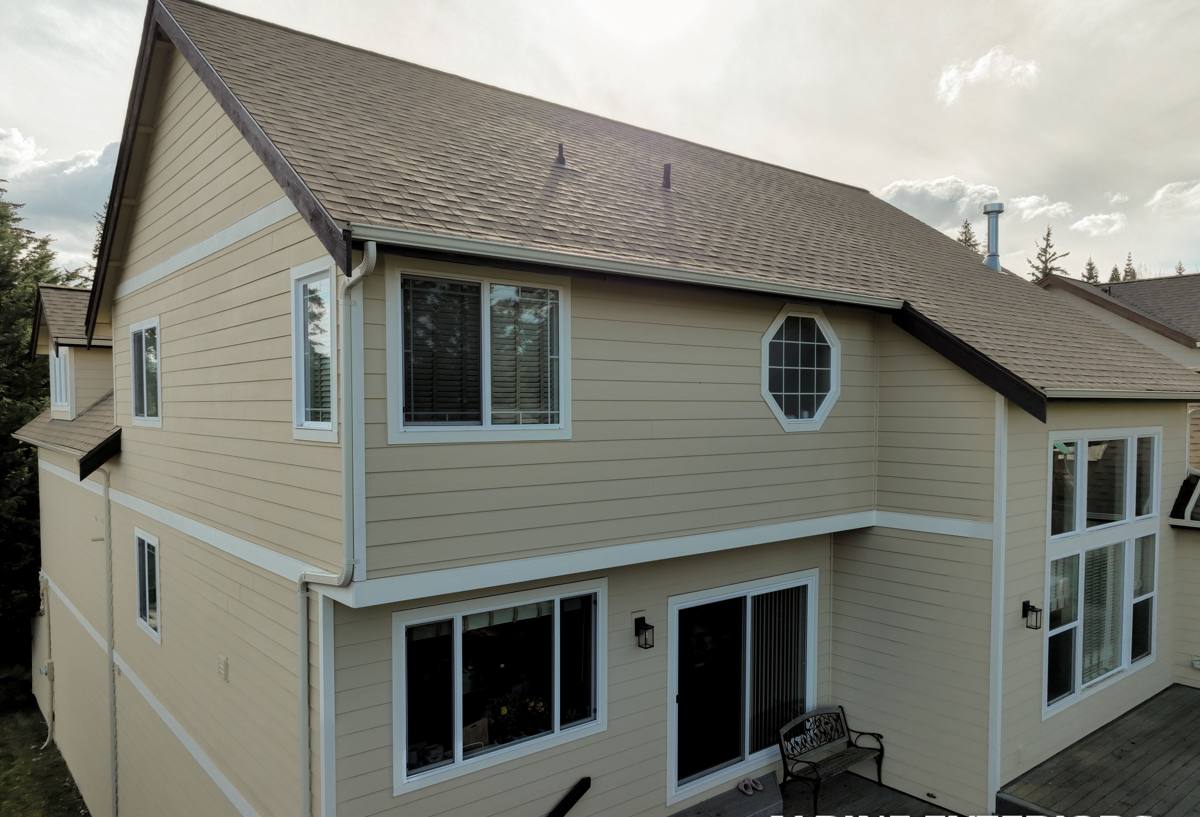
Common Repair Issues We See in This Area
Not every siding problem needs the same fix, and guessing wrong wastes money. Here's what typically shows up on homes in and around Maple Falls, and what's usually behind it.
| What You See | Likely Cause | What It Usually Takes to Fix |
|---|---|---|
| Green or black staining, especially on shaded walls | Moss/algae growth holding moisture against the surface | Cleaning, trimming back vegetation for airflow, and repair of any softened material underneath |
| Soft or spongy panels when pressed | Water intrusion behind the siding, often from a failed seam or flashing | Removal of affected panels, inspection and repair of the water-resistive barrier, replacement with matched material |
| Cracked or split panels | Impact damage or repeated freeze-thaw stress on a weakened area | Section replacement with color- and profile-matched Hardie board |
| Rust streaks near fasteners | Corrosion-prone fasteners exposed to salt-influenced, damp air | Fastener replacement with corrosion-resistant hardware during the repair |
| Gaps or separation at seams | Wind-driven rain forcing joints open over time | Re-sealing or panel replacement depending on how far moisture has traveled |
What a Correct Repair Actually Involves
A repair that only addresses what's visible on the surface tends to come back within a season or two. Doing it right means treating the visible damage as a symptom and tracking down what actually let moisture in.
Diagnosing the Root Cause, Not Just the Symptom
Before any panel comes off, we look at the whole picture: is water coming from a failed seam, a missing flashing detail, a clogged gutter dumping water against the wall, or vegetation holding moisture against the surface? Replacing a damaged panel without fixing what caused the damage just resets the clock on the same failure.
Checking What's Behind the Panel
Once siding is removed, the condition of the water-resistive barrier and sheathing underneath tells the real story. If that layer has been compromised, patching over it with new siding traps the same moisture problem behind a fresh face. A proper repair addresses that layer first.
Matching Materials the Right Way
Mismatched replacement panels are one of the most common signs of a rushed repair — different texture, slightly different color, or a visible seam where old meets new. When we repair James Hardie fiber cement siding, we match plank profile and ColorPlus finish as closely as the product line allows, so the repair blends rather than standing out as a patch job.
Repair vs. Replace: How We Make the Call
Not every problem needs a full re-side, and not every problem is fixable with a patch. The honest answer usually comes down to how much of the wall assembly has been affected and what the existing material is.
| Situation | Usual Recommendation |
|---|---|
| Isolated damage — one or two panels, sheathing underneath is dry | Targeted repair with matched material |
| Damage spread across a wall section, or evidence of moisture behind multiple panels | Broader section replacement, with a look at whether the whole elevation needs attention |
| Original siding is an older wood-based or vinyl product showing widespread wear | Repair as a short-term fix, with a conversation about replacing with James Hardie fiber cement when the budget allows |
| Existing siding is already James Hardie | Straightforward repair — matched replacement panels typically resolve the issue cleanly |
We won't talk you into a full replacement when a repair will genuinely hold up. We also won't patch something that's going to fail again in a year and call it done. The goal is telling you honestly which category your siding falls into.
Why We Repair — and Recommend — James Hardie Fiber Cement
We install James Hardie fiber cement siding exclusively, and it's the material we reach for whenever a repair needs matched product or a homeowner decides a section is beyond patching. Fiber cement doesn't absorb and swell with moisture the way wood-based products can, and it doesn't soften or warp under the kind of prolonged damp exposure this area sees. It's also non-combustible, which matters given wildfire smoke seasons that have become a regular part of Pacific Northwest summers.
That's not a knock on every other siding product on the market — vinyl and engineered wood products each have their place and their advocates. But we've made a professional call not to install them, because in this climate, the maintenance burden and moisture sensitivity of those alternatives tend to show up again down the road, often as the exact kind of repair call we're describing on this page. When we repair a home, we want the fix to hold. James Hardie's ColorPlus factory finish and HZ5 product engineering, designed for the wetter climate zones, back that up with a strong transferable warranty rather than just a sales pitch.
Our Process for a Maple Falls Siding Repair
- Inspection. We walk the affected area, check moisture levels where we can, and identify how far the damage has spread — not just what's visible from the ground.
- Honest diagnosis. We explain what caused the problem, whether it's isolated or spreading, and what your realistic options are, including cost ranges.
- Removal and inspection behind the siding. Affected panels come off so we can check the water-resistive barrier and sheathing condition before anything goes back up.
- Repair the root cause. Flashing, sealant, drainage, or barrier issues get addressed first — not covered over.
- Matched replacement. New material is fit, fastened with corrosion-resistant hardware, and finished to match the surrounding siding as closely as possible.
- Final walkthrough. We show you what was found, what was fixed, and what to keep an eye on going forward.
Why a Crew That Already Works This Area Matters
Siding repair isn't just a swing-the-hammer job — it's knowing what patterns of damage show up in this specific climate and catching them before they become a full re-side. A crew that regularly works Whatcom County homes has already seen how moss season, driving rain, and damp air affect siding out here, which means less guesswork and a faster, more accurate diagnosis when we show up to your property. There's also a practical side: a local crew can respond quickly if a repair reveals more than expected, without the delays of scheduling around a long drive.
Signs You Should Get a Repair Estimate
- Panels that feel soft, spongy, or give slightly when pressed
- Visible green, black, or dark staining that keeps returning after cleaning
- Cracked, warped, or separated panels, especially near corners and seams
- Peeling or bubbling paint on wood-based siding
- Rust streaking near nails or fasteners
- A musty smell along an exterior wall inside the home
- Visible gaps or daylight at siding joints and trim
If any of those sound familiar, it's worth having someone look before the next round of storms works the problem deeper into the wall. We offer free, no-pressure estimates for siding repair in Maple Falls and the surrounding Lynden area — fill out the form below and we'll take a straightforward look at what's actually going on with your siding.