 Lynden Exterior
 Siding Built for the Acme Area's Weather, Not Against It
Homes in and around Acme sit in a part of Whatcom County where the weather does more work on a house than most homeowners realize. Damp air moves in off the Sound and settles into low-lying, tree-shaded lots. Rain doesn't just fall here, it drives sideways during winter storms, forcing water into seams and laps that would stay dry in a calmer climate. And because so many properties in this area sit under fir and cedar canopy with limited direct sun, moss and algae have months at a time to take hold on north-facing walls and anything close to grade.
Siding that isn't engineered for this combination of salt-tinged moisture, wind-driven rain, and shade doesn't fail all at once. It fails slowly, at the seams, at the bottom courses, and behind trim, in ways that are invisible until the substrate underneath is already compromised. That's the problem we solve on every Acme-area job: not just covering a wall, but building a water-management system that holds up to this specific climate year after year.
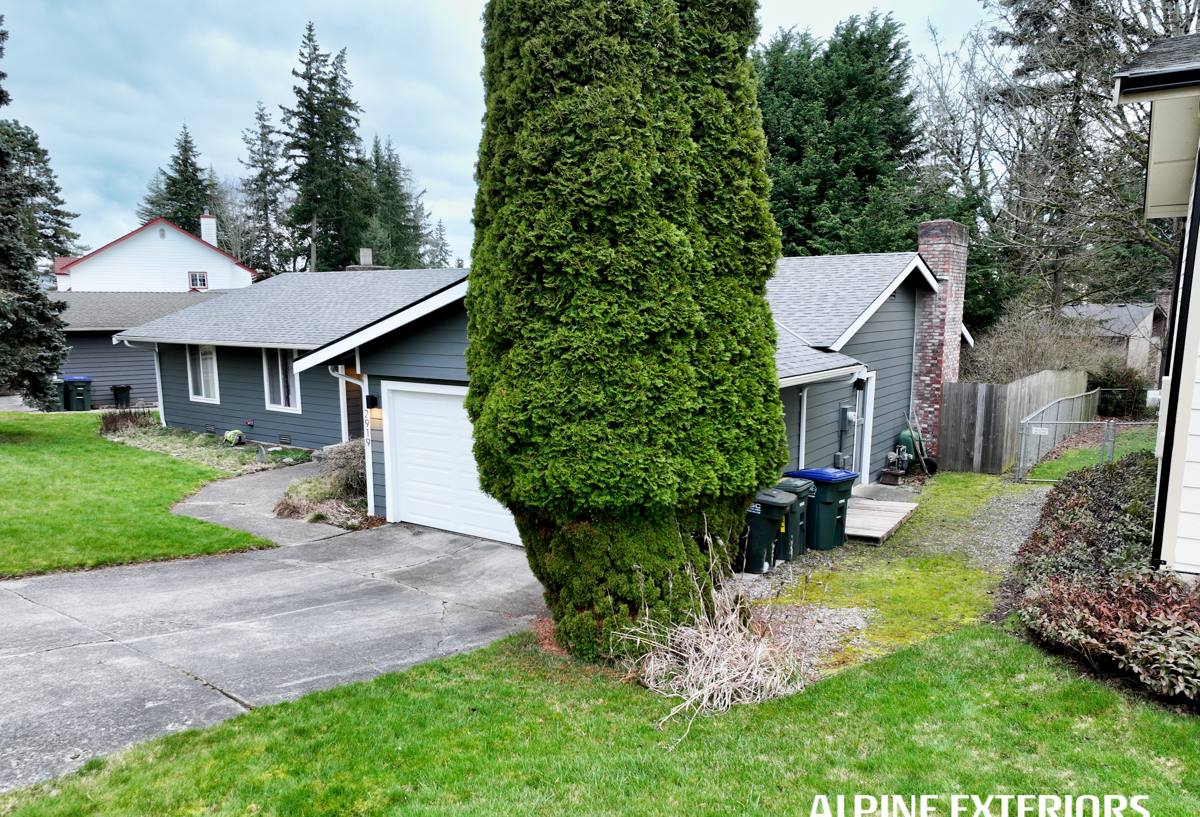
What Driving Rain and Moss Actually Do to the Wrong Siding
It helps to understand the failure pattern before talking about the fix. Wind-driven rain doesn't just wet a wall, it pushes moisture uphill and sideways into laps, corner boards, and butt joints that were designed for gravity-fed water, not pressure. Once moisture gets behind the cladding, it has nowhere to go if the wall assembly wasn't detailed with drainage in mind.
Moss and algae add a second, slower problem. They hold moisture against the siding surface far longer than open air would, and on porous or absorbent materials that moisture eventually works its way into the substrate. On engineered wood products this can mean swelling and edge deterioration. On unfinished wood it means ongoing paint failure and rot. On vinyl it rarely causes structural damage, but it also can't be pressure-washed aggressively without risking cracked panels, so moss becomes a standing maintenance chore instead of a one-time problem.
None of this is unique to any one brand of siding. It's a function of the Acme area's climate meeting whatever is on the wall. The difference is which products are built to shed that moisture and resist that biological growth, and which ones are just tolerating it.
Why We Standardized on James Hardie for This Climate
We install James Hardie fiber cement exclusively. We don't offer vinyl, LP SmartSide, Cemplank, Allura, primed spruce, or cedar as alternatives, and in a climate like this one, that's a deliberate call rather than a sales preference.
Fiber cement is dimensionally stable in a way that engineered wood and solid wood products aren't. It doesn't swell when it absorbs moisture at a cut edge, and it doesn't provide the cellulose that mold and rot organisms need to establish themselves. Hardie's ColorPlus factory finish is baked on under controlled conditions, which means better adhesion and color retention than field-applied paint has to offer, especially on north-facing walls that stay damp and shaded for weeks at a time. And because Hardie makes an HZ5 product line specifically engineered for wetter, harsher climate zones, we're not adapting a general-purpose product to this weather, we're using the version built for it.
None of that means other products are without merit. Vinyl is inexpensive and low-maintenance in mild climates. Cedar has a natural look many homeowners love. LP SmartSide performs reasonably well when detailed and maintained correctly. But in this specific climate, with this much wind-driven moisture and this long a moss season, we've seen enough of the maintenance burden, moisture sensitivity, and installation sensitivity of those alternatives to no longer install them. James Hardie is what we put on Acme-area homes instead, and we stand behind that as our professional standard.
How the Options Compare in This Climate
| Material | Moisture Behavior | Moss/Algae Resistance | Typical Maintenance |
|---|---|---|---|
| James Hardie fiber cement | Dimensionally stable, doesn't swell at cuts | Non-organic substrate, resists biological growth | Periodic wash, factory finish holds color |
| Vinyl siding | Doesn't absorb, but traps moisture behind panels if not vented | Growth sits on surface, needs regular washing | Low, but limited repair options if panels crack |
| LP SmartSide / engineered wood | Can swell at exposed edges if not sealed and maintained | Wood-based substrate is more vulnerable | Ongoing edge sealing and paint upkeep |
| Cedar / primed spruce | Absorbs and releases moisture, moves seasonally | Organic material, most susceptible to moss | Regular refinishing and moisture monitoring |
What a Correct Installation Actually Involves Here
Buying the right siding is only half the job. In a climate that drives rain sideways for months of the year, how the siding is installed matters as much as what it's made of. A correct Hardie installation on an Acme-area home means paying attention to details that don't show up on a spec sheet.
Drainage Plane and Weather-Resistive Barrier
Every wall needs a continuous weather-resistive barrier behind the siding, installed with proper lapping so water is directed outward and down rather than into the sheathing. On homes with the kind of shaded, slow-drying exposure common around Acme, we treat a functioning drainage plane as non-negotiable, not an upsell.
Flashing and Clearances
Window and door flashing, kick-out flashing at roof-wall intersections, and proper clearance between the bottom of the siding and grade, decks, or roofing all matter more in wind-driven rain than they would in a calmer climate. Skipping or shortcutting these details is where most siding failures actually start, regardless of the cladding material.
Fastening, Gaps, and Caulking
James Hardie publishes specific fastening patterns, gap requirements at butt joints and trim, and caulking specifications, and they matter for warranty coverage as well as performance. Panels installed too tight, fastened incorrectly, or caulked in place of proper flashing will underperform even though the material itself is sound.
Ventilation Behind the Cladding
A rain screen gap or vented assembly lets any moisture that does get past the outer layer dry out instead of sitting against the sheathing. This is especially valuable on shaded elevations that don't get the sun exposure to dry quickly on their own.
Our Process for an Acme-Area Project
- On-site assessment: we walk the exterior, check existing siding and trim for moisture damage, and note shaded or exposed elevations that need extra attention to drainage and flashing.
- Tear-off and substrate check: old siding comes off and we inspect sheathing for hidden rot before anything new goes up, since covering a compromised wall defeats the purpose of new siding.
- Weather barrier and flashing: a continuous drainage plane, proper window and door flashing, and kick-out flashing where needed, installed before a single piece of Hardie goes up.
- Hardie installation to spec: correct fastening pattern, gaps, and clearances, following James Hardie's published installation requirements so the manufacturer's warranty stays intact.
- Trim, caulking, and final detailing: corners, trim boards, and joints sealed correctly, not used to compensate for missed flashing.
- Walkthrough: we go over the finished work and what routine maintenance looks like going forward.
Why a Crew That Already Works This Area Matters
A crew that has already worked homes around Acme and greater Lynden isn't guessing at how this climate behaves. We know that a north wall under fir trees needs different attention than a wall that gets afternoon sun, that certain lots hold moisture longer after a storm, and that moss isn't a cosmetic issue here so much as a sign of a wall that stays wet too long. That local pattern recognition shows up in where we put extra flashing, how we detail clearances at grade, and which elevations we flag for a homeowner to keep an eye on.
It also matters for warranty support and follow-up. A contractor who's local and already established in Whatcom County is easier to reach if a question comes up two years after the job, and has a track record in this specific weather rather than a generic one.
Homeowner Checklist: Signs Your Siding Is Losing the Battle with This Climate
- Moss or dark green streaking that returns within weeks of washing, especially on shaded or north-facing walls
- Soft or spongy spots when you press on siding near the bottom courses or around window trim
- Paint or finish that's peeling, bubbling, or chalking unevenly across the wall
- Visible gaps, warping, or separation at butt joints and corner boards
- Persistent damp or musty smell along an interior wall that backs up to an exterior wall
- Siding that sits tight against grade, a deck, or a roofline with little to no visible clearance
Any one of these on its own isn't necessarily an emergency, but a few of them together are worth having looked at before a wet winter turns a small problem into a substrate repair.
Cost Factors Worth Understanding Before You Get a Quote
| Factor | Why It Affects Price |
|---|---|
| Tear-off and substrate condition | Hidden rot found under old siding adds repair scope before new siding can go on |
| Number of stories and roof lines | More cuts, more flashing details, more staging and access needed |
| Trim and detail work | Corner boards, window trim, and fascia detailing add labor beyond flat wall area |
| Siding profile and color | Lap width, shingle-style panels, and factory-finished ColorPlus options vary in material cost |
| Site access and shade exposure | Wooded, hard-to-access lots common around Acme can add setup time |
We don't quote off a square footage number alone, because the substrate condition and detail work drive cost as much as the siding itself does. A real number comes from actually looking at the house.
If you're weighing a siding project for a home in the Acme area, we're glad to come take a look and walk you through what we're seeing, no pressure and no obligation. A free estimate gets you a clear picture of the work involved and what it would take to do it right for this climate — just fill out the form below.