 Lynden Exterior
 Blaine's Coastal Climate Asks More of a Roof Than Most Manuals Admit
Blaine sits right on the water at the top of Whatcom County, which means every roof here deals with a combination of stresses that inland Lynden roofs see in a lighter dose. Salt-laden air off the Strait of Georgia and Semiahmoo Bay accelerates corrosion on any exposed metal — nails, flashing, vent caps, gutter hardware. Add driving rain that comes in sideways during winter storms, and you've got wind-driven moisture testing every seam, lap, and fastener on the roof, not just the open field of shingles. Then there's the moss. Blaine's mix of marine humidity, shade from mature trees, and a mild-but-long wet season creates ideal conditions for moss and algae to take hold on north-facing slopes and anywhere debris collects, sometimes for eight or nine months of the year.
None of this means asphalt shingles are the wrong choice for a Blaine home — they're still the most practical, cost-effective roofing material for most houses in this area. It means the installation details, the fastener choices, and the maintenance rhythm need to account for salt air and sustained moisture in a way a generic install doesn't. That's the difference between a roof that looks fine for two years and one that actually holds up for its full rated life this close to the water.
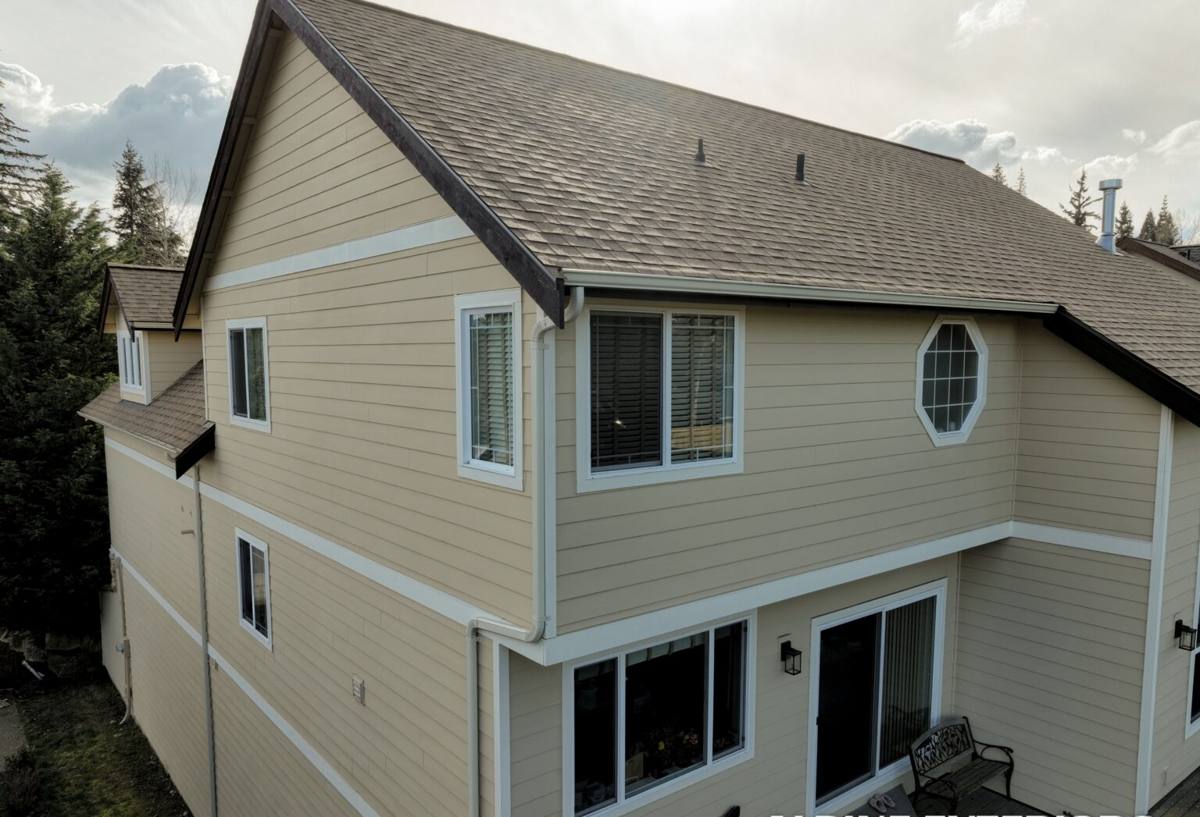
What Blaine Homes Specifically Need From an Asphalt Shingle Roof
Corrosion-Resistant Fasteners and Flashing
Standard electro-galvanized nails and basic aluminum flashing can start showing corrosion within a few years in a salt-air environment. On Blaine jobs we pay close attention to fastener coating and flashing material selection so the metal components aren't the first thing to fail while the shingles themselves still have years of life left.
Wind-Driven Rain Protection at Every Transition
Open field shingle coverage is rarely where a roof fails first. It's the valleys, the sidewall flashing, the chimney and vent penetrations, and the ridge — the places where wind-driven rain gets pushed uphill or sideways instead of just running downhill. A roof built for Blaine needs proper underlayment coverage, correctly lapped flashing, and sealed penetrations that assume rain won't always fall straight down.
A Realistic Plan for Moss and Algae
You can't eliminate moss risk on a shaded, moist lot near the water, but you can reduce how fast it takes hold and how much damage it does before it's addressed. That starts with shingle selection (some products include algae-resistant granules) and continues with how the roof is maintained after installation.
What a Correct Asphalt Shingle Job Actually Involves
A shingle roof is only as good as what's underneath it. Here's what we consider non-negotiable on any Blaine re-roof or major repair:
- Full tear-off to the deck on re-roofs — never layering new shingles over old, which traps moisture and hides deck damage
- Deck inspection and repair or replacement of any soft, rotted, or delaminated sheathing before anything new goes down
- Ice-and-water shield or a comparable self-adhered membrane at eaves, valleys, and around penetrations, sized for the amount of wind-driven rain this area actually sees
- Synthetic or felt underlayment across the full field, lapped correctly with no gaps at seams
- Properly sized and lapped step flashing and counter-flashing at any wall or chimney intersection — not just caulk covering a gap
- Corrosion-appropriate fasteners driven correctly (not overdriven or underdriven) at the manufacturer's specified pattern
- Balanced ridge and soffit ventilation so moisture-laden attic air has somewhere to go instead of condensing under the deck
- Manufacturer-compliant nailing and layout so the shingle warranty actually stays valid
Skipping any one of these doesn't necessarily show up right away. It shows up in year three or four, usually as a leak that seems to come from nowhere but actually traces back to a flashing detail or a ventilation gap from day one.
Common Problems We Run Into on Blaine Roofs
| Issue | Why It Happens Here | What We Address |
|---|---|---|
| Moss buildup on north slopes | Shade, marine humidity, long wet season | Careful removal, root-cause debris and shade factors, algae-resistant shingle options |
| Corroded nail heads or flashing | Salt air accelerates oxidation on exposed metal | Corrosion-appropriate fastener and flashing selection at install |
| Leaks at valleys or wall flashing | Wind-driven rain pushed sideways or uphill | Proper membrane coverage and correctly lapped flashing details |
| Granule loss and premature aging | Combination of UV, moisture cycling, and moss holding water against the shingle | Quality shingle selection and prompt moss/debris management |
| Attic moisture or mold signs | Imbalanced or blocked ventilation trapping humid air | Ridge and soffit vent balance checked as part of every roofing job |
Our Process for a Blaine Roofing Project
1. On-Site Assessment
We look at the whole system, not just the shingles — deck condition, existing ventilation, flashing details, moss and moisture patterns specific to your lot's shade and exposure, and how the roof has performed in past storms if you know its history.
2. Honest Scope and Options
We'll tell you plainly whether you're looking at a repair, a partial re-roof, or a full replacement, and what the real trade-offs are between shingle tiers for a coastal Whatcom County property. No upselling to a premium product you don't need, and no talking you into a patch job on a roof that's past the point of patching.
3. Tear-Off, Deck Repair, and Correct Buildup
Full removal of old material, deck repair where needed, and a buildup that follows the details above — underlayment, flashing, fasteners, and ventilation matched to a salt-air, high-rainfall environment.
4. Final Walkthrough
We walk the finished roof with you, explain what was done and why, and cover what basic upkeep looks like given your specific lot — shade, tree cover, and exposure all matter to how often you'll need to check for moss or debris buildup.
Shingle Options for a Blaine, WA Property
| Shingle Tier | Typical Lifespan | Best Fit For | Coastal Considerations |
|---|---|---|---|
| 3-tab / economy | 15-20 years | Budget-conscious projects, rental properties | Lower wind resistance rating; less margin against driving coastal rain |
| Architectural / dimensional | 25-30 years | Most Blaine homes | Better wind rating and thicker profile hold up well against sustained moisture exposure |
| Premium / designer | 30-50 years | Higher-end homes, longer hold periods | Often includes algae-resistant granules, useful given the area's moss and algae pressure |
For most Blaine homes, we recommend at least a mid-tier architectural shingle with algae-resistant granules. The extra upfront cost is modest compared to the labor cost of an early re-roof, and it directly addresses the moss and algae issue that's specific to this stretch of coastline rather than a generic upgrade.
What Drives the Cost of a Blaine Re-Roof
| Factor | Why It Matters |
|---|---|
| Roof size and pitch | More steep or complex roofs take longer and require more safety setup and material |
| Number of layers to remove | Multiple existing layers add tear-off labor and disposal cost |
| Deck condition | Rot or soft sheathing found during tear-off adds repair cost not visible from the ground |
| Shingle tier selected | Material cost scales with warranty length and algae/wind resistance features |
| Flashing and penetration count | Chimneys, skylights, and multiple valleys add labor at the details that matter most for leak prevention |
| Ventilation upgrades | Adding or correcting ridge/soffit venting is often bundled into a re-roof for efficiency |
We'll give you a written, itemized quote after the on-site assessment rather than a rough number over the phone — roof condition varies enough house to house on this coastline that a real number requires a real look.
Simple Maintenance That Actually Helps in This Climate
- Clear moss and debris from north-facing slopes and valleys at least once a year, more often under heavy tree cover
- Keep gutters and downspouts clear so water isn't backing up under the shingle edge during heavy rain
- Trim back branches that keep a section of roof shaded and damp longer than the rest
- After major windstorms, do a visual check (from the ground is fine) for lifted or missing shingles
- Have flashing and fastener condition checked every few years, especially on homes closest to the water
- Don't pressure-wash shingles — it strips granules and shortens the roof's life; use manual removal or approved treatments for moss instead
Why a Crew That Already Works Blaine Makes a Difference
Roofing details that work fine in a drier, inland climate can fall short a few miles away on the water. A crew that already works Blaine and the surrounding Whatcom County coastline has already seen which flashing details hold up to wind-driven rain here, which fastener choices actually resist salt-air corrosion over time, and how aggressively moss shows up on a shaded north slope versus an open, sun-exposed one. That's knowledge you can't get from a manufacturer's install manual alone — it comes from doing the work in this specific climate, on this specific coastline, repeatedly.
It also means we're not guessing at permitting, disposal logistics, or typical deck conditions for homes built in this area during a given era. We show up already knowing the conditions your roof is fighting.
Get a Straight Answer About Your Roof
If you're dealing with moss buildup, a leak that shows up only during storms, or you're simply due for a re-roof and want an honest read on your options, we're happy to take a look. Use the form below to request a free, no-pressure estimate — we'll walk the roof, tell you what we actually see, and lay out your real options without any pressure to act on the spot.