 Lynden Exterior
 Kendall's Climate Puts Extra Demands on Exterior Siding
Kendall sits inland from downtown Lynden, along the Nooksack River corridor where Whatcom County's farmland starts giving way to forested foothills. Homes here don't take the direct spray that waterfront property gets, but the same marine-influenced air that moves salt-tinged moisture across Whatcom County still works its way up the valley — and Kendall's heavier tree cover adds a problem that open farmland doesn't have nearly as badly: shade. Big stands of fir and cedar keep north- and east-facing walls damp long after a storm has passed, and that combination of standing moisture and reduced sun exposure is exactly what moss, algae, and mildew need to take hold on exterior siding.
Add in the driving rain that comes through this part of the county for months at a stretch, and you've got a climate that's genuinely hard on exterior materials. Siding in Kendall isn't just a cosmetic choice — it's the first line of defense against water intrusion, and it has to hold up to a moss season that, on shaded lots, can run nearly year-round.
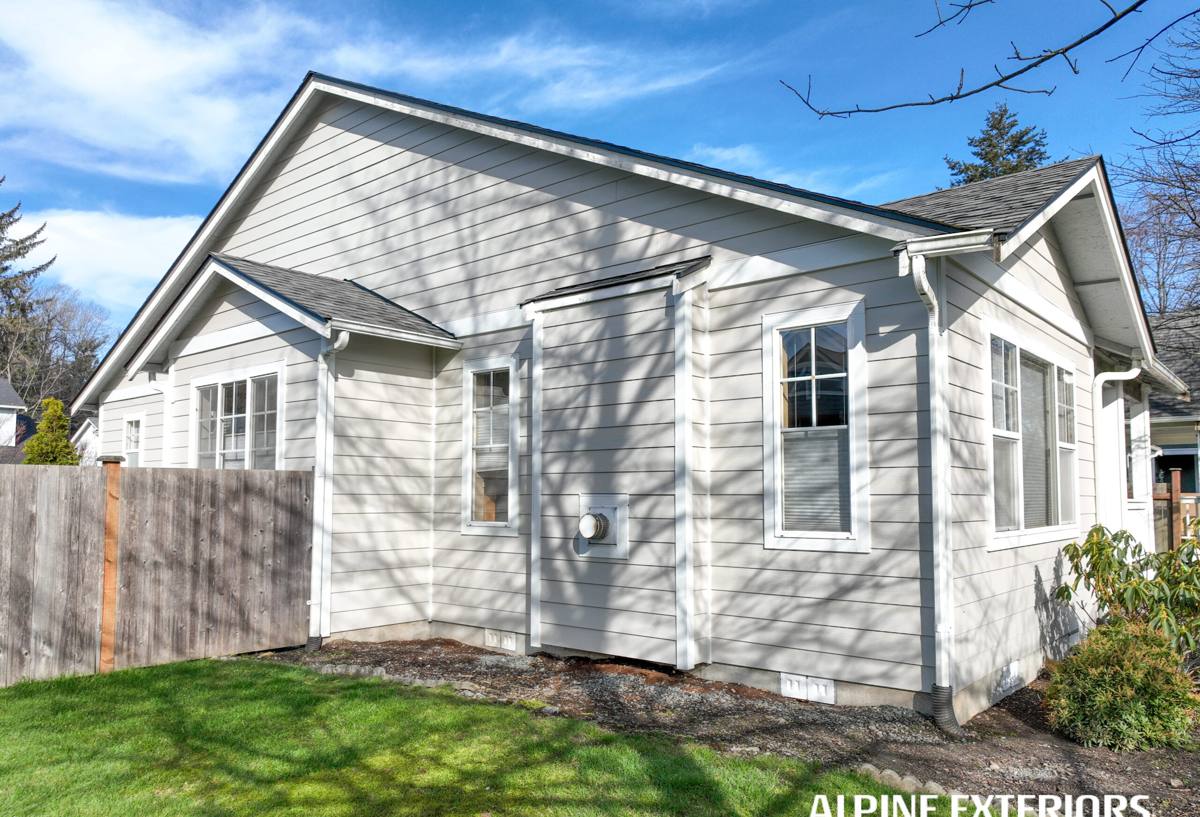
What Kendall Homes Actually Need From Their Siding
We've worked enough properties in and around Kendall to know the failure patterns are predictable. The issues we see most often aren't dramatic — they're slow, and they show up in specific spots:
- North and east walls under tree canopy — slower drying time means more days per year where the siding surface stays wet, which accelerates moss growth and, on the wrong material, rot.
- Ground-level splash zones — properties on larger wooded lots often have less hardscape and more soil, mulch, and vegetation right up against the foundation, which keeps lower courses of siding wetter than on a typical in-town lot.
- Gutter and roofline runoff — heavy tree cover means more debris in gutters, more overflow during hard rain, and more concentrated water hitting the siding right below.
- Long gaps between maintenance visits — rural properties are often lower-traffic, and it's easy for moss or a small caulking failure to go unnoticed for a season or two before someone's up close enough to see it.
Any siding product can look fine for a year or two. What separates a good long-term choice for Kendall is how it behaves after the fifth or tenth wet winter under tree cover — whether it swells, delaminates, holds moss stains permanently, or just keeps doing its job.
Why We Only Install James Hardie
Fiber cement resists moisture in a fundamentally different way than wood-based products. It doesn't absorb and swell the way engineered wood siding can, and it won't rot the way untreated cedar will if a section stays damp for weeks. James Hardie's HZ5 product line is engineered specifically for climates like ours — freeze-thaw cycles, sustained rain, and high humidity — and the factory-applied ColorPlus finish is baked on under controlled conditions, which gives it far better resistance to moss staining and UV fading than a field-applied paint job on wood or hardboard siding ever will. On a shaded Kendall lot, that finish durability is the difference between siding that still looks clean after a decade and siding that needs to be pressure-washed and repainted every few years just to keep moss from taking over.
Siding Options for Kendall's Wooded, Wet Conditions
| Material | Moss/moisture behavior | Fire resistance | Typical maintenance |
|---|---|---|---|
| James Hardie fiber cement | Resists moisture absorption; factory finish resists moss staining | Non-combustible | Occasional gentle rinse; no repainting for decades |
| Vinyl | Doesn't rot, but traps moisture behind it if installed poorly; can warp under sustained heat | Melts/deforms in heat, contributes fuel load | Low, but panels crack and fade over time |
| Cedar / primed wood | Absorbs moisture readily; prone to rot and moss growth in shaded, damp areas | Combustible | Regular repainting/staining and moisture inspection |
| LP SmartSide (engineered wood) | Better than raw wood but still moisture-sensitive at cut edges and seams | Combustible | Caulk and paint maintenance to protect edges |
We don't install vinyl, cedar, or engineered wood products — not because they don't have a place in the market, but because we've made James Hardie the only product we stand behind for this climate, and we'd rather be straightforward about that than sell a homeowner something we wouldn't put on our own house.
What a Correct James Hardie Installation Involves
The siding itself is only part of the equation. A huge share of long-term performance comes down to what's behind it and how it's fastened. On a wooded Kendall property where walls stay damp longer, these details matter even more than usual:
Water Management Behind the Siding
- A properly lapped weather-resistant barrier (drainage plane) installed before any siding goes up
- Correct flashing at every window, door, and roofline intersection — this is the single most common failure point on older installs we open up
- Rainscreen furring where the wall assembly and site conditions call for it, to let moisture drain and the wall breathe rather than sit trapped against sheathing
- Proper clearance between the bottom of the siding and grade, decks, or roofing — a spec that's easy to ignore and expensive to fix later
Installing to James Hardie's Actual Specification
- Correct fastener type, spacing, and placement — Hardie has specific engineering requirements, and shortcuts here void the warranty even if the siding looks fine on day one
- Proper gaps at butt joints and corners to allow for expansion, sealed with the correct sealant rather than caulk that will fail in a season or two
- Field-cutting and priming exposed edges so raw cut ends aren't left to absorb moisture
- Manufacturer-specified overlap and reveal for the specific HZ5 profile being installed
This is where a lot of siding jobs go wrong — not because the material failed, but because it was installed like any other siding instead of to the manufacturer's actual engineering spec. A James Hardie product installed incorrectly will still eventually show the same rot and water problems you're trying to avoid by choosing it in the first place.
Our Process on a Kendall Property
- On-site assessment — we walk the property, note tree cover and shade patterns on each elevation, check current siding and trim for existing moisture damage, and look at drainage, grading, and gutter condition around the house.
- Scope and product selection — we spec the right Hardie profile and finish for the home, and flag any additional work the assessment turned up (flashing repairs, trim rot, gutter issues) so there are no surprises mid-job.
- Tear-off and prep — full removal of failing siding, inspection and repair of sheathing underneath, and installation of a correct weather-resistant barrier and flashing system.
- Installation to spec — Hardie siding installed per manufacturer fastening, sealing, and clearance requirements, with particular attention to the shaded elevations that take the most moisture load.
- Final walkthrough — we go over the finished work with the homeowner, including basic care guidance for a wooded property (gutter clearing frequency, vegetation clearance from walls, what a healthy wall looks like versus one that needs a look).
Why Hiring a Crew That Already Works Kendall Matters
Rural Whatcom County properties come with logistics that in-town jobs don't: longer driveways, septic and well locations to work around, sometimes limited truck access under tree canopy, and material staging that has to account for weather windows since a wooded lot dries out slower after rain delays a job. A crew that's already done siding work out this way knows to plan for those things up front instead of discovering them mid-project. Local familiarity with Whatcom County permitting requirements also keeps the paperwork side of a siding replacement from becoming its own headache.
There's also a simple accountability argument: a contractor based in and around Lynden has a reputation to protect with neighbors, and a truck that's easy to find again if a warranty question comes up five years down the road.
What to Ask Before Hiring Anyone for a Siding Job in Kendall
- Are they licensed, bonded, and insured to do exterior work in Washington State?
- Can they explain, specifically, how they'll handle flashing and the weather-resistant barrier — not just "we'll put up the siding"?
- Do they follow James Hardie's published fastening and clearance specifications, or their own shortcuts?
- Will the quote include tear-off, disposal, and repair of any rotten sheathing found underneath, or is that a change-order surprise waiting to happen?
- Do they have experience with wooded, rural properties and the access/staging issues that come with them?
- What does the warranty actually cover — material only, or labor too, and for how long?
Getting Started
If moss is creeping up the shaded side of your Kendall home, or your current siding is showing soft spots, staining that won't wash off, or gaps opening up at the trim, it's worth having someone look at it before another wet season adds to the damage. We offer free, no-pressure estimates — we'll walk the property, tell you honestly what we see, and give you a straight answer on what a correct James Hardie installation would involve for your home. Use the form below to get in touch.