 Lynden Exterior
 Blaine's Coastal Climate Asks More of a Deck
Blaine sits about as close to the water and the border as a Whatcom County home can get, and that location comes with a specific set of stresses on any outdoor structure. Salt-laden air off the Strait works on fasteners and metal connectors year-round, not just during storms. Driving rain off the water pushes moisture sideways into board ends, ledger connections, and railing posts in ways that vertical rain never would. And the long, damp shoulder seasons that define this part of the county mean a deck surface can stay wet and shaded for weeks at a stretch, which is exactly the condition moss and algae need to take hold.
None of that means a deck in Blaine is doomed to rot or discolor early — it means the build has to account for those conditions from the start. A deck detailed the same way you'd build one in a dry inland yard will show its age faster here. The fixes are not exotic; they are mostly about material choice, fastener grade, and drainage details that get skipped when a crew is not used to building this close to salt water.
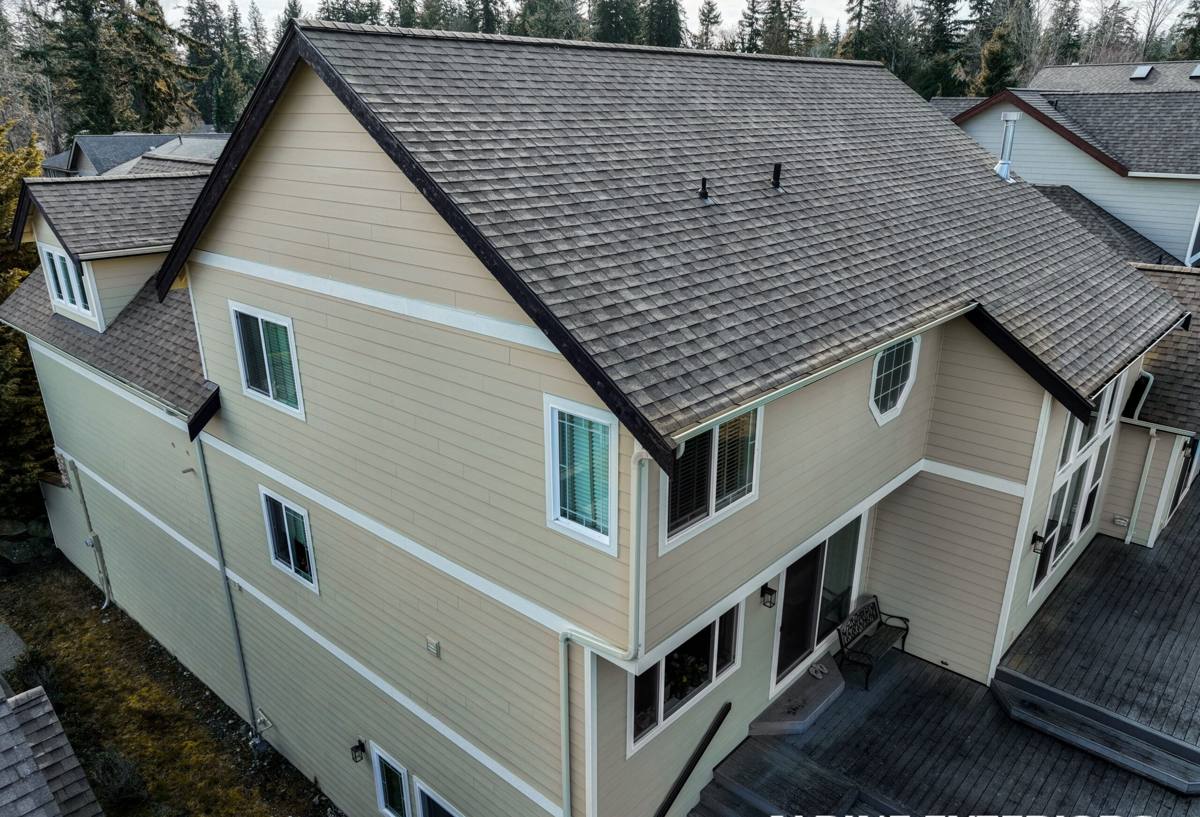
What Goes Wrong With Decks Built Without Blaine's Climate in Mind
We get called out to look at decks that are only a few years old and already showing problems that have nothing to do with the composite decking itself. The pattern is usually the same:
- Standard zinc or electroplated fasteners corroding and staining the board around each screw within a season or two
- Joists and beams that were never wrapped or flashed, so moisture wicks up from the end grain
- Ledger boards attached to the house without proper flashing, letting driving rain track behind the siding
- Deck boards installed tight against each other or against the house with no gap for airflow, trapping moisture and encouraging moss and algae growth
- Footings and post bases set too close to grade, sitting in standing water after heavy rain
Every one of these is preventable at the framing stage. Almost none of them are visible once the decking is installed on top, which is why the substructure matters as much as the surface material — arguably more, since it's harder and more expensive to fix later.
The Substructure: Where a Coastal Deck Is Actually Won or Lost
Framing and Fasteners
In a salt-air environment, we treat fastener selection as a first-order decision, not an afterthought. That means stainless or heavy-duty coated hardware rated for coastal or ground-contact exposure at every connection point — joist hangers, structural screws, ledger bolts, and post hardware. It costs more up front than standard galvanized hardware, but it's the difference between hardware that lasts the life of the deck and hardware that starts bleeding rust stains into the decking within a few wet winters.
Ledger Flashing and Water Management
Where the deck attaches to the house, proper flashing is non-negotiable this close to the water. We integrate flashing with the house's water-resistive barrier so wind-driven rain can't track behind the siding at the connection point — a detail that's easy to shortcut and expensive to repair once it's failed inside a wall.
Ground Clearance and Drainage
Footings and posts need real clearance from grade, and the ground under the deck needs somewhere for water to go. On sites with heavy clay or poor drainage — common in parts of Whatcom County — that can mean grading, gravel, or a drainage system under the deck itself so the substructure isn't sitting in saturated soil through the wet months.
Choosing a Composite Board for This Environment
Not all composite decking behaves the same way in salt air and constant moisture. We steer homeowners toward capped composite boards with a fully wrapped polymer shell rather than uncapped or lightly capped products, because the cap is what keeps moisture, salt residue, and organic growth from working into the wood-fiber core. An uncapped board can absorb moisture at cut ends and fastener holes, which is exactly where problems start in a wet, salty climate.
We also pay attention to surface texture. A board with some grain texture and a matte finish sheds standing water and resists showing algae film better than a very smooth, glossy surface, which can turn slick when damp — a real concern on a deck that stays wet for long stretches of the year.
Color Considerations
Very dark composite boards run hotter in direct sun, but in Blaine's marine climate that's rarely the limiting factor — moisture retention and how a color hides mineral streaking, pollen, or light algae film between cleanings matters more here than heat. Mid-tone, variegated colors tend to hide the normal effects of a coastal environment better than solid dark or solid light tones.
Composite vs. Other Decking Materials in a Salt-Air Setting
| Material | Behavior Near Salt Air | Maintenance Load | Typical Lifespan Here |
|---|---|---|---|
| Capped composite | Resists moisture intrusion at the surface; core is protected from salt and rot | Periodic wash-down to keep organic growth from taking hold | 25-30+ years with proper substructure |
| Pressure-treated wood | Absorbs moisture readily; salt air accelerates fastener corrosion and surface graying | Regular sealing/staining, ongoing plank replacement | 10-15 years before major repair |
| Uncapped composite | Core can wick moisture at cuts and fastener holes over time | More prone to surface mold/algae than capped boards | 15-20 years |
| PVC decking | Fully impervious to moisture; performs very well near water | Low; wash-down only | 25-30+ years |
Capped composite is our default recommendation for most Blaine homeowners because it strikes the best balance of upfront cost, low maintenance, and proven performance in this climate. PVC is a reasonable alternative where budget allows and a homeowner wants the lowest possible maintenance, but composite gives most homes the durability they need without the added cost.
Our Process, Start to Finish
- On-site assessment — we look at the existing structure or site conditions, drainage, sun and wind exposure, and how close the deck sits to prevailing weather off the water.
- Design and material selection — board profile, color, railing system, and fastener hardware chosen specifically for the site, not a one-size-fits-all package.
- Framing and substructure — coastal-grade hardware, proper ledger flashing, correct joist spacing for the board span, and attention to grade clearance and drainage.
- Decking installation — hidden or color-matched fasteners, correct expansion gaps at board ends and against the house, and picture-frame or border detailing where called for.
- Railing and finish work — railing systems matched to the deck material and rated for the same exposure.
- Final walkthrough — we go over maintenance expectations specific to this climate before we consider the job done.
Living With a Composite Deck Through Blaine's Moss Season
Capped composite decking dramatically cuts maintenance compared to wood, but "low maintenance" doesn't mean "no maintenance" in a climate that stays damp and shaded for months at a time. A seasonal wash-down — plain soap and water or a composite-safe cleaner, applied before moss or algae has a chance to establish — keeps boards looking good and keeps the surface from getting slick. Areas under overhangs or heavy tree cover, which hold moisture longest, deserve the closest attention.
Gaps between boards and the gap along the house wall are there for a reason: they let air move and water drain instead of pooling. Keeping those gaps clear of debris — fallen leaves, needles, dirt — does more to prevent moss buildup than any cleaning product.
Why Local Experience in Blaine Matters
A deck built to a generic spec sheet can look identical to one built for this specific stretch of Whatcom County coastline — until a few winters of salt air and driving rain have passed. Crews who haven't built along the water regularly don't always know which fastener grades hold up here, how tight to run expansion gaps given our humidity swings, or where standing water tends to collect on a given lot. That's the kind of judgment that comes from having built and maintained decks in Blaine and the surrounding area, not from a manufacturer's install guide alone.
We treat every coastal build the same way: substructure and hardware sized for the exposure, drainage worked out before the framing goes up, and a composite product chosen to match how the site actually behaves through the wet season, not just how it looks on a sample board.
Get a Straightforward Estimate
If you're weighing a new composite deck or replacing an aging wood deck in Blaine, we're happy to walk the site, look at drainage and exposure, and give you an honest read on what the job actually needs. Use the form below to request a free, no-pressure estimate.