 Lynden Exterior
 Why Kendall Decks Face a Tougher Climate Test
Kendall sits inland from the Salish Sea but close enough that salt-laden air still reaches homes here, especially on windier days when marine air pushes through the Nooksack valley toward the foothills. Combine that with Whatcom County's long wet season, heavy tree cover on many Kendall lots, and stretches of shade that keep surfaces damp for days at a time, and you get a set of conditions that are genuinely hard on an outdoor structure. A deck built the same way you'd build one in a dry inland climate will show problems here years earlier than it should: rusted fasteners, soft ledger boards, black-green moss carpeting the walking surface, and joists that stay wet long after the rain stops.
None of that means a deck can't last decades in Kendall. It means the build has to account for moisture and organic growth from the first framing decision, not as an afterthought once the deck is already discolored or spongy underfoot.
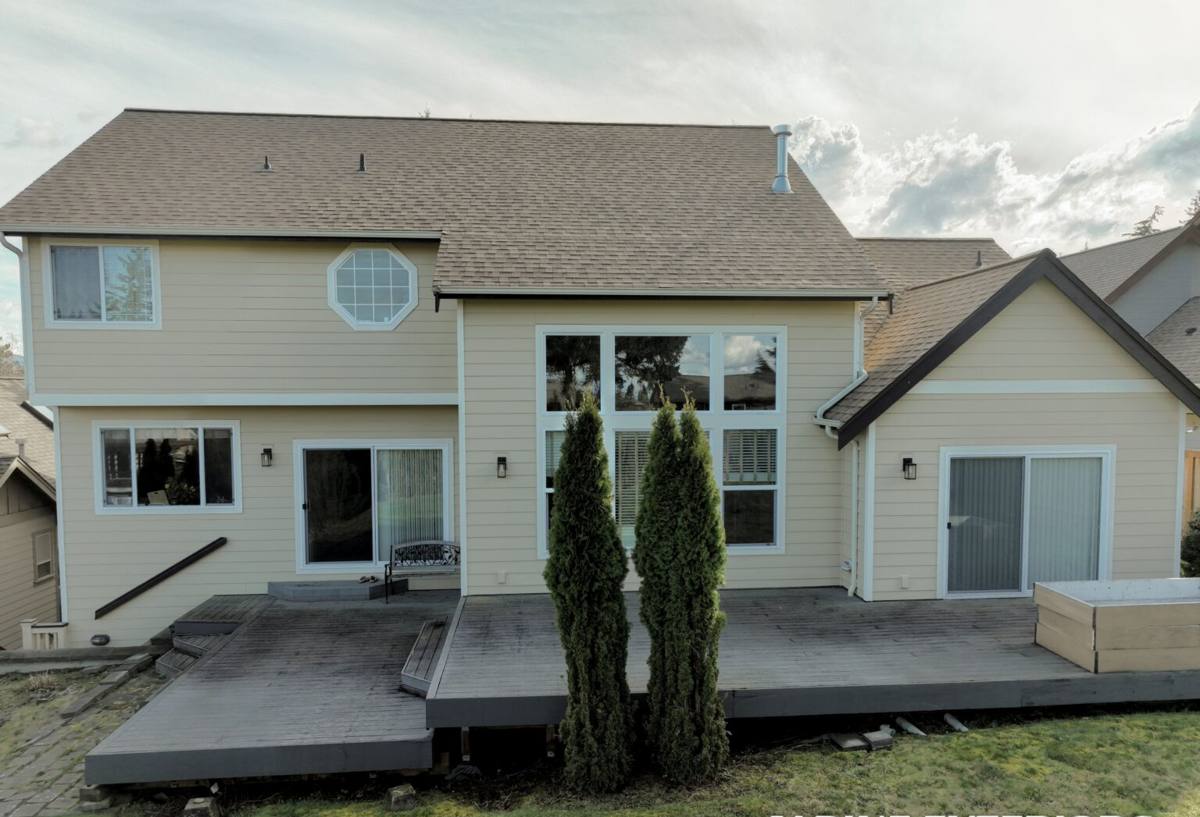
What a Correctly Built Deck Needs Here
A deck is really two structures: the frame that carries the load, and the surface you walk on. In this climate, the frame is where most failures start, because it's the part that stays wet longest and gets inspected least.
Ledger Attachment and Flashing
Where a deck attaches to the house is the single most common source of rot we find on older Kendall decks. If the ledger board isn't properly flashed to shed water away from the house band joist, water tracks behind the siding and rots the framing from the inside — often invisible until the deck starts to sag or pull away from the house. Correct flashing, installed in the right sequence with the house's water-resistive barrier, is non-negotiable on every deck we attach to a structure.
Footings and Framing for Whatcom County Soil
Footing depth has to account for local frost depth and drainage, and soil on Whatcom County lots varies enough lot to lot that we don't assume a standard footing spec will work everywhere — some Kendall properties have heavier clay content that holds water around a footing longer than sandier soil would. We size and place footings based on what we find on site, not a generic assumption, and we grade around footings so water moves away from the post base instead of pooling against it.
Joist Protection
Standard framing lumber, even pressure-treated, will absorb water at every cut end and fastener penetration if it's left bare. We use joist tape over the top of joists and beams to keep standing water off end grain and out of screw holes, which is one of the cheapest, highest-value steps in extending a deck frame's life in a wet climate.
Fasteners and Hardware: Why Grade Matters
Salt-influenced air corrodes standard hardware faster than most homeowners expect, and once a fastener starts rusting, it weakens from the inside before it ever looks bad on the surface. We treat fastener and hardware grade as a structural decision, not a cosmetic one.
- Stainless steel or high-grade coated fasteners rated for ground-contact and coastal-influenced exposure, matched to the treated lumber or composite manufacturer's fastener requirements
- Hot-dip galvanized or stainless structural connectors (joist hangers, post bases, hurricane ties) — never bare or lightly coated hardware exposed to weather
- Fastener compatibility checked against the decking material, since some coatings react with certain treated-lumber chemicals and accelerate corrosion
- All structural hardware installed per manufacturer nailing/screw patterns — under-fastened hardware is a common shortcut we won't take
Material Choices for Kendall's Climate
There's no single "best" decking material — the right choice depends on how much moss and moisture exposure the site gets, how much upkeep the homeowner wants to do, and budget. Here's how the common options actually perform under Kendall conditions:
| Material | Moss/Algae Resistance | Maintenance | Typical Lifespan Here |
|---|---|---|---|
| Pressure-treated wood | Low — needs regular cleaning and sealing to resist growth in shaded, damp spots | Annual cleaning, re-sealing every 2-3 years | 15-20 years with upkeep |
| Cedar | Moderate — natural oils help, but shaded areas still need attention | Cleaning and oil/stain every 2-3 years | 15-25 years with upkeep |
| Capped composite | Good — cap layer resists moisture absorption that feeds growth | Periodic washing, no sealing required | 25-30+ years |
| PVC decking | Very good — non-porous surface gives moss and algae little to hold onto | Occasional washing | 25-30+ years |
We don't push one material on every homeowner. A shaded Kendall lot under mature trees is a different conversation than an open, sunnier yard — the shaded lot benefits more from a low-porosity capped composite or PVC surface, while a sunnier, well-ventilated deck can do fine with wood if the owner is willing to maintain it.
Moss, Algae, and Drainage: Design Choices That Matter
Moss and algae need two things to take hold: moisture and a surface to grip. A deck's design can starve them of both, or hand it to them.
Board spacing and airflow underneath the deck matter more than most homeowners realize. A deck built low to the ground with poor underfloor ventilation stays damp long after a rainstorm, which is exactly the environment moss favors. We frame in enough clearance and cross-ventilation where the design allows it, and we specify board gapping that lets water drain through rather than sheet across the surface and sit in low spots.
Slope also matters. A deck surface needs a slight pitch away from the house so water runs off instead of pooling near the ledger — a detail that's easy to get wrong and hard to fix after the fact. On decks near heavy tree cover, we also talk with homeowners about periodic branch trimming to let more sun and airflow reach the surface, since no decking material fully resists moss if it never dries out.
Our Process for a Kendall Deck Project
- On-site assessment — we look at grade, drainage, tree cover, sun exposure, and how the deck will attach to the house before recommending a design or material.
- Design and material selection — sized to the site's actual moisture exposure, not a one-size-fits-all recommendation.
- Permitting — we handle the permit application and inspections required for the project.
- Footings and framing — footings sized to soil and frost conditions, joist tape and flashing installed before any decking goes down.
- Decking and railing installation — fastener and hardware grade matched to material and site exposure.
- Final walkthrough — we review drainage, spacing, and maintenance expectations with the homeowner before calling the job done.
Permits and Code Considerations in Whatcom County
Most attached decks and any deck reaching a meaningful height above grade require a permit in Whatcom County, and inspections typically check footing depth, ledger attachment, and railing/guard height before the project can be signed off. Skipping or shortcutting the permit process is a common way homeowners end up with a deck that can't be legally sold or insured without costly rework later. We pull the required permits and build to the inspected standard as a matter of course, not as an upsell.
Maintenance Checklist for Long Deck Life
Whatever material you choose, a Kendall deck needs some seasonal attention to get its full lifespan. This is the baseline we recommend to every homeowner:
- Clear leaves and debris from board gaps and between joists at least twice a year, more often under heavy tree cover
- Wash the surface annually to remove early moss and algae growth before it establishes
- Check and re-seal wood decking on the manufacturer's recommended cycle — don't wait until it looks gray
- Inspect the ledger flashing and house connection point yearly for any sign of water staining
- Confirm gutters and downspouts near the deck are directing water away, not onto the structure
- Look underneath the deck once a year for standing water, soft wood, or fastener rust
Why Hire a Crew That Already Works in Kendall
A deck contractor who only sees Kendall properties occasionally is guessing at how a design will hold up here. A crew that regularly works Whatcom County's mix of marine-influenced air, heavy rain, and shaded, tree-covered lots knows which fastener grades actually hold up, which footing approach fits the soil, and which material trade-offs are worth explaining before the homeowner commits to a look that will fight the climate for the next twenty years. That familiarity shows up in fewer callbacks, fewer surprises during inspection, and a deck that still looks and performs well after its first few wet winters.
If you're planning a new deck or replacing one that's showing its age, we're happy to walk the site with you and put together a free, no-pressure estimate — no obligation, just an honest look at what your property needs. Use the form below to get started.