 Lynden Exterior
 Laurel's Climate Puts Real Demands on Exterior Siding
Laurel sits in the stretch of Whatcom County between Lynden and the Nooksack River bottomland, close enough to the Salish Sea that homes here deal with moisture-laden air moving through most of the year. That's on top of the driving, sideways rain that comes with fall and winter storms off the water, and long stretches of gray, damp weather that keep tree-shaded roofs and north walls wet for days at a time. Add a moss season that can run from October through April on lots with mature trees, and you've got a climate that's genuinely tough on the outside of a house.
Siding in Laurel isn't just cosmetic. It's the barrier between that moisture and your home's framing, sheathing, and insulation. When it fails — through cracking, delaminating, or trapping water behind it — the damage usually isn't visible until it's expensive.
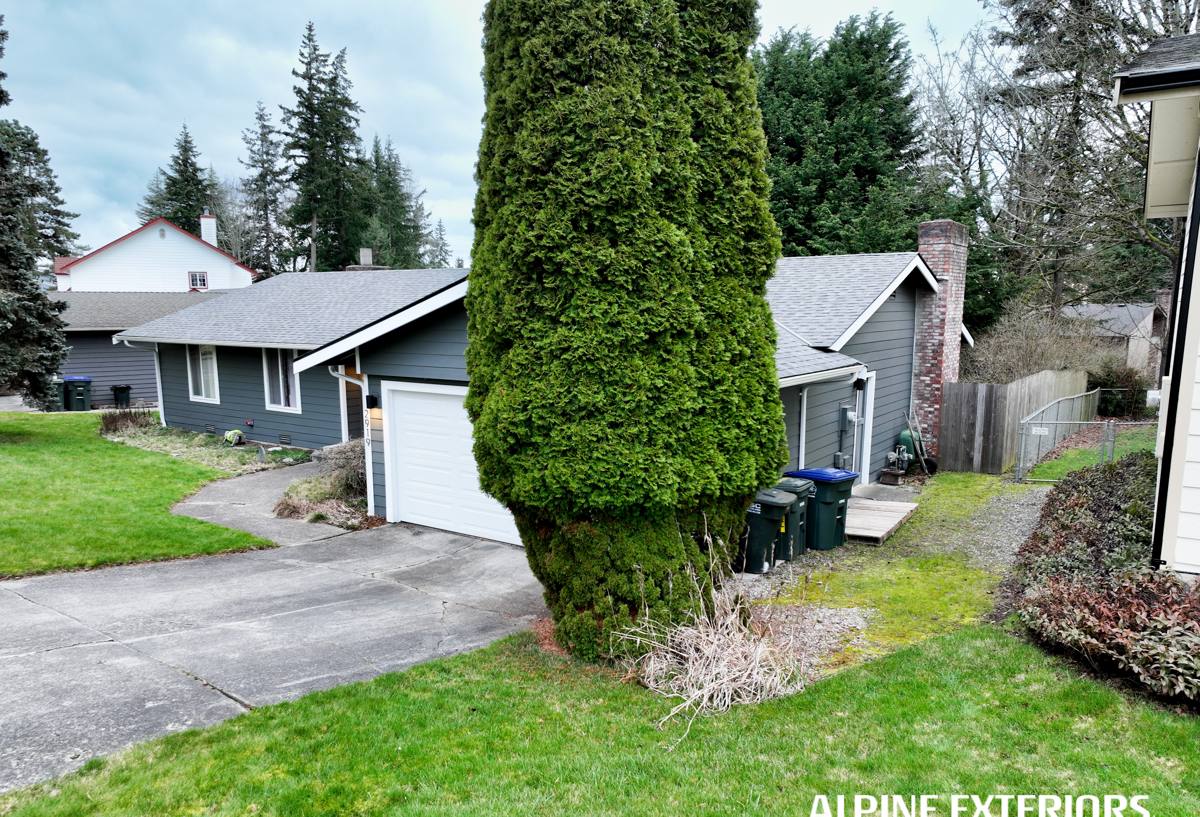
What Laurel Homes Actually Need From Their Siding
Based on the conditions we see working this part of Whatcom County, siding here needs to do four things well:
- Shed water aggressively. Driving rain doesn't just fall straight down — it hits walls at an angle, especially on west and south exposures. Siding and flashing details need to handle that, not just vertical rainfall.
- Resist moisture absorption. Materials that soak up water and hold it against the wall stay wet longer between storms, which is exactly the condition moss, mold, and rot need to take hold.
- Hold paint and color through freeze-thaw cycles. Whatcom County winters aren't brutal, but they're damp and they do dip below freezing. Materials that expand and contract with moisture crack their paint film faster here than in drier climates.
- Stand up to green growth without constant intervention. On shaded lots — and Laurel has plenty of them — moss and algae are a fact of life. Siding needs a surface that doesn't give organic growth an easy foothold.
Why We Only Install James Hardie Fiber Cement
We made a decision early on to install one siding system: James Hardie fiber cement. We don't install vinyl, LP SmartSide, Cemplank, Allura, primed spruce, or cedar, and we're upfront with Laurel homeowners about why.
Fiber cement is a cement, sand, and cellulose fiber composite. It doesn't absorb water the way wood-based or wood-fiber products do, and it's non-combustible, which matters more each year as wildfire smoke and ember exposure become a bigger part of Pacific Northwest summers. James Hardie specifically engineers its siding by climate zone — the HZ5 and HZ10 product lines are formulated for different moisture and temperature profiles across the country, and Western Washington falls into a zone where moisture resistance is the priority, not extreme heat or cold.
The factory-applied ColorPlus finish is the other piece. It's baked on in a controlled environment rather than field-applied, which gives it better adhesion and a longer service life before repainting than site-painted wood or fiber cement alternatives. Combined with a strong transferable warranty, that adds up to a product that's built for exactly the conditions Laurel deals with — not a compromise we're asking homeowners to accept.
This doesn't mean every other product is unusable. Vinyl is inexpensive and low-maintenance in mild climates. Cedar has real aesthetic appeal and a long history in this region. LP SmartSide and other engineered wood products have improved over the years. But each comes with a trade-off — vinyl's tendency to warp and fade, cedar's ongoing maintenance and moisture sensitivity, engineered wood's reliance on an intact paint and sealant system — that we don't think holds up as well over 20-30 years in this specific climate. We'd rather install one product correctly than several products with asterisks.
What a Correct Fiber Cement Siding Job Actually Involves
Fiber cement siding is only as good as its installation. A huge share of the siding failures we get called out to inspect in Whatcom County aren't material failures — they're installation shortcuts. Getting it right means:
Weather-Resistive Barrier and Flashing
A properly lapped weather-resistive barrier goes on before any siding, with flashing integrated at every window, door, and penetration so water is directed out and down, never behind the cladding. This is the layer that actually keeps your wall assembly dry — the siding is the second line of defense, not the first.
Correct Fastening
James Hardie has specific fastener spacing, type, and placement requirements depending on the product and exposure. Under-fastening or fastening into the wrong substrate is one of the most common causes of boards working loose or cracking at the nail line.
Clearances and Gaps
Fiber cement needs proper clearance from grade, roofing, and decking, plus expansion gaps at butt joints and trim. Skip these and you're inviting the exact wicking and trapped-moisture problems fiber cement is supposed to avoid.
Caulking and Sealant Details
Not every joint should be caulked — some are designed to drain. Knowing which joints get sealed and which get left open to breathe is a detail that separates a crew that's installed hundreds of Hardie jobs from one that's guessing.
Our Process for Laurel Projects
- On-site assessment. We walk the exterior, check current siding and sheathing condition, note moss and moisture patterns specific to your lot's shade and drainage, and look at trim, window, and roofline details that affect the job.
- Product and color selection. We help you choose the right Hardie plank profile, texture, and ColorPlus color for your home, factoring in HOA guidelines where they apply and how the color performs against the region's gray-sky light.
- Tear-off and substrate check. Old siding comes off and we inspect sheathing for hidden rot or moisture damage before anything new goes up — this is often where we find problems the homeowner didn't know existed.
- Weather barrier and flashing installation. Done to manufacturer spec, with extra attention at every window and door opening.
- Siding installation. Installed to James Hardie's fastening and clearance specifications, not shortcuts that happen to look fine on day one.
- Final walkthrough. We go over the finished job with you, including basic care and what to expect from the ColorPlus finish over time.
Fiber Cement vs. Other Siding Materials in a Damp Climate
| Material | Moisture Behavior | Maintenance | Typical Lifespan |
|---|---|---|---|
| James Hardie Fiber Cement | Does not absorb water into the board itself; factory finish resists cracking and fading | Occasional wash; repaint interval is long due to ColorPlus finish | 30+ years with correct install |
| Vinyl | Doesn't absorb water but can warp, buckle, or gap, letting moisture behind it | Low, but color fades and can't be repainted easily | 20-30 years, shorter in freeze-thaw conditions |
| Cedar / Primed Wood | Absorbs moisture readily; prone to swelling, checking, and rot without diligent upkeep | High — regular repainting or restaining, caulk maintenance | Varies widely with maintenance, often 15-20 years before major repair |
| Engineered Wood (LP SmartSide) | Resin-treated but still wood-based; performance depends heavily on sealed edges and paint integrity | Moderate to high — edge sealing and touch-up matter | 20-30 years if maintained closely |
Signs Your Laurel Home May Need New Siding
- Soft or spongy spots when you press on the siding, especially near the bottom courses
- Persistent moss or dark streaking that comes back within weeks of cleaning
- Paint that's peeling, bubbling, or chalking heavily rather than just fading
- Visible warping, cupping, or gaps opening up between boards
- Rising energy bills that can't be explained by the furnace or windows
- Interior signs — musty smell, staining on interior walls near exterior corners
Any one of these on its own isn't necessarily an emergency, but a few together usually means moisture has already gotten past the siding and into the wall assembly.
Why Hiring a Crew That Already Works Laurel Matters
A siding job that looks identical on paper can perform very differently depending on who installs it and how well they understand the site. A crew that regularly works Laurel and the broader Lynden area already knows which exposures take the worst of the driving rain, which lots hold shade and moss longest into spring, and how local permitting and inspection typically go in Whatcom County. That familiarity shows up in the small decisions — where extra flashing gets added, which corners get more attention — that don't show up on a spec sheet but matter over 20 years.
It also means accountability doesn't disappear once the job is done. A local crew is the one you call if a question comes up two years later, not a company that's moved on to the next region.
Ready to Talk About Your Laurel Home?
If your siding is showing its age, or you're planning ahead before Laurel's next wet season, we're happy to take a look and walk you through what a James Hardie fiber cement installation would involve for your specific home. There's a form below — reach out for a free, no-pressure estimate.