 Lynden Exterior
 Siding Installation in Maple Falls: A Different Kind of Whatcom County Lot
Maple Falls sits out in the wooded, rural stretch of Whatcom County, a good drive from the coastline but still inside the marine weather system that shapes exterior work across this whole region. It's a different kind of property than what you'll typically find in town — bigger lots, heavier tree cover, longer driveways, and often a house that sits well back from the road under a canopy that never fully thins out. That changes what a siding installation needs to account for, even though the core climate pressures are the same ones every Whatcom County home deals with: salt-tinged air moving in off the water, rain that arrives sideways more often than it falls straight down, and a moss season that, under heavier tree cover, can run longer here than it does on an open, in-town lot.
This page is specifically about siding installation for Maple Falls homes — new work and full re-siding, not spot repair — and what a correct job looks like on a rural, tree-sheltered property like the ones common out here. We're based in Lynden and cover this area regularly, and we install James Hardie fiber cement exclusively, which is the system everything below assumes.
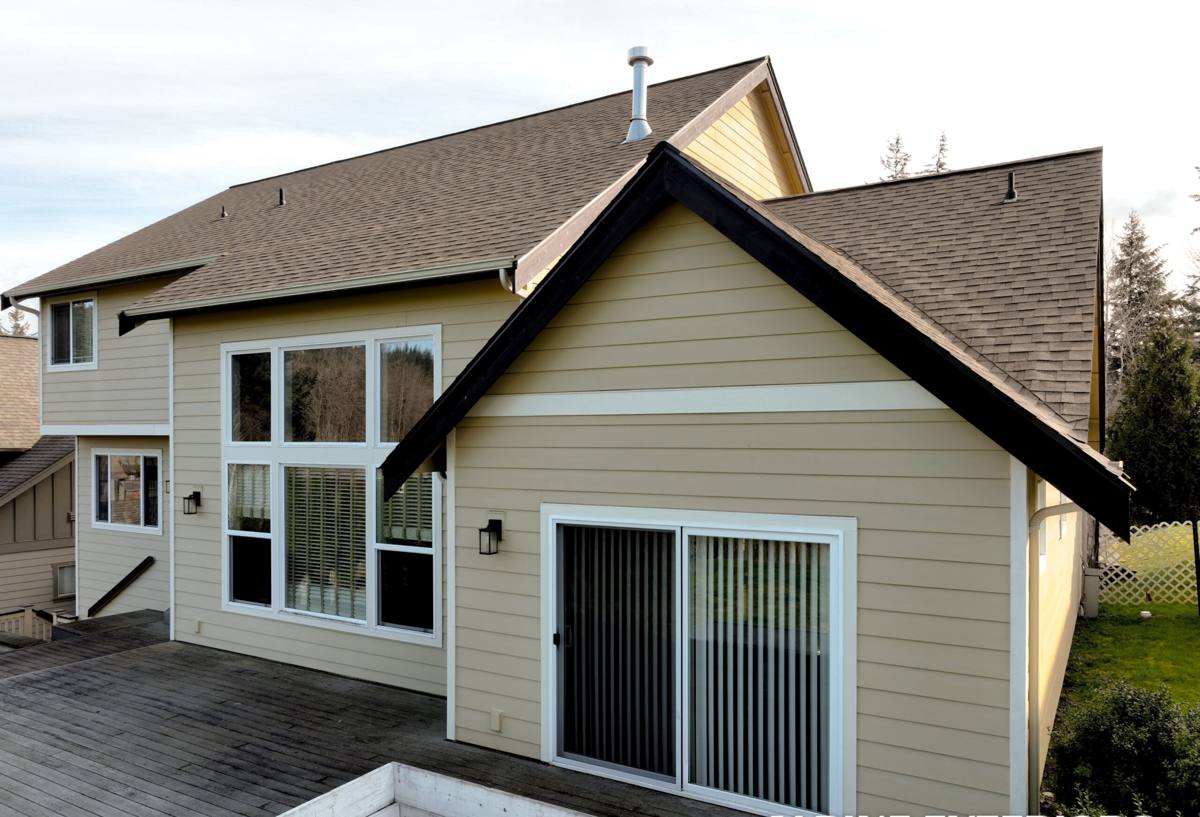
What Maple Falls' Climate Puts a New Installation Through
Marine Air That Still Reaches the Foothills
Maple Falls sits farther from open water than most of the towns we work in, and it's tempting to assume that distance takes salt-laden air out of the equation. It doesn't, entirely. Marine air moves broadly across this part of Whatcom County, and while the corrosion risk here is a lesser dose than a shoreline property gets, it's still enough over the years to argue against cutting corners on fastener and hardware grade.
Driving Rain in a Valley Setting
Rain through fall and winter rarely falls straight down anywhere in this county, and out toward Maple Falls, wind moving through the valley can push it into wall assemblies and window flashing just as hard as it does closer to the water. An installation that assumes calm, straight-down rainfall because a property sits inland is making an assumption the actual weather doesn't support.
A Moss Season Extended by Tree Cover
This is where Maple Falls diverges most from an open, in-town lot. Heavier, more continuous tree canopy keeps walls shaded and damp for longer stretches, and it drops needles, sap, and debris into gutters and against lower courses of siding in a way open properties don't deal with as much. The result is a moss and mildew season that can run longer here than it does on a sunnier, more exposed lot just a few miles away.
Why Rural, Tree-Sheltered Lots Change the Installation Calculus
A few things about a typical Maple Falls property change how an installation should be planned, beyond just the climate. Longer driveways and more limited staging area mean material delivery and site access need to be worked out ahead of time, not discovered on the first day of the job. Heavier tree cover means certain walls — often the ones facing away from whatever clearing exists on the lot — almost never see direct sun, which affects how quickly they dry out after a storm and how much attention drainage and clearance details deserve on those specific elevations. Septic systems, wells, and established landscaping on rural lots also mean equipment staging and material storage sometimes take more planning than a standard in-town yard does.
None of this changes what James Hardie siding needs to perform correctly, but it does change how a crew plans the job, sequences the work, and which walls get the closest attention during installation.
Why We Install Only James Hardie Fiber Cement
We install one siding system. We don't install LP SmartSide, vinyl siding, Cemplank, Allura, primed spruce, or cedar, and that's a professional standard rather than a limitation on what we're able to do. On a shaded, tree-covered lot like a typical Maple Falls property, the products we've stepped away from share a common weakness: they either absorb moisture directly, rely on a coating that has to be maintained indefinitely to keep water out, or move enough with temperature and humidity swings that seams eventually work themselves loose.
- Non-combustible core: a real consideration on a wooded, rural lot, where both wildfire risk and insurance underwriting factor in
- Factory-applied ColorPlus finish: baked on under controlled conditions, holding color and adhesion longer than a field-applied coating exposed to constant shade and damp
- Climate-engineered HZ5 formulation: built for regions with sustained moisture exposure and freeze-thaw cycling, which fits this part of the county
- Dimensional stability: doesn't swell, cup, or warp the way engineered wood can after repeated wetting under heavy tree cover
- A strong transferable warranty: backed by Hardie provided installation follows their published specification
Homeowners on a shaded lot often ask specifically about moss resistance, since that's the most visible problem on a tree-covered property. Fiber cement doesn't feed moss growth the way a porous or wood-based surface can, but no siding material stays moss-free indefinitely under constant shade — that's a maintenance reality of the lot itself, not a product flaw.
What a Correct James Hardie Installation Involves
Fastening and Spacing
James Hardie publishes exact fastener type, spacing, and placement requirements, and following that spec is what keeps the manufacturer's warranty valid and keeps panels secured through wind that can move differently through a valley or forest clearing than it does in open country.
Clearances at Grade and Landscaping
Hardie specifies minimum clearance between siding and grade, decks, and other horizontal surfaces. On a rural lot, that clearance often has to account for established landscaping, mulch beds, or grade that's built up around a foundation over years, not just a fresh, flat yard.
Flashing at Every Penetration
Windows, doors, vents, and hose bibs all interrupt the siding plane. On a shaded property where walls take longer to dry between storms, correct flashing at every one of these points matters even more, since any water that gets behind the cladding has fewer dry days to evaporate before the next round of rain arrives.
Field-Cut Edges
Any panel cut on site needs its edge sealed or primed to spec before it goes up. This is one of the more common places fiber cement actually takes on water when the step gets skipped, and it's worth the extra few minutes per cut regardless of how far along the schedule is.
How Our Process Works, Step by Step
Site and Access Assessment
Before we price a Maple Falls job, we look at the property itself — driveway access and staging area, which walls sit under heavy tree cover, and whether limbs need to be cleared back before work can safely start.
Tear-Off and Sheathing Check
Old siding comes off and we check the sheathing underneath before anything new goes up. On a shaded, damp-prone wall, this is often where we find out whether a moisture problem has already been developing behind the old siding, and we address it here rather than covering it over.
Weather Barrier Installation
The water-resistive barrier goes on with proper overlap and taped seams at every seam and penetration before flashing and siding go up over it. This layer does most of the real work of keeping wind-driven rain out of the wall assembly.
Installation to Manufacturer Spec
Panels go up following Hardie's fastening, spacing, and clearance requirements as the baseline, not as an option. Field cuts get sealed as they're made, not at the end of the day.
Final Walkthrough
We walk the finished job with the homeowner, confirm it matches what was estimated, and talk through what maintenance looks like on a shaded, rural lot specifically — since that's different from what an in-town homeowner needs to watch for.
Cost and Timeline Factors for a Maple Falls Installation
Every estimate is specific to the house, but a few factors consistently move both price and schedule on a rural installation out here:
| Factor | Why it matters on a Maple Falls property |
|---|---|
| Driveway access and staging area | Longer or narrower access can affect how quickly material and equipment reach the house |
| Tree cover and clearance needs | Limbs may need to be trimmed back before staging and installation can proceed safely |
| Sheathing condition underneath old siding | Shaded, slow-drying walls are more likely to reveal moisture damage once old siding comes off |
| Square footage and trim complexity | More wall area, windows, and roofline transitions mean more labor and flashing work |
| Product line and finish selection | James Hardie offers multiple panel styles, textures, and ColorPlus finishes at different price points |
Weather and seasonal access can also affect scheduling more on a rural lot than an in-town one — a driveway or staging area that's fine in summer can be considerably harder to work around during a wet stretch, so we build some flexibility into the schedule rather than promising a fixed date that a bad week is likely to break.
A Checklist for a Correct Siding Installation
Whether you're evaluating our estimate or getting a second opinion from another contractor, these are reasonable things to confirm before a siding installation on a property like this is considered done:
- Fasteners and hardware rated for sustained moisture exposure, not the cheapest available grade
- Documented clearance between the bottom of the siding and grade, decks, and landscaping
- Flashing visible and properly lapped at every window, door, and penetration before siding covers it
- All field-cut edges sealed or primed, not left raw
- A continuous, properly lapped water-resistive barrier underneath the siding
- Extra attention on shaded, tree-covered walls specifically, not a uniform approach applied to every elevation
- A final walkthrough where the contractor explains the work, not just a final invoice
Why a Crew That Already Works Out Here Matters
A siding crew that mostly installs on open, in-town lots makes different assumptions than one that regularly works properties like the ones out toward Maple Falls — how much staging room to expect before showing up, which walls are going to need extra drying time and drainage attention because of tree cover, and how access and scheduling change on a rural lot compared to a standard in-town yard. We're based in Lynden and cover this part of the county regularly, which means those aren't unfamiliar questions we're solving for the first time on your job.
That familiarity shows up in small decisions that matter more than they seem — where to stage material given a long driveway, which walls need closer flashing attention because they rarely see direct sun, and how to sequence a job around a property's specific access and tree cover rather than treating every lot the same way.
If you're planning a new siding installation for a Maple Falls home, or want a straightforward second opinion on an existing one, we're glad to come take a look. Reach out using the form below for a free, no-pressure estimate.