 Lynden Exterior
 Metal Roofing That Actually Holds Up in Aldergrove
Aldergrove sits close enough to the water and low enough in the Fraser Valley/Whatcom lowlands that its roofs take a specific kind of beating: damp salt-tinged air rolling in off the Strait, long stretches of driving rain through fall and winter, and a moss season that can run eight months out of twelve if a roof gives it the chance. Metal roofing handles that combination better than almost any other material available to homeowners in this area, but only when it's specified and installed correctly for the conditions. A metal roof put on wrong is just an expensive way to have the same problems as a bad asphalt job, with a bigger repair bill.
This page is about metal roofing specifically for homes in and around Aldergrove, BC — what the local climate demands from the material, what a correct installation actually involves, and why the crew doing the work matters as much as the panels themselves.
What Aldergrove's Climate Does to a Roof
Salt Air and Corrosion
Even well inland from open ocean, the marine air that moves through this corridor carries enough salt to accelerate corrosion on unprotected or poorly coated metal, and to speed up the breakdown of cheap fasteners and flashing. This is why fastener selection and coating quality aren't cosmetic details on a metal roof here — they're the difference between a 40-plus-year roof and one that's showing rust streaks at year twelve.
Driving Rain
Rain in this part of Whatcom County and the adjacent Fraser Valley doesn't always fall straight down. Wind-driven rain pushes water sideways and upward under laps, ridge caps, and around penetrations — exactly where a rushed installation fails first. Metal roofing sheds bulk water extremely well, but only if the underlayment, seam laps, and flashing details are built to handle wind-driven moisture, not just gravity-fed runoff.
Moss and Organic Growth
Shade, moisture, and mild temperatures are a perfect recipe for moss, and this area has all three for most of the year. Moss doesn't take hold on metal the way it does on asphalt shingles or cedar, but it can still colonize debris that collects in valleys, around chimneys, and at low-slope transitions. Left alone, that trapped organic matter holds moisture against the panel and can eventually compromise coatings and seams.
Why Metal Roofing Fits This Climate
We install metal roofing on Aldergrove-area homes because it directly answers the three problems above:
- Steel and aluminum panels with quality factory coatings resist salt-driven corrosion far longer than exposed fasteners or bare metal flashing on other roof types
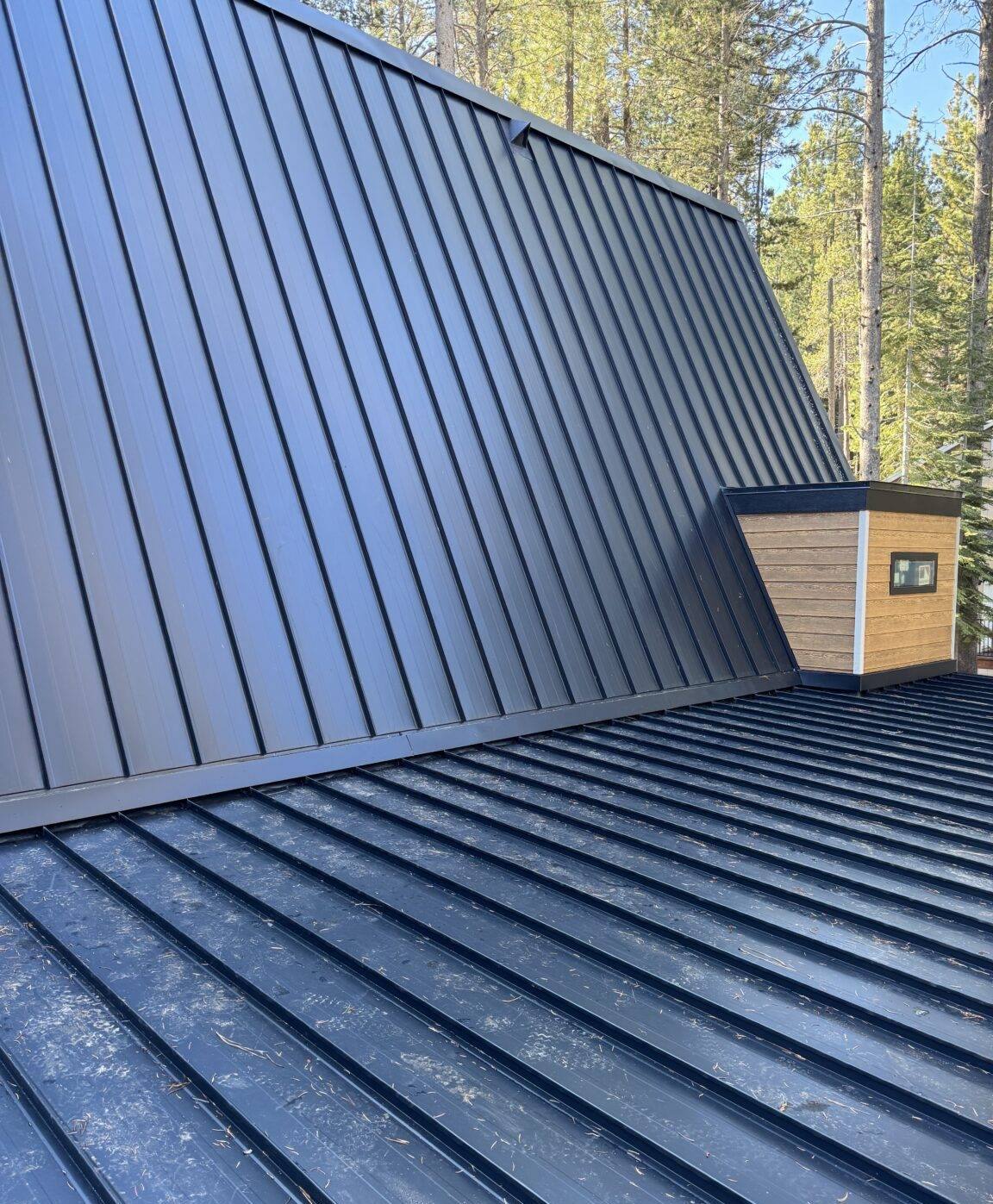
- Standing-seam and properly lapped panel systems shed wind-driven rain instead of relying on gravity alone
- A hard, smooth, sloped metal surface gives moss almost nothing to grip, and what does accumulate is easy to clear without damaging the roofing material itself
- Metal handles freeze-thaw cycling and heavy winter rain loads without the granule loss and edge curling that shortens asphalt shingle life in wet climates
None of that means metal roofing is automatically "better" for every home or every budget — it's a longer-term investment with a different maintenance profile than asphalt. We'll walk you through that trade-off honestly rather than oversell it.
Panel Types We Work With
Not all metal roofing is the same product wearing a different name. The systems suited to this climate differ mainly in seam type, exposed fasteners, and cost.
| System | How It Sheds Water | Best For | Relative Cost |
|---|---|---|---|
| Standing seam (concealed fastener) | Raised interlocking seams, no exposed screws | Homes wanting maximum wind/rain resistance and longevity | Higher |
| Exposed-fastener panel | Overlapping ribbed panels, screws through the face | Budget-conscious projects, outbuildings, garages | Lower |
| Metal shingle/shake profile | Interlocking stamped panels mimicking shingle or shake look | Homeowners wanting a traditional look with metal durability | Mid to Higher |
For primary residences in an area with this much wind-driven rain, we generally steer clients toward standing seam or a well-engineered interlocking profile. Exposed-fastener panels can still perform well, but the screws and washers become a maintenance item — they loosen and their rubber seals degrade over time, and in salt-influenced air that timeline shortens. We'll size up the trade-off with you rather than assume one answer fits every roof or every budget.
What a Correct Metal Roof Installation Involves
Deck and Underlayment
Metal roofing is only as good as what's underneath it. We check the deck for soft spots, rot, or prior water damage before anything goes down, and we use a full synthetic or self-adhered underlayment rated for the panel type — not a minimal barrier that only meets code minimums. In this climate, underlayment is the real backup layer if wind ever drives water under a seam.
Fasteners and Flashing
We use fasteners and flashing rated for coastal/marine exposure, matched to the panel metal to avoid galvanic corrosion between dissimilar metals — a detail that gets skipped more often than homeowners realize. Flashing at valleys, chimneys, skylights, and wall transitions is formed and lapped to shed wind-driven rain, not just straight-down runoff.
Ventilation
A sealed, well-insulated attic still needs to breathe. Proper intake and exhaust ventilation keeps condensation from forming under the deck, which matters even more with a metal roof since metal doesn't absorb moisture the way some other roofing materials do — trapped condensation has nowhere to go but into your framing and insulation.
Seam and Panel Layout
Panel runs are planned to minimize end laps in the path of prevailing wind-driven rain, and seams are oriented and fastened according to the manufacturer's wind-load engineering, not just laid out for convenience. This is where cutting corners shows up years later as leaks that are hard to trace back to their real cause.
Living With a Metal Roof in This Climate
Moss and Debris Management
Even though metal resists moss far better than shingles or shakes, valleys and low-slope areas can still collect needles, leaves, and organic debris that hold moisture. A yearly check and clear-out — especially heading into the wet season — keeps that debris from building up against seams and flashing.
Coating Life and Touch-Ups
Factory coatings on quality metal roofing are rated for decades, but scratches from ladders, debris, or storm impact can expose bare metal to salt-influenced air. Minor scratches should be touched up with matched coating rather than ignored, since that's the point corrosion gets a foothold.
Fastener Checks
If your roof uses an exposed-fastener system, the washers and screws are the weak point over time. We recommend a fastener check every few years so any loosening or seal degradation gets caught before it becomes a leak.
Maintenance Checklist for Aldergrove Homeowners
- Clear valleys and low-slope areas of leaves, needles, and debris at least once a year, ideally before fall rains set in
- Check flashing around chimneys, skylights, and wall transitions for lifted edges or sealant breakdown
- Look for scratches or exposed bare metal after storms and touch up coating promptly
- On exposed-fastener systems, check screws and washers periodically for looseness or cracked seals
- Keep gutters clear so water leaving the roof edge doesn't back up under drip edge flashing
- Trim overhanging branches that drop debris or hold moisture against the roof surface
Cost Factors Homeowners Should Know
| Factor | Why It Affects Price |
|---|---|
| Panel system chosen | Standing seam costs more than exposed-fastener panel, mainly in labor and material for concealed fastening |
| Roof complexity | Valleys, dormers, and multiple penetrations increase flashing work and panel cutting |
| Deck condition | Rot or soft decking found during tear-off adds repair costs before roofing can proceed |
| Coating/gauge upgrade | Heavier gauge metal and premium coatings cost more upfront but extend service life in salt air |
| Access and pitch | Steep or hard-to-access roofs take longer and require more safety setup |
We won't quote a number without seeing the roof, but we'll always explain what's driving the price so you're not guessing at where your money is going.
Why a Crew That Already Works This Area Matters
Aldergrove sits right at the border, close enough to Lynden that we treat it as part of our regular service area, not a special trip. That matters for a few practical reasons. We already know how the wind and rain patterns behave on this side of the valley and design flashing and seam layouts accordingly. We're not learning the local weather on your roof. We also carry the coastal-grade fasteners and flashing materials as standard stock rather than special-ordering them after a job starts, which keeps projects moving instead of stalling mid-install waiting on the right hardware.
Cross-border logistics for permits, inspections, and scheduling are also something we're used to navigating for homes near the crossing — we won't be figuring that out for the first time on your project. A crew that treats Aldergrove as an occasional job, rather than part of its regular territory, is more likely to default to generic details that don't hold up against this specific climate.
Get an Honest Look at Your Roof
If you're considering metal roofing for a home in Aldergrove, we're happy to come take a look, walk you through what your roof specifically needs given its slope, exposure, and condition, and give you a straight answer — including if metal isn't the right fit for your situation. The estimate is free and there's no pressure attached to it; use the form below to get started.