 Lynden Exterior
 Why Custer Homes Need a Roof Built for This Specific Climate
Custer sits close enough to the water that salt-laden air is a real, everyday factor in how a roof ages here — not just a coastal talking point. Add in the driving rain that comes through Whatcom County for much of the year, plus a moss season that runs longer here than it does further inland, and you've got a combination that will find every weak point in a roofing system within a few years. A metal roof can handle all three of these conditions extremely well, but only if it's specified and installed with this exact climate in mind. A metal roof detailed for a dry inland town isn't the same product, in practice, as one built for a home near Custer.
We work on homes throughout the Lynden area, and Custer is one of the places where we see the clearest gap between "a metal roof" and "the right metal roof." The material choice, the coating, the fastener strategy, and the flashing details all need to account for salt exposure and sustained moisture — not just wind and snow load, which is what a lot of generic roofing guidance focuses on.
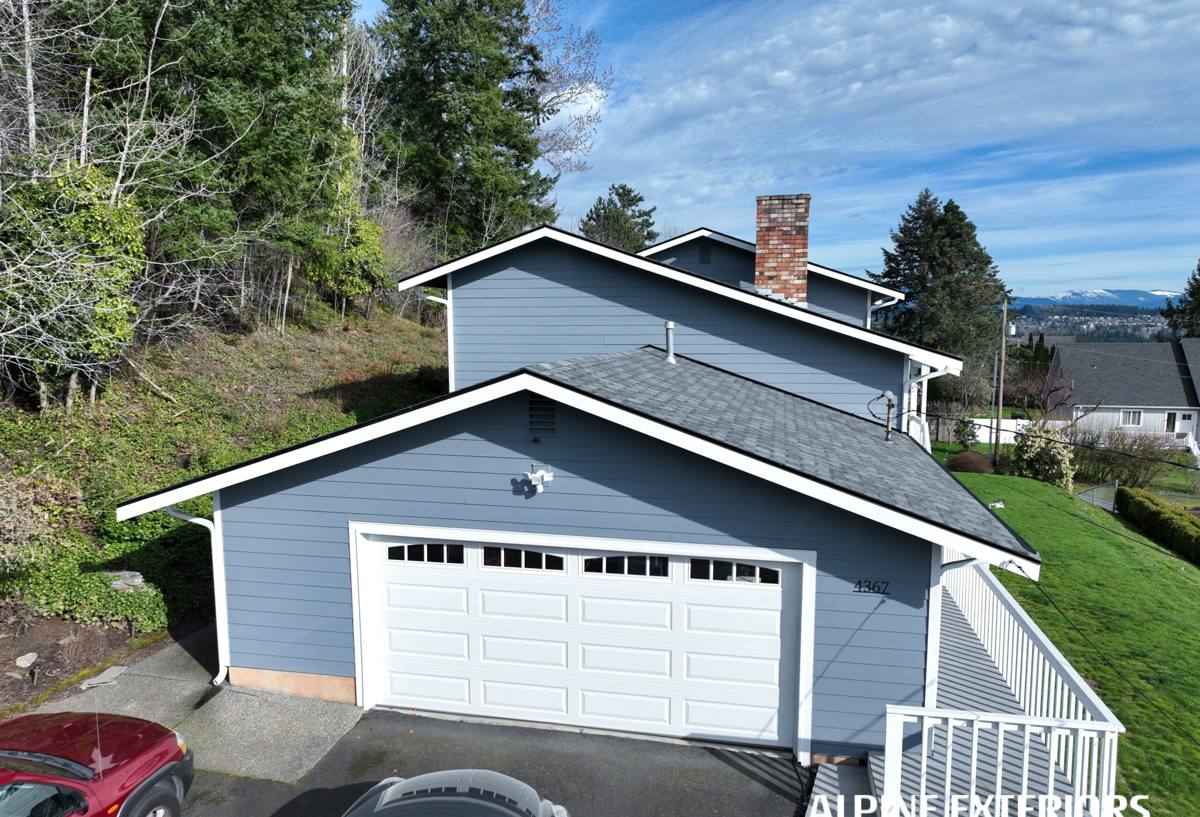
The Three Climate Factors That Actually Matter Here
Salt Air and Corrosion
Airborne salt doesn't need to be dramatic to cause damage — a steady, low-level exposure over years is what actually wears down fasteners, cut edges, and lower-grade coatings. Bare or poorly coated steel components will show rust well before the rest of the roof is due for attention. This is a metallurgy and coatings issue, not an installation-skill issue, which is why material selection matters as much as workmanship on a Custer roof.
Driving Rain
Rain that comes in at an angle, pushed by wind off the water, behaves differently than rain falling straight down. It gets forced sideways under lapped panels, around penetrations, and into any gap that a fastener or seam wasn't meant to leave. A roof system built for this needs redundant water management — underlayment and flashing that assume some water will get past the primary surface, because on enough days a year, it will.
Moss and Sustained Moisture
Whatcom County's moss season isn't a footnote — it's a stretch of many months where roof surfaces stay damp, shaded areas rarely fully dry out, and organic growth gets a real foothold if a roof doesn't shed water and debris efficiently. Moss holds moisture against the roof surface long after rain has stopped, which accelerates coating breakdown and, on non-metal roofs, encourages rot underneath.
What a Correctly Specified Metal Roof Looks Like in Custer
Material and Coating
Not all metal roofing handles salt exposure the same way. Aluminum doesn't rust the way steel can, which makes it a strong choice for homes with real coastal exposure. Steel panels can still be a good option, but they need a quality factory finish and properly coated or stainless fasteners — cutting corners here is exactly how you end up with rust streaks at every screw head within a few winters.
Fasteners and Sealants
Exposed fasteners are the most common failure point on any metal roof, and salt air makes that worse. We use fasteners rated for the coastal-adjacent conditions Custer sees, and on standing seam systems, we favor concealed-fastener designs specifically because they take the fastener heads out of the weather entirely.
Underlayment and Detailing
Given how much sustained moisture this area deals with, we don't treat underlayment as an afterthought. Valleys, eaves, and any low-slope transitions get self-adhered, ice-and-water-style membrane, not just standard felt. Every penetration — vents, chimneys, skylights — gets flashed with the assumption that wind-driven rain will test it directly.
Comparing Metal Roofing Types for a Custer Home
| System | How It Handles Salt Air | How It Handles Driving Rain | Moss Resistance |
|---|---|---|---|
| Standing seam (concealed fastener) | Best option — no exposed fastener heads to corrode | Excellent; interlocking seams shed wind-driven rain | Smooth surface, minimal moss foothold |
| Exposed-fastener panel | Fair; depends heavily on fastener quality and maintenance | Good, but fastener washers are the weak point over time | Good; still smooth but seams are more numerous |
| Stone-coated steel | Good if coating and cut edges are properly sealed | Good; profile helps shed water but has more surface texture | Fair; textured surface can trap organic debris |
Standing seam tends to be our default recommendation for homes in this area specifically because it removes the exposed-fastener weak point that salt air targets first. That said, exposed-fastener panels remain a reasonable, more budget-conscious option when they're installed with the right fastener spec and a realistic maintenance plan.
Moss, Debris, and Long-Term Roof Health
A metal roof resists moss far better than shingles or wood, but "resists" doesn't mean "immune." Debris that collects in valleys or against a chimney can hold moisture and give moss a place to start, even on a metal surface. The panel profile, valley design, and gutter sizing all affect how well a roof sheds debris on its own versus needing manual clearing.
We also pay attention to how a roof drains at slower slopes and around dormers, since these are the spots on any Custer roof where debris tends to sit longest and moss gets its best chance to establish.
Our Installation Process
- On-site assessment — we look at slope, exposure direction, existing decking condition, and drainage before recommending a system.
- Deck preparation — any soft or damaged decking gets addressed before anything goes down over it; skipping this is how good roofs fail early.
- Underlayment installation — self-adhered membrane at eaves, valleys, and penetrations, synthetic underlayment across the field.
- Panel installation — panels run and fastened to spec for the system chosen, with attention to expansion allowance on longer runs.
- Flashing and detail work — chimneys, vents, skylights, and wall transitions get individually flashed rather than relying on sealant alone.
- Final walkthrough — we go over the finished roof with the homeowner, including what routine maintenance to expect.
Maintenance Custer Homeowners Should Actually Plan For
A well-installed metal roof is low-maintenance compared to most other roofing materials, but "low" isn't "none" in this climate. A short seasonal routine goes a long way:
- Clear gutters and valleys of needles, leaves, and debris at least twice a year — more often under overhanging trees.
- Do a visual check after major windstorms for lifted flashing or debris impact.
- Rinse visible moss or algae growth early rather than letting it establish and hold moisture.
- Check fastener heads and seams during routine gutter cleaning, especially on exposed-fastener systems.
- Keep an eye on any coating fade or chalking near the coast-facing side of the roof, which shows up before structural issues do.
Why Hiring a Crew That Already Works in Custer Matters
Metal roofing done wrong doesn't fail dramatically — it fails quietly, with a rust streak here, a lifted seam there, moss creeping in at a valley nobody checks. A crew that already works this specific area knows which details matter for homes exposed to salt air and driving rain off the water, and which corners simply can't be cut here even if they'd be fine somewhere inland. We also know the local permitting process for Whatcom County and how to plan installation timing around this area's wetter stretches, so the job gets done without water sitting on an open deck.
Lynden-area homeowners are often surprised at how much the coastal exposure near Custer changes the right roofing spec compared to a home just a few miles further from the water. That's exactly the kind of judgment call that comes from working this ground regularly, not from a general roofing checklist.
What Affects Cost on a Custer Metal Roof
Every roof is priced based on its own specifics, but the main cost drivers on a metal roofing project here are consistent: total roof area and complexity (valleys, dormers, penetrations), the system chosen (standing seam runs higher than exposed-fastener panel due to material and labor), the condition of the existing deck, and how much additional flashing or underlayment work the coastal exposure calls for. Homes with more roof complexity or existing deck damage will cost more regardless of panel choice, so an accurate on-site assessment matters more than a quick square-footage estimate.
If you're weighing a metal roof for a home in or around Custer, we're happy to take a look and walk you through what your specific roof needs — no pressure, no obligation. Use the form below to request a free estimate.