 Lynden Exterior
 Nooksack's Climate Puts Real Stress on Exterior Siding
Nooksack sits in the Nooksack River valley just east of Lynden, in a part of Whatcom County where marine air off the Salish Sea funnels inland and settles. Homes here deal with a long wet season, humid air moving up the valley, and short winter days that don't give exterior walls much chance to dry out between storms. Add driving rain that comes in sideways during winter systems, salt-tinged coastal air, and a moss season that can run from October well into spring, and you get a climate that is genuinely hard on siding — harder than most manufacturers' generic warranty language accounts for.
This isn't a climate where "good enough" siding gets by for long. Wood-based products absorb moisture and swell, paint fails early under UV and damp cycling, and anything with seams or joints that aren't detailed correctly becomes an entry point for water within a few wet seasons. Siding for a Nooksack home has to manage bulk water, resist sustained dampness without breaking down, and hold its finish through repeated freeze-thaw and moss growth — year after year, not just in the showroom.
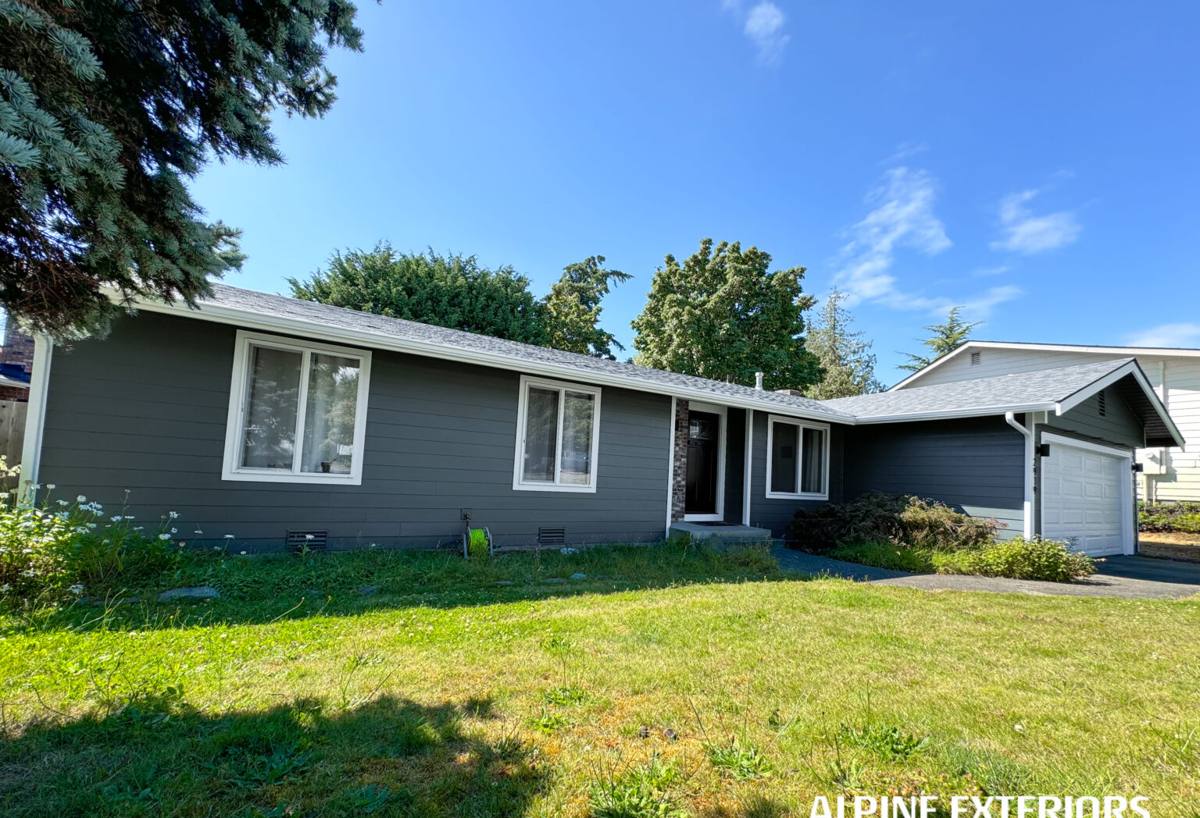
Why We Install Only James Hardie Fiber Cement
We install James Hardie fiber cement siding exclusively. We don't install vinyl, LP SmartSide, Cemplank, Allura, primed spruce, or cedar. That's a deliberate standard, not a sales preference, and it comes down to how each of those products behaves over ten, twenty, and thirty years in a climate like this one. Vinyl expands and contracts with temperature swings and can crack or warp; wood-based products need consistent maintenance to keep moisture out of their core; unfinished or field-primed materials depend entirely on paint quality and painter skill to perform. James Hardie's fiber cement formulation resists moisture intrusion, doesn't feed mold or rot the way wood-based sidings can, and is non-combustible — a real consideration given how dry Whatcom County summers have been getting, even alongside the wet winters.
Engineered for This Region: HZ5
James Hardie makes region-specific product lines called HZ (HardieZone) products, engineered for the moisture and freeze-thaw conditions of a given climate zone. Whatcom County falls in the zone that calls for HZ5, which is formulated to hold up against the sustained damp, rain, and humidity cycling typical of the Pacific Northwest. That's a meaningful difference from a generic siding product sold the same way in every state — HZ5 boards are built with this specific weather pattern in mind, not just a national average.
ColorPlus Technology and the Moss Problem
Moss and mildew staining are a fact of life on north- and shade-facing walls anywhere in Whatcom County, and Nooksack's tree cover and valley humidity make it worse than most. The factory-applied ColorPlus finish on James Hardie siding is baked on under controlled conditions and backed by its own finish warranty, which matters here for two reasons. First, a factory finish is far more uniform and durable than a field-applied paint job, which is only as good as the weather conditions and prep work on the day it went on. Second, ColorPlus finishes are formulated to resist fading and hold color integrity through repeated wet-dry cycling, which is exactly the stress moss-prone siding is under for half the year. Siding that needs repainting every five to seven years in this climate is siding you'll be paying to maintain indefinitely; a correctly installed ColorPlus finish is not.
What a Correct Installation Involves in a Wet Climate
Fiber cement siding is only as good as the installation behind it. In a climate that delivers this much rain, the difference between a siding job that lasts thirty years and one that fails at the seams in five to ten comes down to details most homeowners never see once the wall is closed up.
Flashing and Water Management
Every window, door, and roof-to-wall transition needs proper flashing integrated with a weather-resistant barrier behind the siding — not caulk used as a substitute for flashing. Water that gets behind the cladding needs a planned path back out, not a place to pool against sheathing.
Clearances and Fastening
James Hardie specifies minimum clearances from grade, roof lines, and decks, along with correct fastener type, spacing, and placement. Skipping these clearances is one of the most common shortcuts we see, and it's also one of the fastest ways to trap moisture against the bottom edge of a board in a climate that rarely lets that edge fully dry.
Joints, Gaps, and Caulking
Manufacturer-specified gaps at butt joints and trim allow the board to move without buckling, while the right sealant — used in the right place, not everywhere — keeps water out without trapping it in. Over-caulking is as much a problem as under-caulking; it can seal moisture inside a joint instead of letting it escape.
Our Process, Start to Finish
We keep the process straightforward and give you visibility at each stage:
- Walkthrough and assessment — we inspect your current siding, sheathing, and trim, and check for existing moisture damage before quoting anything.
- Written estimate — a clear scope covering tear-off, sheathing repair if needed, house wrap, flashing, siding, and trim, with the product lines and colors specified.
- Tear-off and inspection — removing old siding lets us see the sheathing condition directly, which is often the real story behind a siding failure.
- Water-resistive barrier and flashing — installed to manage bulk water before a single piece of siding goes up.
- Hardie panel or plank installation — installed to manufacturer clearance, fastening, and gapping specifications.
- Trim, caulking, and final detailing — the finish work that determines how the wall performs at every joint and penetration.
- Final walkthrough — we review the completed job with you before calling it done.
Common Problems We Find on Older Nooksack-Area Homes
When we're called out to a home in the Nooksack area with a siding complaint, a handful of issues show up repeatedly. None of these are unique to any one manufacturer or contractor — they're the predictable result of shortcuts under time pressure in a climate that doesn't forgive them.
- Siding installed tight to grade or a deck surface, with no clearance for water to drain away
- Caulk used in place of proper flashing at windows and roof-wall intersections
- Butt joints installed with no gap, causing buckling as the boards expand and contract
- Missing or degraded house wrap behind the cladding, found only once the siding comes off
- Fasteners driven at the wrong spacing or angle, loosening the board's hold over time
- Moss and organic buildup left untreated on shaded walls, holding moisture against the finish
Most of these are invisible from the ground and only show up once water has already found its way in. That's why the installation details matter more than the brand name on the product itself.
Why a Crew That Already Works Nooksack Matters
General siding knowledge and Whatcom County-specific siding knowledge are not the same thing. A crew that regularly works Nooksack, Lynden, and the surrounding valley knows how this area's rainfall totals, humidity, and shade patterns behave on real houses, not just on a spec sheet. That shows up in decisions a homeowner never sees directly: which side of the house needs extra attention to moss and shade exposure, how much clearance to leave given local rainfall intensity, and which older building practices in this area tend to cause problems down the line. Local experience also means faster response if a warranty question or a storm-related issue comes up later — you're not waiting on a crew that has to drive in from outside the county and relearn the conditions every time.
What Determines Your Project Cost
Every home is different, but the same handful of factors drive most of the cost variation we see on siding projects in this area. We don't publish fixed prices because they'd be misleading — an accurate number requires seeing the house — but this is what actually moves the estimate:
| Cost Factor | Why It Matters |
|---|---|
| Sheathing condition | Rot or moisture damage found during tear-off adds repair scope before new siding can go on |
| Home size and wall complexity | Dormers, gables, and cut-up wall lines take more labor and material than simple rectangular walls |
| Siding profile (lap, panel, shingle) | Profile and reveal size affect material cost and installation time |
| Trim and accent work | Window trim, corner boards, and fascia detail add labor beyond the flat wall area |
| Color (ColorPlus vs. field-painted) | Factory-finished ColorPlus colors cost more upfront but remove a repainting cycle down the road |
| Access and site conditions | Multi-story walls, tight lot lines, or landscaping obstacles affect staging and labor time |
Keeping Your Hardie Siding Looking Right
Correctly installed James Hardie siding needs very little upkeep compared to wood or vinyl, but a small amount of seasonal attention goes a long way in this climate:
- Rinse siding down once or twice a year, focusing on shaded or north-facing walls where moss tends to establish
- Keep gutters clear so overflow doesn't run down the wall face during heavy rain
- Trim back landscaping and tree limbs that keep a wall section shaded and damp longer than the rest of the house
- Check caulking at trim and window joints every year or two and have any cracked sealant redone before water gets behind it
- Watch for any staining or soft spots near ground level, which can indicate a clearance or drainage issue worth having looked at
If you're weighing a siding replacement for a home in Nooksack or elsewhere around Lynden, we're happy to take a look and give you a straightforward, no-pressure estimate — including an honest read on what your current siding and sheathing actually need. Use the form below to get started.