 Lynden Exterior
 Siding Built for the Abbotsford–Lynden Border Climate
Homes in and around Abbotsford, BC sit just minutes from Lynden, sharing the same weather system that rolls in off the Salish Sea and funnels up the Fraser Valley. That means the same three problems show up on siding here again and again: salt-laden marine air that corrodes fasteners and trim, driving rain that gets pushed sideways into wall assemblies during winter storms, and a moss season that runs longer than most homeowners expect because shaded, moisture-heavy siding rarely gets a chance to fully dry out between storms.
None of this is exotic weather. It's the normal cost of living in the Pacific Northwest border country. But it means siding installed to a spec written for a drier climate — or installed a little loose because "it's just siding" — tends to show problems years before it should: swollen edges, bubbling paint, black-green streaking, and soft spots where moisture found a way in and stayed.
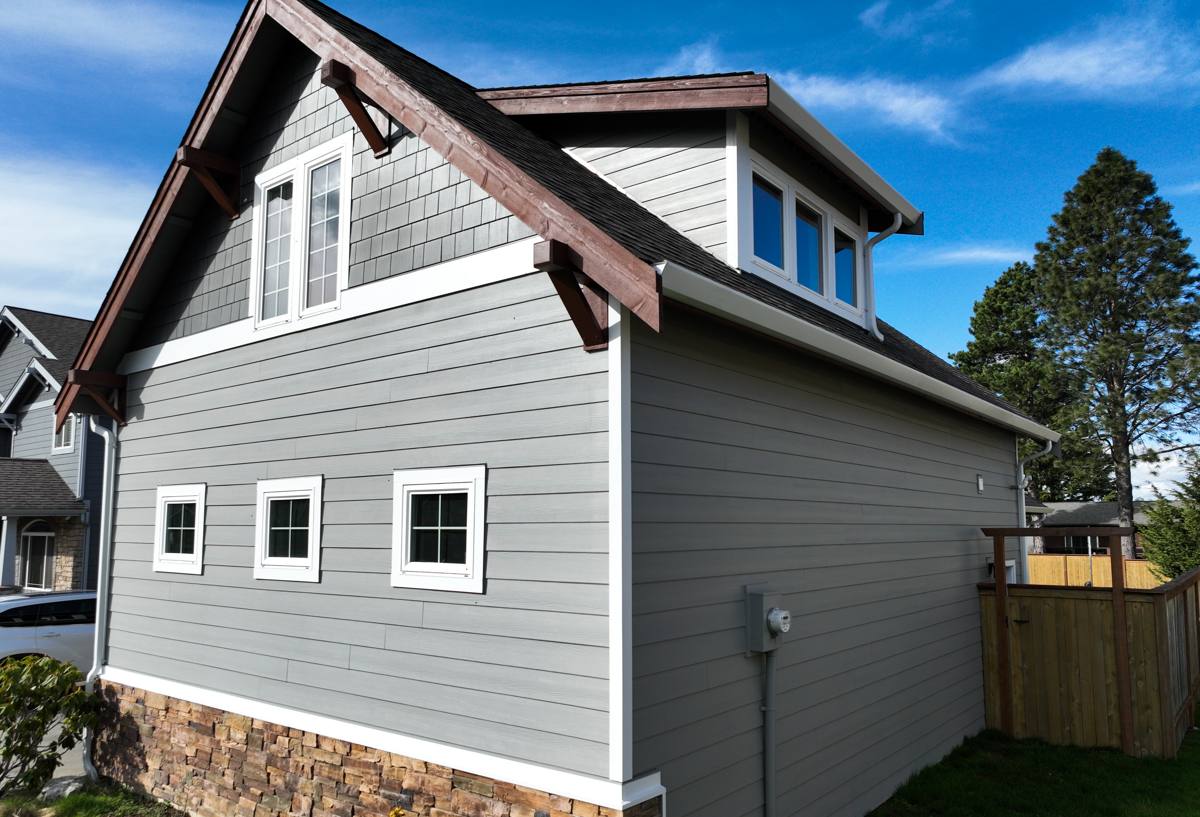
What Driving Rain and Moss Actually Do to a Wall
Driving rain isn't just rain falling harder. It's rain being pushed horizontally by wind, which means it hits siding at an angle and gets forced up under laps, around trim, and into any gap that wasn't properly flashed or caulked. On a well-built wall, that water hits a drainage plane behind the siding and runs back out. On a wall where the weather-resistive barrier was installed wrong, or flashing was skipped at a window or door, that water gets trapped against sheathing — and trapped water is what leads to rot, mold, and expensive repairs behind siding that still looks fine from the curb.
Moss adds a second layer to the problem. It doesn't just look bad — moss and algae hold moisture against the siding surface for days after a storm has passed, which is exactly the kind of prolonged dampness that breaks down products not engineered to handle it. North-facing walls, shaded elevations, and anything near overhanging trees are the areas we see it worst.
What a Correct Siding Installation Actually Involves
The Weather-Resistive Barrier
Everything starts here. A properly lapped, properly taped weather-resistive barrier is the drainage plane that carries incidental water back out of the wall assembly. Cut corners at this stage and no amount of good siding on top will fix it.
Flashing at Every Penetration
Windows, doors, hose bibs, light fixtures — anywhere something interrupts the wall plane needs proper flashing that directs water outward, not into the wall. This is the single most common failure point we find when we tear old siding off a home in this region.
Fastening and Clearances
Fiber cement siding has manufacturer-specified nailing patterns, fastener types, and minimum clearances from grade, roof lines, and decks. Skipping these to save time is how you get siding that cups, cracks at fastener points, or wicks moisture from ground contact.
Caulking and Sealant Judgment
Correct installation actually uses less caulk than a rushed job, not more — because the assembly is designed to shed water mechanically, with sealant only where the manufacturer specifies it. Heavy caulking everywhere is often a sign that the underlying flashing and lap work wasn't done right.
Why We Install Only James Hardie Fiber Cement
We get asked fairly often why we don't offer vinyl, LP SmartSide, or other engineered wood products, since they're cheaper up front and plenty of homes around here already have them. The honest answer is that we've made a professional standard out of what holds up best against this specific climate, and fiber cement is the clear winner for salt air, driving rain, and long wet seasons.
Vinyl is inexpensive and low-maintenance in mild weather, but it's a petroleum-based product that expands and contracts with temperature swings, can crack in a hard impact, and simply melts if exposed to enough heat from a nearby grill or fire pit. It doesn't offer real fire resistance, and in a wind-driven storm, loose panels are a known weak point.
Engineered wood siding like LP SmartSide performs well when installed and maintained exactly to spec, but it's still wood at its core — treated and engineered, but still vulnerable to moisture intrusion at cut edges and fastener points if caulking and paint maintenance ever lapse. In a climate with this much sustained dampness, that's a maintenance schedule we're not willing to bet a homeowner's wall assembly on.
James Hardie fiber cement is cement, sand, and cellulose fiber. It doesn't expand and contract the way vinyl does, it's non-combustible, and it's manufactured in climate-specific formulations that are engineered for exactly the moisture exposure this region deals with. It costs more than vinyl up front. It earns that back in decades of not being the thing you're replacing again in ten or fifteen years.
James Hardie Product Lines for This Climate
Hardie builds its siding in engineered climate zones — HZ5 for colder, wetter regions like the Pacific Northwest, and HZ10 for milder, drier zones. Getting the right formulation matters more than most homeowners realize.
| Product | Best Use | Why It Fits This Area |
|---|---|---|
| HardiePlank Lap Siding | Primary wall siding, most home styles | HZ5 formulation resists moisture and freeze-thaw cycling common in border-region winters |
| HardiePanel Vertical Siding | Modern facades, accent sections | Clean lines that hold up under sustained wind-driven rain |
| HardieShingle | Gable accents, Craftsman-style detailing | Textured look without the moisture vulnerability of real cedar shingle |
| HardieTrim | Corners, window and door trim, fascia | Fiber cement trim to match, avoiding wood trim rot at high-exposure edges |
All of it comes with Hardie's factory-applied ColorPlus finish, which is baked on under controlled conditions rather than field-painted. That matters here specifically because it resists the fading and moss-friendly surface breakdown that field-applied paint is more prone to in a climate this wet.
Our Installation Process
- On-site assessment — we walk the home, check current siding and sheathing condition, and note problem elevations (usually north- or west-facing walls, shaded sections, and anything near grade).
- Tear-off and sheathing check — old siding comes off and sheathing gets inspected for rot or soft spots before anything new goes on. This is where hidden moisture damage gets found and fixed, not covered up.
- Weather-resistive barrier and flashing — installed and lapped correctly at every seam, window, and door before a single piece of siding goes up.
- Hardie installation to manufacturer spec — correct fastener type, nailing pattern, and clearances from grade, decks, and rooflines.
- Trim, caulking, and final inspection — sealant applied only where specified, followed by a walk-through so you know exactly what was done and why.
Signs Your Current Siding Needs Attention
- Dark green or black streaking that comes back within weeks of cleaning
- Soft or spongy spots when you press on the siding, especially near the bottom courses
- Paint or finish that's bubbling, peeling, or chalking heavily
- Visible gaps, warping, or cupping at panel seams
- Rusted or popped fasteners leaving streaks below them
- Persistent moss growth on north-facing or shaded walls that won't stay clean
- Higher heating bills that suggest the wall assembly isn't sealing the way it used to
Cost Factors for Siding Installation in This Area
| Factor | Why It Matters Here |
|---|---|
| Home size and elevation count | More wall area and more corners/trim details means more labor and material |
| Sheathing condition | Rot or moisture damage found during tear-off adds repair scope before new siding goes on |
| Existing siding type | Removal complexity varies between vinyl, wood, and older fiber cement |
| Product line and trim selection | Lap siding, panel siding, and shingle accents price differently, as does trim detailing |
| Access and site conditions | Slopes, fencing, and tight lot lines common in established neighborhoods can affect labor time |
We won't quote a number without seeing the home, but we'll always walk you through exactly what's driving the estimate and where you have real choices versus where the climate here isn't optional.
Why a Crew That Already Works This Area Matters
Siding installed by someone unfamiliar with this specific stretch of the Whatcom County–Fraser Valley border often looks fine the day it goes up and starts showing problems within a few wet seasons — because the installer didn't account for how much moisture this climate actually pushes at a wall, or how long moss has to work on a shaded elevation before the next dry spell. A crew that works Lynden, Abbotsford, and the surrounding border communities regularly knows which elevations need extra attention on every job, not just the ones that are obviously exposed.
That familiarity also means we're not guessing at code requirements or inspection expectations on either side of the border — we know what a correct install looks like in this specific climate because we see the failures from incorrect ones on a regular basis.
If your siding is showing its age or you're planning ahead for a replacement, we're happy to take a look and walk you through what your home actually needs — no pressure, no obligation. Fill out the form below and we'll set up a free estimate.