 Lynden Exterior
 Siding Repair, Sized to What Birch Bay Actually Deals With
Birch Bay sits right on the water, and that location changes what "siding repair" actually means out here compared to a few miles inland. Homes get a steady dose of salt-laden marine air off the bay, wind-driven rain that hits walls sideways instead of straight down, and a moss and mildew season that can run most of the year on shaded or north-facing walls. Siding damage that would take a decade to develop in a sheltered inland location can show up in half that time on a waterfront-exposed wall, and a repair that only addresses what's visible on the surface tends to come back within a season or two.
This page is specifically about siding repair for Birch Bay homes — not a full exterior overview, and not a pitch for a whole-house replacement you may not need. Plenty of siding problems out here are legitimately fixable without tearing off a whole wall. The goal is diagnosing what's actually happening behind the damaged section, fixing that correctly, and being honest with you about the cases where a patch repair isn't the right call.
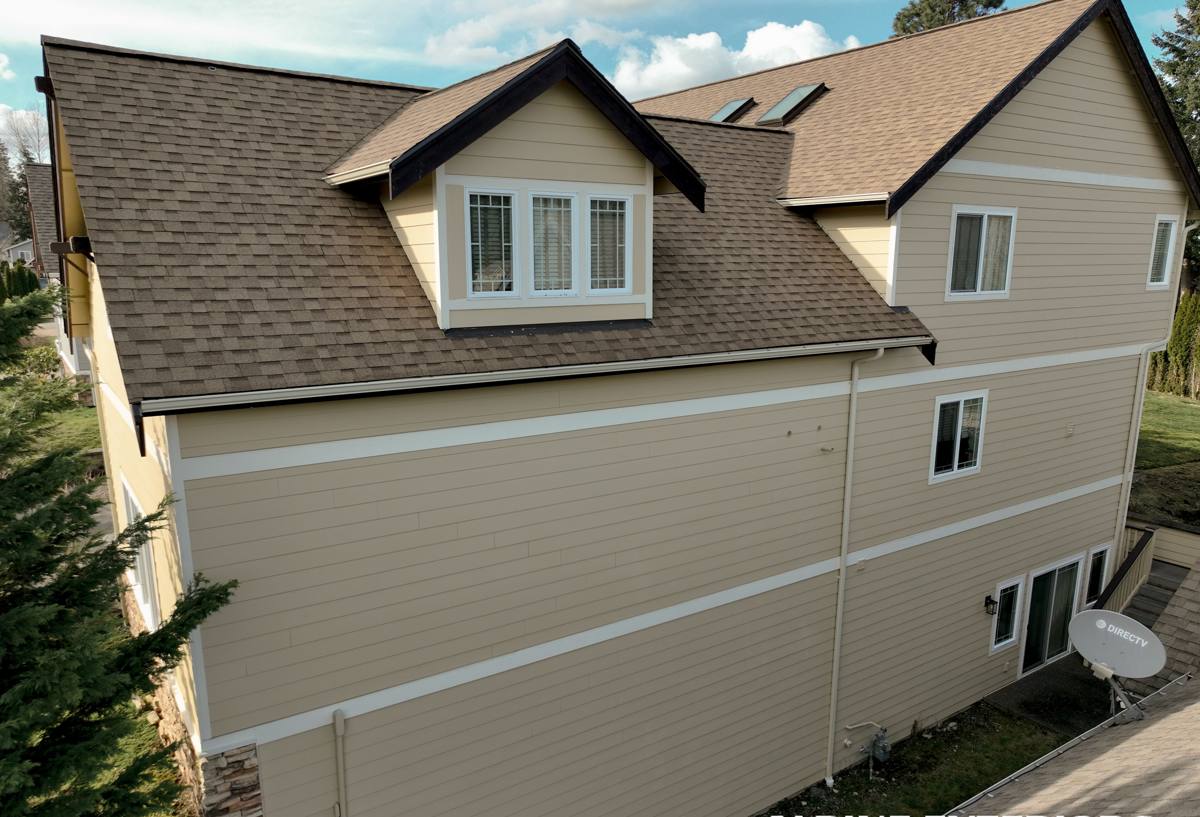
What Birch Bay's Climate Does to Siding Specifically
Salt Air and Direct Water Exposure
Being on the bay means more direct salt exposure than most of Whatcom County sees. Salt accelerates corrosion on fasteners, trim hardware, and flashing, and it breaks down lower-quality paint and caulk faster than a drier climate would. A repair that uses the wrong fastener grade or a caulk that isn't rated for this kind of exposure can fail again within a year or two, even if the visible damage looked minor.
Driving Rain That Hits Walls Sideways
Wind off the water pushes rain sideways into wall assemblies, not just straight down onto roof planes. That matters for repair work because the visible damage — a cracked board, a stained seam, a soft spot — is often just the exit point for water that got in somewhere else, at a window edge or a lapped joint upstream. Repairing the visible spot without tracing where the water actually entered is one of the most common ways a "fixed" repair fails again.
A Long Moss and Mildew Season
Mild temperatures, shade, and near-constant moisture add up to a moss season that can run close to year-round on shaded walls. Moss and mildew growth on siding isn't just cosmetic — it holds moisture against the surface, and on porous or already-compromised siding that constant dampness accelerates rot and finish failure underneath the growth. A repair job that cleans the surface without addressing what's letting moisture linger there tends to see the same staining return within a season.
Signs a Birch Bay Home Needs Siding Repair
Some of these are urgent, some can wait for a scheduled visit, but all of them are worth a professional look rather than a guess:
- Cracked, split, or buckled boards or panels, especially after a windstorm off the water
- Soft or spongy siding when pressed, particularly low on the wall or around window and door trim
- Rust staining bleeding down from fasteners or trim hardware
- Moss or dark staining that returns quickly after cleaning, especially on shaded, north-facing walls
- Gaps, warping, or separated seams at panel joints and corner trim
- Peeling paint or chalking finish on wood-based or engineered wood siding
- Musty smells or staining on interior walls that back up to exterior siding
- Visible daylight or drafts around siding penetrations for vents, spigots, or fixtures
What a Correct Siding Repair Actually Involves
Diagnosing the Real Cause First
The first job on any repair call is figuring out why the damage happened, not just what it looks like. A cracked board might be impact damage with no deeper issue, or it might be a symptom of trapped moisture that's been working on the substrate for a while. Those two situations get very different repairs, and treating one like the other either wastes money on unnecessary work or leaves a real problem in the wall.
Checking What's Behind the Damaged Section
Once damaged siding comes off, we look at the weather-resistive barrier, flashing, and sheathing underneath before anything new goes up. In a climate with this much wind-driven rain, it's common to find that the visible damage is downstream of a flashing gap or a torn house wrap a foot or two away. Covering that back up with a fresh piece of siding hides the actual problem instead of fixing it.
Matching Material, Profile, and Finish
Repairs on James Hardie siding are more straightforward to match than repairs on many other materials, since Hardie's ColorPlus finish is factory-applied to a documented color line and the plank profiles are standardized. Repairs on older wood, vinyl, or engineered wood siding are harder to match exactly, especially once the surrounding material has weathered or faded unevenly — that's a real limitation of patch-repairing those products that's worth knowing about before deciding how to proceed.
Correct Fastening and Clearances
A repaired section needs the same attention to fastener spacing, grade clearance, and joint detailing as new installation. Repairs that get rushed on these details — over-driven fasteners, panels set too close to grade or a roofline, joints that aren't properly lapped or sealed — tend to fail again faster than the original damage took to develop, which defeats the point of repairing instead of replacing.
Repair vs. Replacement: How We Make That Call
| Situation | Repair Usually Makes Sense | Replacement Is Usually the Better Call |
|---|---|---|
| Extent of damage | Isolated to a few boards or one wall section | Spread across multiple walls or a large percentage of the total siding |
| Cause of damage | Impact damage, a single flashing failure, storm damage | Widespread moisture intrusion, systemic installation errors from the original job |
| Siding age and material | Newer siding, or Hardie fiber cement with an easy color/profile match | Siding near or past its expected service life, or a material that can't be matched well |
| Sheathing condition | Sheathing underneath is sound once exposed | Rot or moisture damage found in the sheathing during tear-off |
| Cost over time | Repair cost is a small fraction of full replacement | Repeated repairs are adding up to a meaningful share of a full replacement |
We'll tell you plainly which side of that table your situation falls on. If a repair genuinely solves the problem, that's what we recommend — there's no reason to sell a homeowner a full replacement for damage that a correct, well-diagnosed repair will fix.
When Replacement Is the Better Call, We Only Install James Hardie
If a repair assessment turns up damage extensive enough that replacement is the honest recommendation — or if the existing material can't be repaired to a standard we're willing to stand behind — we install James Hardie fiber cement exclusively for that replacement work. That's not an upsell tacked onto a repair visit; it's a professional standard we've settled on after years of repairing exterior systems in exactly this kind of coastal, wet climate.
- Non-combustible core: Fiber cement doesn't feed a fire the way wood-based siding can.
- Factory-applied ColorPlus finish: Baked on under controlled conditions rather than brushed on in the field, which is also what makes future repairs easier to color-match.
- Climate-engineered HZ5 line: Built for regions with heavy moisture exposure and freeze-thaw cycling, which describes waterfront Whatcom County well.
- Dimensional stability: Doesn't swell, warp, or cup the way engineered wood can after repeated wetting cycles.
- Strong transferable warranty: Backed by Hardie provided the installation follows their published spec.
We won't install LP SmartSide, vinyl siding, Cemplank, Allura, primed spruce, or cedar as a replacement material. Each has a place in the market and homeowners who are satisfied with them. Our position is a professional one: on a shoreline exposure like Birch Bay, we'd rather replace failing sections with a system we fully stand behind than patch in a material that's likely to need the same repair call again in a few years.
Our Siding Repair Process
On-Site Assessment
We walk the affected area and look beyond just the visible damage — checking nearby trim, flashing, and joints for related issues, since problems in this climate rarely stay isolated to one spot for long.
Written Scope and Estimate
You get a clear explanation of what we found, what caused it, and what the repair involves, along with a written estimate before any work starts. If we think replacement is the better call for part or all of the affected area, we'll say so and explain why.
The Repair
Damaged material comes off, the substrate and flashing underneath get checked and corrected if needed, and new material goes in with the same fastening, clearance, and sealing standards as new construction.
Handling Hidden Damage
If we find sheathing rot or a flashing problem once we're into the wall that wasn't visible from the outside, we'll stop and talk through it with you before proceeding rather than quietly expanding the scope or covering it back up.
Follow-Up
We walk the finished repair with you, confirm it matches what was discussed, and go over what to watch for going forward given how this specific property's exposure and shading affect it.
What Affects the Cost of a Siding Repair in Birch Bay
| Factor | Why It Matters |
|---|---|
| Size of the affected area | A single board or corner costs far less to correct than damage spread across a wall |
| Root cause found behind the siding | A straightforward board swap costs less than a repair that also involves flashing or house wrap correction |
| Sheathing condition | Rot found during tear-off adds material and labor beyond the original visible repair |
| Material match | Matching existing Hardie ColorPlus is usually simpler than matching aged wood, vinyl, or engineered wood siding |
| Access and wall height | Second-story or hard-to-access sections take more setup time than ground-level walls |
Exact numbers depend on what we find once we're actually looking at the damage, which is why we walk the property before giving a real number rather than quoting sight-unseen.
Why a Crew That Already Works Birch Bay Matters for Repair Work
Siding repair is diagnostic work as much as it is construction work, and that diagnosis gets more accurate with local experience. A crew that's already done repair calls on this stretch of coastline knows that water damage on a waterside wall behaves differently than damage on a tree-sheltered inland lot, knows which fastener grades hold up against this level of salt exposure, and knows how far a single flashing failure tends to travel before it shows up as visible siding damage. That familiarity is what separates a repair that actually solves the problem from one that just covers it up until the next storm season. It also means if a question comes up after the repair — a warranty issue, a new spot of staining, a follow-up question about maintenance — it's a call to a crew that's still working in the area and already knows the property.
If your Birch Bay home has siding damage, storm impact, or staining that keeps coming back, we're glad to take a look and give you an honest read on what it actually needs — repair or replacement, no upselling either direction. Reach out using the form below for a free, no-pressure estimate.