 Lynden Exterior
 Building Decks for Birch Bay's Marine Climate
Birch Bay sits close enough to the water that homes here deal with a different set of conditions than a deck built a few miles inland in Lynden. Wind off the bay carries salt spray onto siding, railings, and fasteners. Rain comes in sideways more often than it falls straight down. And because so many lots have mature trees or sit in the shade of neighboring homes, moss and algae get a long, uninterrupted season to take hold on any horizontal surface that stays damp. A deck built to a generic spec sheet, without accounting for any of that, tends to show its age in the first few winters — loose fasteners, dark streaking, soft spots at the ledger board, and boards that stay slick well into spring.
A custom deck project for Birch Bay isn't about a fancier design. It's about material choices, fastener grades, drainage details, and attachment methods that are picked specifically because of what this stretch of Whatcom County throws at a structure year-round.
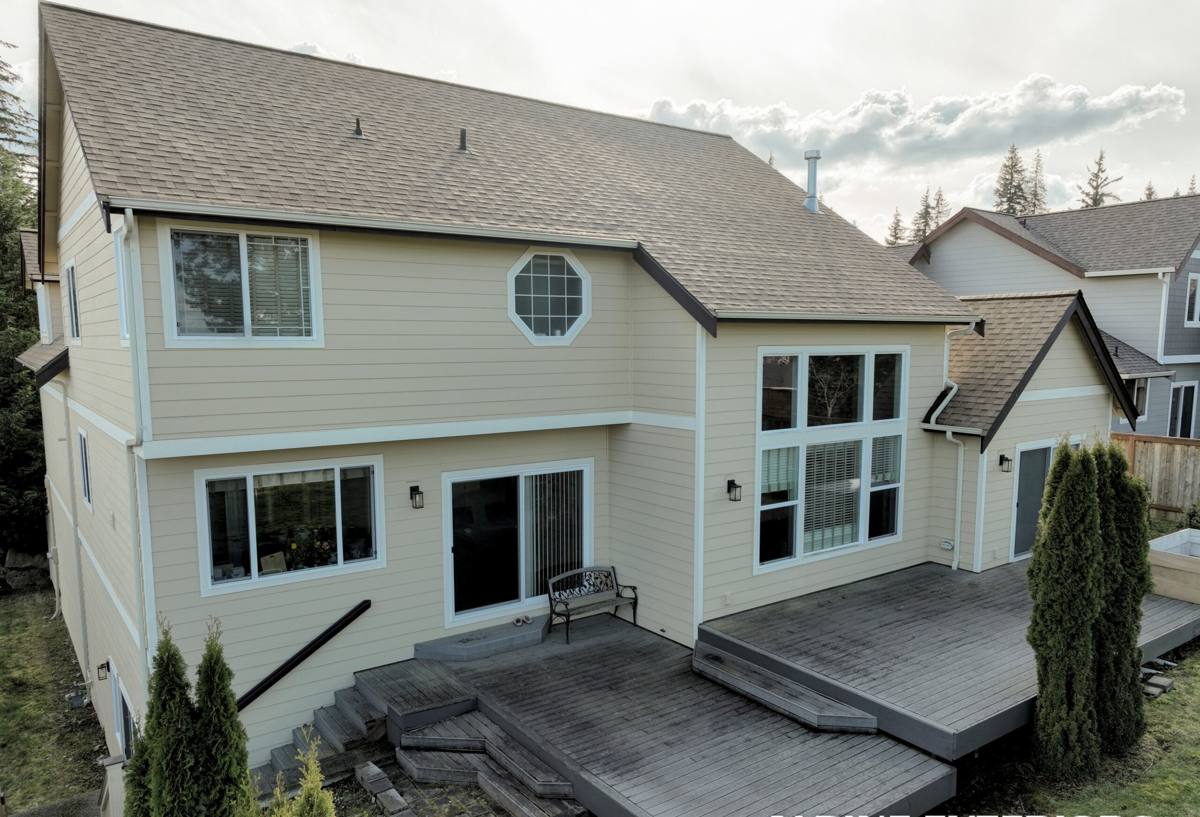
What Salt Air Does to an Ordinary Deck
Hardware Corrosion
Salt-laden air accelerates corrosion on anything metal — screws, joist hangers, post bases, railing brackets. Standard electro-galvanized fasteners can start showing rust bleed within a couple of seasons in a marine-influenced environment, and once a fastener starts to corrode, it loses holding strength long before it looks obviously bad. That's a structural concern, not just a cosmetic one, especially at load-bearing connections like ledger bolts and post-to-beam hardware.
Finish and Fiber Breakdown
Salt air also speeds up UV and moisture breakdown on wood finishes and some composite capstocks, particularly on the side of a deck that faces the prevailing wind off the water. Paired with driving rain that drives moisture into end grain and fastener holes, an unprotected or poorly sealed deck ages faster here than the same deck would 20 miles inland.
Moss, Moisture, and the Rot Clock
Whatcom County's long wet season means any deck surface that doesn't shed water and dry out between rain events becomes a moss and algae host. On shaded Birch Bay lots, that season can stretch nearly year-round. Moss itself isn't just unsightly — it holds moisture against the board surface, which is exactly the condition that leads to rot in real wood and premature capstock failure in some composites.
Correct deck-building addresses this at the framing stage, not with a pressure washer after the fact:
- Board spacing sized for drainage, not just appearance
- Joist tape or a moisture barrier on top of framing members to stop water from wicking into end grain
- Airflow underneath the deck so the structure can actually dry between storms
- Ledger and rim joist flashing detailed to shed water away from the house, not toward it
- Fastener placement and countersinking that doesn't trap standing water in screw heads
Choosing the Right Decking Material
There's no single "correct" decking material for Birch Bay — the right call depends on how much sun exposure the deck gets, how close it sits to salt spray, and how much upkeep the homeowner actually wants to do. Here's how the common options stack up under these specific conditions.
| Material | Salt/Moisture Behavior | Moss & Algae Resistance | Ongoing Maintenance |
|---|---|---|---|
| Pressure-treated wood | Good if properly sealed and re-sealed; end grain is the weak point | Needs regular cleaning and re-sealing to resist buildup | Highest — annual inspection and periodic refinishing |
| Cedar or other natural wood | Naturally rot-resistant but still needs sealing near salt exposure | Moderate; darkens and holds moisture if not maintained | Moderate to high — finish maintenance matters |
| Composite decking | Very good; doesn't absorb moisture like wood | Better, though shaded boards still need periodic cleaning | Low — occasional washing, no sealing |
| PVC decking | Excellent; fully moisture-resistant material | Best of the group in consistently shaded, damp spots | Lowest — cleaning only |
We'll walk through this trade-off honestly during the design conversation rather than steering everyone to the same product. A well-built wood deck that's sealed and maintained on schedule can perform fine here; it just asks more of the homeowner over time than composite or PVC does.
Framing and Fasteners Built for Coastal Exposure
The framing and fastening choices matter more than the decking material in terms of how long the structure lasts. For Birch Bay projects, our standard is to use stainless steel or hot-dip galvanized hardware rated for coastal or ACQ-treated lumber contact at every structural connection — joist hangers, post bases, ledger bolts, and structural screws — rather than the lighter-duty coated fasteners that are fine in a drier, inland setting but corrode faster here.
Ledger board attachment gets particular attention. This is the connection point between the deck and the house, and it's the single most common source of deck failure nationwide when it's flashed poorly — water gets behind the ledger, the rim joist or sheathing rots from the inside, and the problem stays hidden until the deck starts to sag or pull away from the house. We flash this connection to shed water away from the wall assembly, not just seal it and hope, and we check that the existing wall covering and moisture barrier are actually intact before attaching anything to them.
Our Custom Deck-Building Process
Site and Design Evaluation
Every Birch Bay deck starts with a look at the specific lot: how much wind and salt exposure the site gets, how much shade the deck footprint will sit in through the year, existing drainage patterns, and soil conditions for footing depth. Whatcom County's frost depth and soil requirements factor into footing design, and coastal lots sometimes need deeper or differently placed footings depending on soil composition near the water.
Permitting
Most new decks and many significant deck replacements require a permit through the applicable local jurisdiction. We handle that process as part of the project rather than leaving it to the homeowner, and we build to the approved plan and inspection schedule rather than cutting corners to avoid a callback.
Construction Sequence
Footings and posts go in first, sized to the load and soil conditions on site. Framing follows, with joist tape and flashing details built in as the structure goes up rather than added afterward. Decking, railings, and stairs are the last stage, and that's also when final fastener spacing and drainage gaps get set. We inspect our own work at each stage before moving to the next, and we're available for the required inspections along the way.
Railings, Stairs, and Hardware That Hold Up
Railings and stair hardware take a disproportionate amount of the wear on a coastal deck because they're the parts most exposed to blowing salt spray and hand contact. A few things we check on every Birch Bay project before calling it finished:
- All railing brackets and post connections are stainless or coastal-rated hardware, not standard interior-grade fasteners
- Stair stringers are sized and fastened to code, with corrosion-resistant connectors at each stringer-to-frame connection
- Baluster spacing meets current code requirements for the jurisdiction
- Any embedded post bases have positive drainage so water doesn't pool at the base and wick into the post
- Cap rail and top connections are sealed or capped to keep water out of end grain
Realistic Maintenance for a Birch Bay Deck
No deck here is maintenance-free, even the low-upkeep materials. What changes by material is how much and how often. A wood deck near the water benefits from an annual inspection of fasteners and finish, with resealing on the schedule the finish manufacturer recommends — often more frequently than the same product would need inland. Composite and PVC decking mainly need periodic washing to keep moss and algae from establishing, particularly in shaded corners that stay damp longest. On every material, keeping gutters and downspouts directed away from the deck structure, and keeping nearby vegetation trimmed back so the deck gets some airflow and light, does more to extend its life than any single product choice.
Why Hiring a Crew That Already Works Birch Bay Matters
A contractor who mostly builds decks in drier inland settings can still build a structurally sound deck — but the details that matter here are easy to under-spec if you don't build in this specific environment regularly. Fastener grade, ledger flashing, drainage detailing, and footing depth all get judgment calls that a crew familiar with Birch Bay's soil, wind exposure, and moss season has already made correctly many times over. That familiarity also extends to the permitting process for this part of Whatcom County, which saves time and avoids the back-and-forth that comes from an unfamiliar submission.
If you're planning a new deck or replacing one that's showing its age, we're happy to come take a look at your specific site, talk through material trade-offs honestly, and put together a plan that accounts for what your lot actually faces. Reach out for a free, no-pressure estimate using the form below.