 Lynden Exterior
 Why Birch Bay's Waterfront Setting Changes How a Deck Should Be Built
Birch Bay sits close enough to saltwater that a deck built there faces a different set of conditions than one built a few miles inland. Salt-laden air, wind-driven rain off the water, and Whatcom County's long stretch of wet, low-sun months all work on a deck's structure and surface at the same time. A deck that would hold up fine in a drier, more sheltered part of the county can start showing corrosion, soft spots, or slick moss growth within a couple of seasons in Birch Bay if it wasn't built with those specific conditions in mind.
None of this means a deck can't be built well here — it means the material choices, fastener selection, and drainage details all need to be picked for a coastal environment rather than a generic one. That's the difference between a deck that needs real attention every few years and one that just quietly holds up.
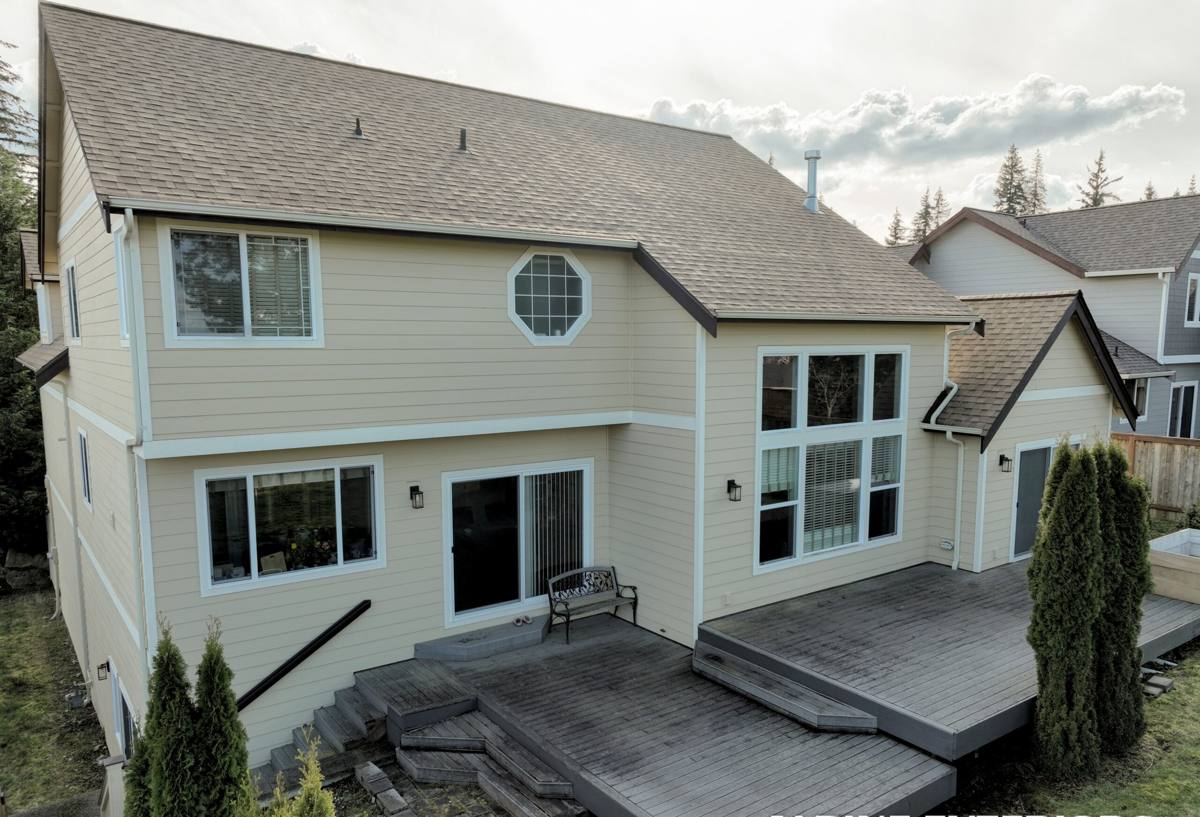
What Salt Air Actually Does to a Deck Over Time
Salt air doesn't just affect boats and metal railings near the shoreline — it settles on every exposed surface of a deck, including fasteners, connectors, and any exposed metal hardware. Over time, that salt exposure speeds up corrosion in standard-grade screws, nails, and joist hangers, sometimes years before a homeowner would expect it based on the manufacturer's general life expectancy. Corroded fasteners are one of the most common hidden problems we find on older decks near the water — the boards can look fine on top while the connections holding them together are quietly failing underneath.
Wood surfaces also weather differently in salt air. It tends to pull moisture out of the wood grain unevenly, which can accelerate checking and splitting on some boards while others age normally. This is one of the reasons material selection and fastener grade matter more here than they would on a deck built ten or fifteen miles from the water.
Choosing Decking Material for a Birch Bay Property
There's no single "correct" decking material for every home — it depends on budget, how much upkeep you want to take on, and how exposed the deck is to wind and salt spray. Here's how the common options generally compare in a coastal Whatcom County setting:
| Material | Moisture & Salt Air Behavior | Maintenance | Typical Lifespan |
|---|---|---|---|
| Pressure-treated lumber | Good if properly sealed; exposed cut ends are vulnerable | Needs re-staining/sealing every 2-3 years in coastal exposure | 15-20 years with upkeep |
| Cedar | Naturally decay-resistant but softer, can gray and check faster near salt air | Regular sealing recommended; more attention than treated lumber | 15-20 years with upkeep |
| Composite decking | Doesn't absorb moisture the way wood does; handles salt exposure well | Occasional cleaning, no staining or sealing | 25-30+ years |
| PVC/capped decking | Fully moisture-resistant surface, best resistance to salt and standing water | Lowest maintenance of the group | 25-30+ years |
Composite and capped PVC products generally cost more up front than pressure-treated lumber, but for a deck that's going to sit in salt air and long wet winters, the reduced maintenance and moisture resistance often make the difference over the life of the deck. We're honest with homeowners about that trade-off — wood decks can absolutely work in Birch Bay, they just need a homeowner willing to keep up with sealing on a real schedule.
Framing and Fasteners: The Part Nobody Sees But Everyone Regrets Skipping
The framing underneath a deck does all the structural work, and it's the part most likely to be under-specified on a coastal build. For Birch Bay projects we use hardware rated for corrosive and coastal exposure — stainless steel or heavy hot-dip galvanized fasteners and connectors rather than standard-grade hardware — because standard fasteners are exactly what tends to corrode first in salt air. The same goes for joist hangers, post bases, and any structural screws.
It's an easy detail to skip because it doesn't show on the finished deck, and it doesn't cost much less to cut that corner. But it's the single biggest factor in whether a deck's structure holds up quietly for decades or needs framing repairs within ten years.
Framing details worth asking about
- Fastener and connector grade rated for coastal or corrosive exposure
- Joist spacing appropriate to the decking material and expected snow/wind load
- Post bases set to keep wood posts off standing water
- Beam and ledger sizing matched to the actual span, not just "what's typical"
Drainage, Ledger Attachment, and Moisture Management
Whatcom County gets long stretches of steady rain, and on a waterfront-adjacent property like Birch Bay, wind-driven rain can hit a deck from angles a more sheltered inland deck rarely sees. Two details matter most here: how the deck attaches to the house, and how water moves off and through the structure once it's built.
The ledger board — where the deck attaches to the house — has to be flashed correctly so water is directed away from the house framing rather than trapped behind the ledger. A poorly flashed ledger is one of the most common sources of hidden rot on older decks, and it's a problem that can go unnoticed for years because it's happening behind the decking boards, not on top of them. Proper joist spacing and gapping between boards also matters more here than in a dry climate, since it affects how quickly the deck surface sheds water and dries out between storms.
Moss, Algae, and Surface Maintenance in a Long Wet Season
Anyone who's lived in Whatcom County through a full winter knows moss doesn't need much encouragement. On a deck, moss and algae growth isn't just a cosmetic issue — a mossy, algae-covered surface gets slick fast and becomes a real slip hazard, especially on stairs. It also holds moisture against the decking surface longer than a clean one would, which shortens the life of wood decking in particular.
Board spacing, surface texture, and how much shade and airflow a deck gets all affect how quickly moss takes hold. A deck built under heavy tree cover with tight board spacing in a low-airflow spot will need more frequent cleaning than one with better exposure to sun and wind. We take that into account when planning layout and orientation, but no deck design fully eliminates moss season in this part of the county — regular cleaning is still part of ownership here.
Permitting and Local Building Requirements
Deck projects in Whatcom County typically require a building permit once the deck exceeds a certain height or size, and there are setback and structural requirements to account for depending on the property. Waterfront and near-waterfront properties can also carry additional shoreline or critical-area considerations depending on the specific parcel. We handle the permitting process as part of the job, but it's worth knowing upfront that a legitimate deck build in this area isn't a weekend permit-free project — it's a code-reviewed structure, and that's a good thing for a deck that has to hold up to coastal weather.
Our Process for a Birch Bay Deck Build
We approach every Birch Bay deck project the same structured way, adjusted for the specific site conditions of that property:
- On-site assessment of sun, wind, and water exposure for that specific lot
- Material recommendation based on budget, maintenance preference, and exposure level
- Structural design sized to the actual span and load, not a generic template
- Coastal-rated fasteners and connectors throughout the framing
- Proper ledger flashing and drainage planning before decking goes down
- Permit handling through the appropriate local process
- Final walkthrough covering maintenance expectations specific to the material chosen
Why Local Experience in Birch Bay Matters
A crew that's worked in and around Lynden and out toward Birch Bay has already seen how these conditions play out over time — which fastener grades actually hold up, which decking products handle the salt air well, and where moisture problems tend to show up first on a coastal-adjacent build. That's different from applying a standard inland deck spec to a waterfront property and hoping it holds. Building for Birch Bay's climate from the start costs less than fixing a deck that was built for the wrong conditions five years in.
If you're planning a new deck or replacing an aging one in Birch Bay, we're happy to take a look at your property and put together a free, no-pressure estimate — just fill out the form below.