 Lynden Exterior
 Blaine's Coastline Puts Extra Demands on Exterior Walls
Blaine sits right on the water, with Semiahmoo Bay, Drayton Harbor, and Boundary Bay all within a few minutes of most neighborhoods. That waterfront setting is part of why people love living here, but it also means homes take a different kind of weather beating than a house fifteen minutes inland in Lynden. Salt-laden air off the Strait of Georgia, wind-driven rain rolling in off the water, and a moss season that can run eight or nine months out of the year all work on exterior siding at the same time. Most siding products are rated for average conditions, not this combination, and it shows up as premature failure long before the "expected" lifespan on the label.
This page is about one thing specifically: what it takes to install James Hardie fiber cement siding correctly on a home in Blaine, given what this stretch of coastline actually does to a wall system over the years.
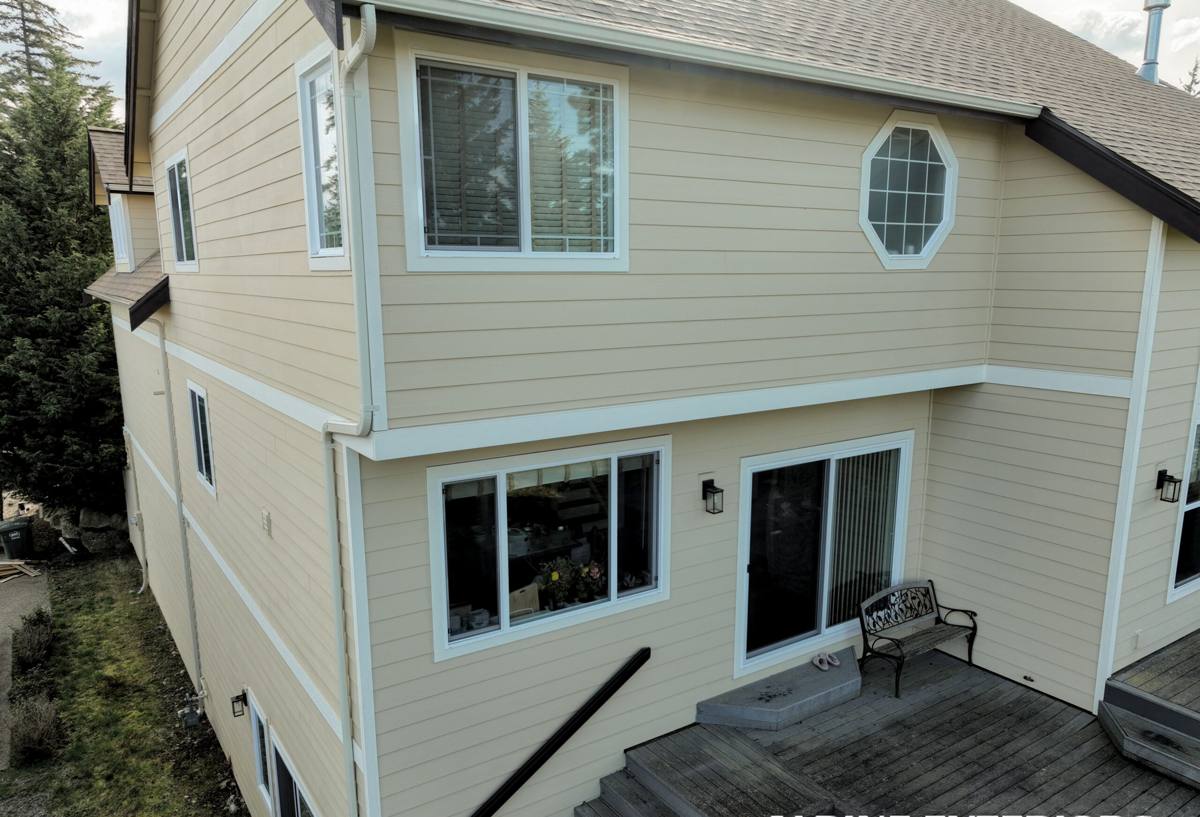
What Salt Air, Driving Rain, and Moss Actually Do to a Wall
Salt Air and Exposed Metal
Salt in the air accelerates corrosion on anything metal — exposed nail heads, unsealed flashing seams, trim fasteners. On a lot of siding jobs, those small metal points are the first thing to fail. Once a fastener starts to rust and back out, or a flashing seam starts to weep, water finds its way behind the cladding, and the damage from that point on happens where you can't see it until it's serious.
Wind-Driven Rain
Storms coming off the water don't just drop rain straight down — they push it sideways into the wall. Siding that isn't lapped, caulked, and flashed to spec will let that wind-driven rain behind the panel, especially around window and door openings and anywhere two materials meet. Wood-based sidings swell and start to rot in those spots. Vinyl can bow or pop loose at the seams under sustained wind pressure. The wall assembly behind the siding — the weather-resistive barrier, the flashing, the drainage path — matters as much as the siding itself.
Moss and Trapped Moisture
Shaded, north- and west-facing walls near mature trees or hedges stay damp for weeks at a stretch through the fall and winter. That constant dampness is exactly what moss and algae need to take hold, and once it's established it holds even more moisture directly against the siding surface. On products with any wood content, that's a slow rot cycle. On any siding, it usually means periodic power-washing to knock the growth back — and repeated washing is hard on a painted or lower-grade factory finish, leading to a fade-and-repaint cycle that never really ends.
Why We Only Install James Hardie in This Climate
James Hardie siding is a fiber cement product — cement, sand, and cellulose fiber, cured into a dense, stable board. It doesn't absorb and swell with moisture the way wood-based sidings do, and there's no wood content for rot to establish in. That matters directly for the driving-rain and moss issues above.
Hardie also engineers its products by climate zone. The HZ5 formulation is built specifically for regions with heavy moisture exposure and freeze-thaw cycling — which is the Pacific Northwest coast, including Blaine and the rest of Whatcom County. It's a different engineering target than the HZ10 formulation used in hot, dry regions, and using the correct HZ designation for this climate is not optional if you want the product to perform as designed.
The other piece is ColorPlus Technology, Hardie's factory-applied finish. It's a baked-on, multi-coat finish applied under controlled conditions, and it's formulated to resist fading and hold up to the repeated washing that moss removal requires here — without the recurring paint cycle that field-painted or primed siding eventually needs. For a home that's going to get washed for moss more than once a decade, that's a real practical difference, not a marketing point.
What a Correct Hardie Install Looks Like on a Blaine Home
The product is only half the equation. A lot of the failures we get called out to inspect on other homes aren't a materials problem — they're an installation shortcut that didn't matter in a drier climate but matters a great deal fifty yards from salt water.
| Installation Detail | Why It Matters in Blaine | Shortcut We Won't Take |
|---|---|---|
| Rainscreen / drainage gap behind panels | Lets wind-driven rain that gets past the siding drain and dry out instead of sitting against the sheathing | Installing panels tight to the weather barrier with no drainage path |
| Fastener type and spacing | Corrosion-resistant fasteners at the manufacturer's spacing hold through salt exposure and wind loads | Standard fasteners or wider spacing to save time |
| Clearances from grade, roofs, and decks | Keeps the bottom edge of the siding out of standing water and splash-back | Siding run down close to grade or a deck surface |
| Cut-edge sealing | Factory finish doesn't extend to a field cut; unsealed cut edges are where moisture gets in first | Leaving field cuts unprimed or uncaulked |
| Flashing at windows, doors, and penetrations | These are the highest-pressure points for wind-driven rain intrusion | Relying on caulk alone instead of proper flashing |
| Expansion gaps at joints | Fiber cement moves slightly with temperature and moisture; gaps prevent buckling | Butting boards tight with no gap |
Our Process for a Blaine James Hardie Project
The steps don't change much house to house, but the amount of attention each one gets does, based on how exposed the home is to salt air and driving rain.
- Walk-through and exposure assessment — which walls take direct weather off the water, whether there's a moss history, and whether we can see signs of existing rot or fastener corrosion.
- Tear-off and sheathing inspection — we don't cover up a problem. Any rot or moisture damage found underneath the old siding gets addressed before new siding goes on.
- Weather-resistive barrier and drainage plane — installed correctly the first time, since it's the layer you won't see again once siding is up.
- Hardie installation to manufacturer spec — correct HZ5 product, fastener schedule, flashing, and clearances as outlined above.
- ColorPlus selection — matched to the home's style and the neighborhood, in a factory finish that will hold up to periodic moss cleaning.
- Final walkthrough and care guidance — including a reasonable cleaning cadence for this climate, so the finish isn't scrubbed harder or more often than it needs to be.
James Hardie vs Other Siding Options Near the Water
Every siding product has honest trade-offs. Here's how the common alternatives compare specifically on the issues that matter in a marine, moss-prone climate like Blaine's.
| Siding Option | Behavior with Salt Air & Wind-Driven Rain | Maintenance Through Moss Season |
|---|---|---|
| Vinyl siding | Can bow, gap, or blow loose under sustained wind pressure; seams are a common water entry point | Doesn't rot, but growth on the surface is harder to remove without damaging the finish |
| LP SmartSide / engineered wood | Wood-strand core is vulnerable if moisture gets past the edges or fasteners | Prone to swelling and edge damage if washing isn't gentle and infrequent |
| Cedar | Natural material moves with moisture; needs consistent sealing to resist rot in constant dampness | Moss and algae take hold quickly on damp cedar; regular treatment is part of ownership |
| Primed spruce / wood composite | Wood content means any breach in the primer or paint layer leads to rot | Repaint cycles get shorter as washing and salt exposure wear the coating down |
| James Hardie fiber cement (HZ5) | No wood content to rot; engineered for this moisture and freeze-thaw profile | ColorPlus finish is built to tolerate periodic washing without stripping the color |
Checklist: What to Ask Before You Sign a Siding Contract in Blaine
- Is the product rated HZ5 (or better) for this specific climate zone, not a generic all-purpose spec?
- Does the bid include a rainscreen or drainage gap behind the siding, or is it going up tight to the barrier?
- What fastener type and spacing schedule is specified, and is it corrosion-resistant?
- How are cut edges and joints sealed, and are expansion gaps built into the plan?
- Is flashing detailed separately at every window, door, and penetration — not just caulk?
- Does the estimate include a sheathing inspection once the old siding is off, or is that an unknown until demo day?
- Is the finish factory-applied (like ColorPlus) or field-painted, and what does that mean for touch-up over time?
- Is the manufacturer's warranty transferable if you sell the home?
Why Local Experience in Blaine Matters
A crew that already works this stretch of Whatcom County coastline knows which elevations on a typical Blaine lot take the worst of the weather, how long moss takes to establish on a shaded wall near the water versus a sun-exposed one, and how to sequence a tear-off around this area's rain patterns instead of getting caught mid-project by an incoming storm off the water. That kind of familiarity doesn't replace following the manufacturer's install spec — it's what makes sure the spec actually gets applied correctly to the walls that need it most on your particular home.
If you're planning a siding project in Blaine, or want a second opinion on a bid you've already received, we're happy to take a look and give you a straightforward, no-pressure estimate — no invented urgency, just an honest read on what your home needs.