 Lynden Exterior
 Custer's Climate Asks More of Siding Than Most Products Can Give
Custer sits close enough to the water that salt-laden air reaches home exteriors year-round, and it sits squarely in the path of Whatcom County's long wet season. That combination — salt air, driving wind-driven rain, and a moss season that can stretch from fall through spring — is a tougher test for exterior cladding than most manufacturers design around. Products that look identical on a spec sheet can perform very differently once they've spent a few winters absorbing that moisture load.
Homes in and around Lynden and the Custer area don't get a break between storms the way drier regions do. Wood-based and wood-adjacent siding products stay damp longer here, moss and algae get a longer growing window on north-facing walls and shaded elevations, and any siding with a weak point at seams, fastener holes, or trim transitions will find that weakness exploited over years, not decades. Choosing the right material — and installing it correctly — matters more here than it does in a lot of the country.
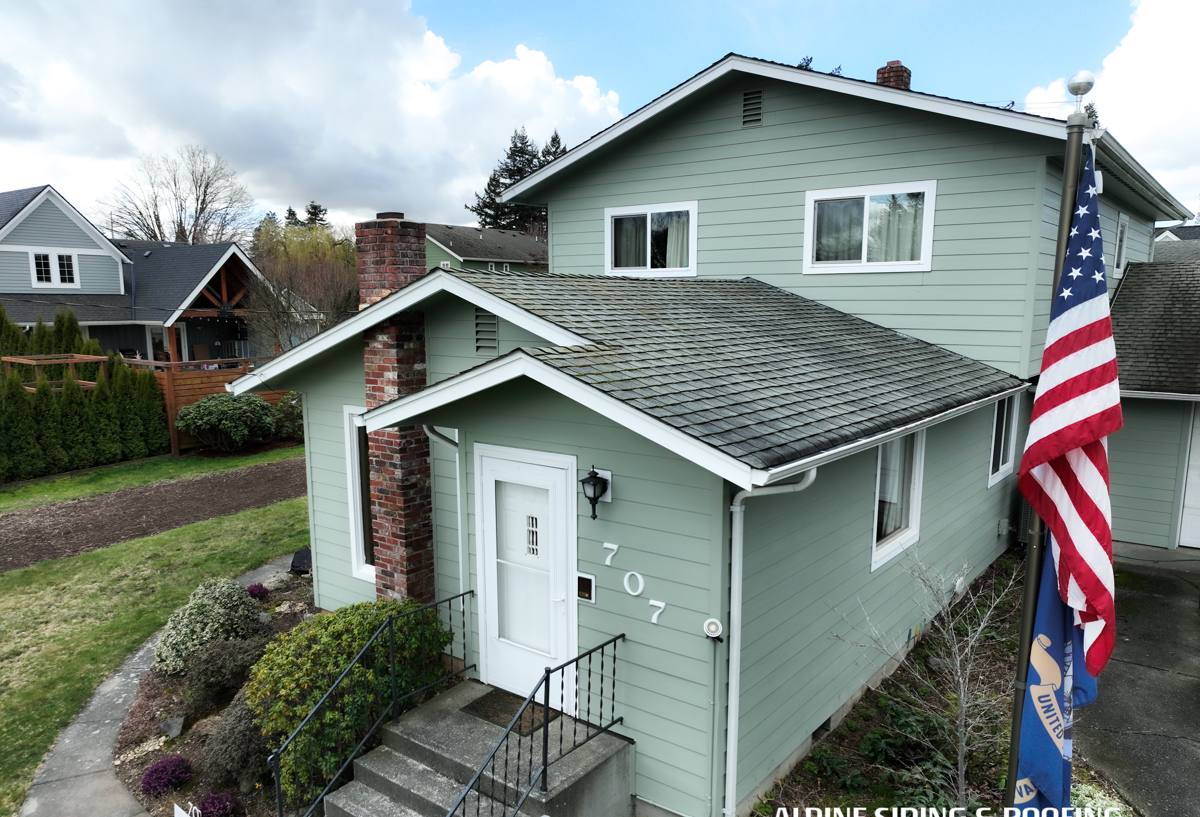
What Salt Air, Rain, and Moss Actually Do to a Wall System
It helps to understand the specific mechanisms at work, because they explain why some siding choices hold up in Custer and others don't:
- Salt air accelerates corrosion on fasteners, flashing, and any exposed metal trim, and it can degrade certain paint and coating systems faster than inland exposure would.
- Driving rain pushes water sideways into laps, seams, and butt joints rather than letting it simply run down the face of the wall — this is why lap coverage, caulking practice, and flashing details matter as much as the siding material itself.
- Extended moss and algae growth holds moisture against the wall surface for longer stretches, which is hard on any material that isn't dimensionally stable when wet, and can stain or degrade finishes that aren't built to resist biological growth.
None of these are exotic problems — they're the normal, cumulative weather pattern for this part of Whatcom County. The right siding system just needs to be built to shrug them off instead of slowly losing the fight.
Why Fiber Cement Is the Right Category for This Job
Fiber cement is a mix of cement, sand, and cellulose fiber, engineered to be dimensionally stable in wet-dry cycling — it doesn't swell, cup, or warp the way wood and wood-composite products can when they take on repeated moisture. It's also non-combustible, which matters for insurance considerations and long-term peace of mind, and it holds a factory-applied finish far longer than field-applied paint on wood siding.
That's the category. Within that category, though, not all fiber cement products are engineered the same way for climate exposure — which is why we're specific about which brand goes on Custer homes.
Why We Install James Hardie and Nothing Else
We install only James Hardie fiber cement siding. We don't install LP SmartSide, vinyl, Cemplank, Allura, or primed wood siding, and we're upfront about why. Vinyl flexes and can distort in temperature swings, and its seams and J-channels are only as good as the installer's attention to detail — over time, especially with wind-driven rain, minor gaps become entry points for moisture. Engineered wood products like LP SmartSide use wood strand cores that are more moisture-tolerant than raw wood but still rely on an intact resin-treated shell; if that shell is compromised at a cut edge or fastener hole, the core underneath is wood, and wood that stays wet in a climate like this doesn't age gracefully. Other fiber cement brands may be reasonable products on paper, but we've standardized on one system so our crews master its details completely rather than splitting attention across several product lines with different installation quirks.
James Hardie backs its siding with ColorPlus factory-baked finishes and offers engineered product lines built specifically for regional exposure, and it carries a strong transferable limited warranty when installed to the manufacturer's specifications. That last part — installed to spec — is doing a lot of work in that sentence, and we'll come back to it.
HardiePlank HZ5: Built for the Pacific Northwest
James Hardie engineers its lap siding into climate-specific "HZ" formulations rather than shipping one generic product nationwide. The HZ5 line is formulated for regions with significant moisture exposure and freeze-thaw cycling — which describes Whatcom County's weather pattern well. That means the product going on a Custer home isn't a general-purpose siding pressed into service; it's a version engineered around the moisture load this specific climate produces.
In practical terms, that shows up as better resistance to moisture-related cracking and better long-term stability across the wet winters and drier summers typical here. It's one of the reasons we don't treat "fiber cement" as a single interchangeable category — the engineering behind the specific product line matters.
What a Correct Installation Actually Involves
Fiber cement siding's long-term performance depends almost entirely on installation quality. A well-made product installed poorly will still fail early — usually at the details, not the field of the wall. For a Custer home, the details that matter most include:
- Proper weather-resistive barrier and flashing behind the siding, with correct lapping so water sheds outward at every horizontal transition — windows, doors, and trim boards.
- Correct fastener placement and type — James Hardie specifies fastener spacing, embedment depth, and corrosion-resistant fastener types, which matters even more given the corrosive potential of salt-laden air.
- Minimum clearance from grade, decks, and roof lines so splash-back and standing water don't sit against the bottom edge of the siding.
- Correct gapping and caulking at butt joints and trim, using sealants rated for the movement and moisture exposure this climate produces — not just whatever's on the truck.
- Field-cut edge sealing so any cut end of a plank gets primed or sealed before installation rather than left exposed to soak up moisture.
Skip any one of these and the wall can still look right for a season or two before problems show up — usually as staining, soft spots at trim, or premature caulk failure. This is also why James Hardie's warranty coverage depends on installation meeting their published specifications; a rushed or careless install can quietly void the protection the product is supposed to provide.
Fiber Cement vs. the Alternatives, Side by Side
| Factor | Vinyl Siding | LP SmartSide | James Hardie Fiber Cement |
|---|---|---|---|
| Behavior in sustained wet weather | Can warp or distort at seams over time | Moisture-tolerant core, but vulnerable if outer shell is breached | Dimensionally stable; doesn't swell or rot |
| Salt air / corrosion resistance | Plastic itself is inert, but trim fasteners still corrode | Moderate; depends on coating integrity | Non-combustible core, corrosion-resistant fastening when installed to spec |
| Finish longevity | Color can fade or chalk over years | Field or factory paint, needs upkeep | Factory-baked ColorPlus finish, long-term color retention |
| Fire resistance | Combustible | Combustible (wood-based) | Non-combustible |
| Typical warranty structure | Prorated, product-only | Limited, product-only | Non-prorated limited warranty when installed to spec |
This isn't a claim that the alternatives are worthless products — it's why, given this specific climate and our own installation standards, we've chosen to put only one system on the homes we work on.
Our Process for a Custer Siding Project
- On-site assessment — we look at existing siding condition, trim and flashing details, moisture staining, and exposure on each elevation before recommending anything.
- Tear-off and substrate check — removing old siding lets us confirm sheathing condition and address any hidden moisture damage before it's covered up again.
- Weather barrier and flashing installation — this layer does the real waterproofing work; the siding is the second line of defense, not the first.
- HardiePlank installation to manufacturer spec — correct fastening, gapping, and sealing at every joint and penetration.
- Trim, caulking, and finish detailing — the small details that determine how the wall performs in year five and year fifteen, not just on install day.
- Final walkthrough — we go over the completed work with the homeowner before calling the job done.
Living With Fiber Cement Siding in This Climate
Fiber cement is low-maintenance compared to wood, but "low-maintenance" doesn't mean "no maintenance" — especially with the moss and algae pressure common on shaded and north-facing walls in this part of Whatcom County. A simple seasonal routine keeps a Hardie installation looking and performing the way it should:
- Rinse siding gently once or twice a year to clear moss spores, pollen, and salt residue before they build up.
- Check caulking at trim and joints annually for cracking or separation, and have it addressed before winter rains arrive.
- Keep gutters clear so overflow doesn't run down the wall face and feed moss growth at specific spots.
- Trim back vegetation and landscaping that keeps a wall section shaded and damp longer than the rest of the house.
- Have any impact damage or chipped paint touched up promptly rather than letting it sit exposed.
Why It Matters to Hire a Crew That Already Works This Area
A crew that installs siding across Whatcom County — not just occasionally, but as regular, familiar territory — already knows how Custer's exposure differs from a more sheltered inland lot, which elevations tend to take the worst of the driving rain, and where moss pressure typically shows up first. That knowledge shapes real decisions on the job: where to pay extra attention to flashing, which trim details need more sealant, and how to sequence a tear-off around the wetter months here. It's the difference between a generic installation and one that's actually built for the property it's going on.
If you're weighing your siding options for a home in the Custer area, we're happy to take a look and talk through what we're seeing — no pressure, no obligation. Use the form below to request a free estimate.