 Lynden Exterior
 Building Decks for the Aldergrove and Lynden Climate
A deck built in Aldergrove, BC or Lynden, WA lives a harder life than most homeowners expect. This stretch of the border between Whatcom County and Langley Township sits in a transition zone — Pacific moisture rolling off the Salish Sea, wind-driven rain that comes in at an angle instead of straight down, and long stretches of gray, damp weather that keep wood surfaces wet for days at a time. Add a moss season that can run from fall through spring, and a deck here needs to be built differently than one going up somewhere dry and sunny. We build decks specifically for this climate, not a generic deck dropped into a wet region.
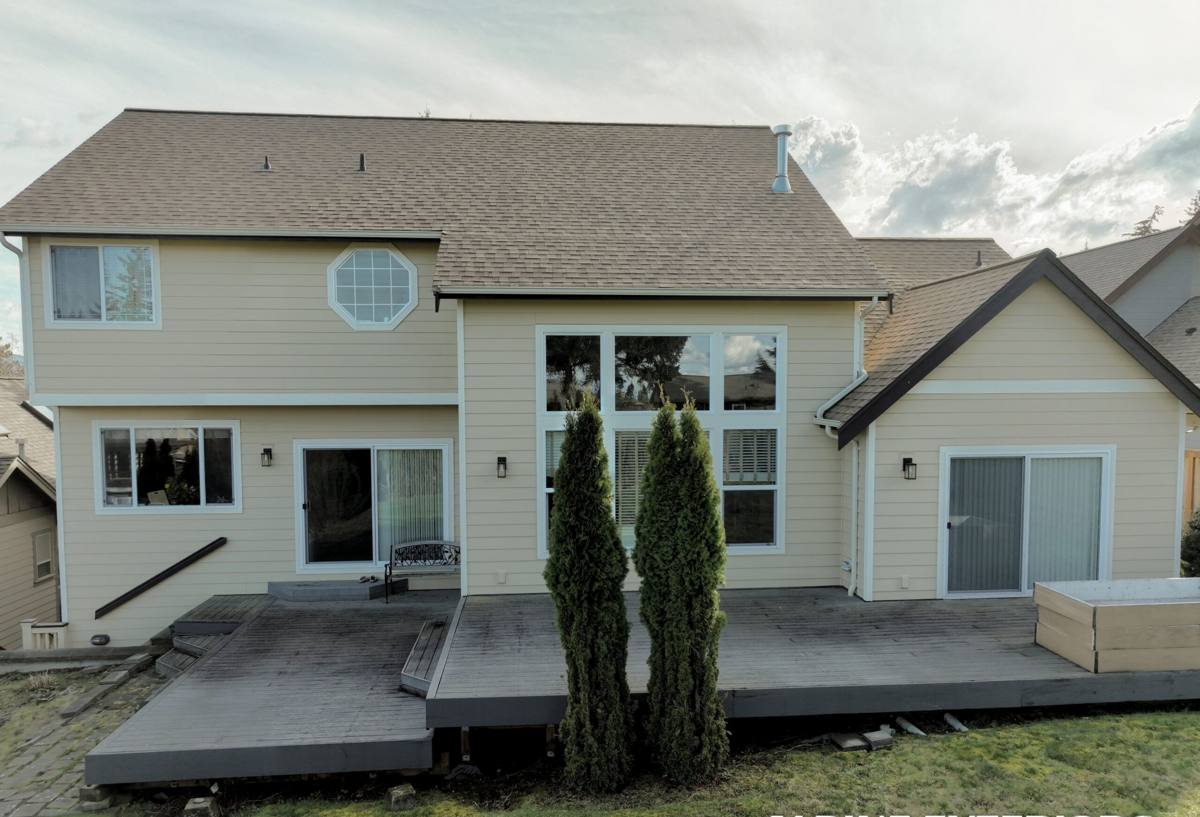
What This Climate Actually Does to a Deck
Before talking about materials or design, it helps to understand the specific ways local weather attacks a deck over time. This isn't abstract — it's the pattern we see on tear-outs and repair calls year after year.
Moisture That Never Fully Dries
Driving rain doesn't just fall on a deck — it gets pushed sideways into joints, under railing posts, and behind ledger boards. Combined with our long overcast stretches, surfaces that would dry out in a sunnier climate stay damp for days. That trapped moisture is what causes rot at fastener points, delamination in poor-quality composites, and swelling at board ends long before the rest of the deck shows wear.
Moss and Organic Growth
Moss doesn't just look bad — it holds moisture against the decking surface and can work its way into board grain and seams. On shaded decks, north-facing decks, or anything under trees, moss can become a near-permanent tenant if the deck wasn't built with drainage, airflow, and spacing in mind from the start.
Salt-Influenced Air
Proximity to the Salish Sea and Puget Sound means the air here carries more salt than an inland location would. Salt accelerates corrosion on fasteners, brackets, and any exposed metal hardware. Cheap galvanized screws or generic joist hangers that might last a decade elsewhere can start showing rust streaks in a fraction of that time here.
Choosing Decking Material for This Environment
There's no single "best" decking material — there's a best material for your budget, your maintenance appetite, and how much sun or shade the deck actually gets. Here's how the common options hold up specifically in a wet, moss-prone, salt-influenced climate.
| Material | How It Handles This Climate | Maintenance | Relative Cost |
|---|---|---|---|
| Pressure-treated fir/hem-fir | Affordable and strong, but needs consistent sealing to resist moisture and moss uptake | Annual cleaning, re-sealing every 1-2 years | Lowest |
| Cedar | Naturally rot- and insect-resistant, ages to gray if untreated; still needs cleaning to prevent moss | Cleaning plus staining/sealing every 2-3 years | Moderate |
| Capped composite | Strong resistance to moisture absorption and moss staining; performance varies a lot by brand quality | Occasional washing, no sealing | Higher |
| PVC decking | Fully synthetic, essentially immune to rot and moisture damage; can be slicker when mossy or wet | Occasional washing | Highest |
We don't push one product over another as a blanket rule. A cedar deck that gets good sun exposure and a homeowner willing to maintain it can look excellent for decades. A shaded, north-facing deck is usually a much better candidate for composite or PVC, where moss has less to grip onto and moisture doesn't sit in the grain. We'll walk your specific site — sun exposure, drainage, tree cover — before recommending a direction.
What's Underneath Matters More Than What's On Top
Homeowners naturally focus on the decking surface, but the framing underneath is what determines whether a deck lasts 12 years or 30. In this climate, that structure takes the brunt of the moisture damage because it's shaded from sun and airflow by the decking above it.
- Ledger board flashing that actually sheds water away from the house rim joist, not just a bead of caulk
- Joist tape or a moisture barrier on top of framing lumber, so screw penetrations don't become entry points for rot
- Proper joist spacing and blocking sized to the decking material you choose, not a generic spec
- Post bases that hold posts above grade and off standing water, with drainage gravel beneath footings
- Stainless steel or heavy-duty coated fasteners and hardware rated for coastal or high-moisture exposure
- Airflow underneath the deck — proper height and skirting design so the underside can actually dry between rain events
This is where a lot of decks fail early, and it's almost never visible until something starts sagging, staining, or smelling musty. It's also the part of the job that's genuinely hard to inspect or fix after the fact, which is why getting it right the first time matters more here than in a drier climate.
Railings, Stairs, and Hardware Built for Wet Conditions
Railing posts and stair stringers see concentrated water exposure at their base, and hardware corrosion is one of the most common issues we find on older decks in this area. We spec fasteners and connectors rated for exterior, high-moisture, and salt-influenced environments rather than standard interior-grade or basic galvanized hardware. On stairs specifically, tread spacing and surface texture matter for safety once moss or algae starts forming during the wetter months — a smooth board that's fine in July can become genuinely slick by December.
Permits and Building Considerations on Both Sides of the Border
One thing that makes this service area a little unusual: Aldergrove, BC and Lynden, WA sit on opposite sides of an international border, and that means different permitting authorities, building codes, and inspection processes depending on which side your property is on. A deck project in Whatcom County follows Washington state and local permitting rules; a project in Aldergrove falls under Langley Township and BC building code requirements. We don't guess at this — we confirm the correct permitting path for your specific address before work starts, rather than assuming one country's rules apply to both. If your deck involves height, proximity to property lines, or attachment to the house, a permit is almost always required on either side of the border, and skipping it can create real problems at resale or insurance time.
Our Deck Building Process
The process is straightforward, but the sequencing matters, especially in a climate where every stage of construction is exposed to weather risk.
- On-site assessment — we look at sun exposure, drainage patterns, existing structure (for replacements), and how water moves across your yard and against your house.
- Design and material selection — sizing, layout, and material recommendations based on how the deck will actually be used and how much maintenance you want to take on long-term.
- Permitting — we handle or coordinate the correct permit process for your jurisdiction before any digging or framing begins.
- Footings and framing — built to the moisture-management standards above, not just minimum code.
- Decking, railing, and stairs — installed with attention to fastener spacing, drainage gaps, and manufacturer specifications (composite and PVC products in particular have specific installation tolerances that affect their warranty).
- Final walkthrough — we go over maintenance expectations specific to the material you chose, so there are no surprises in year two or three.
Protecting Your Deck Once It's Built
Even the best-built deck needs some seasonal attention in this climate. The good news is that most of it is simple and inexpensive if it's done consistently.
- Clear leaves and debris from between boards before fall rains set in — trapped organic matter is what starts moss colonies
- Sweep or rinse shaded areas more often than sun-exposed areas, since they dry out slower
- Check and re-seal wood decking on the schedule appropriate to your species and finish
- Inspect fasteners and hardware annually for early rust or corrosion, especially near the ground and stair stringers
- Keep gutters and downspouts clear so roof runoff isn't dumping extra water directly onto or under the deck
Why Local Deck-Building Experience Matters Here
A contractor who mostly builds in dry, inland climates will make different default choices than one who works Aldergrove and Lynden year-round — different fastener grades, different flashing details, different material recommendations for shaded versus sun-exposed sites. We build decks in this specific climate as a regular part of our work, which means we've already seen what fails here and we build to avoid it from day one, rather than learning it on your project. We also know the practical difference between permitting on the US and Canadian sides of this border, so there's no guesswork about which rules apply to your property.
If you're planning a new deck or replacing one that's showing its age, we're happy to walk the site, talk through material options honestly, and give you a straightforward estimate — no pressure, no sales script. Use the form below to request your free estimate.