 Lynden Exterior
 Why Decks Wear Out Faster in Maple Falls
Maple Falls sits in the foothills east of Lynden, tucked closer to the tree line than the open farmland that surrounds most of Whatcom County. That changes how a deck ages. Homes here tend to have more shade from conifers and big-leaf maples, less direct sun to dry things out between storms, and a longer stretch of the year where wood, concrete, and metal fasteners just stay damp. Combine that with the driving rain that moves through this part of Western Washington and the moss season that can stretch from October well into spring, and you get a deck environment that's tougher on materials than a typical suburban lot.
Salt-tinged coastal air affects fasteners and metal hardware across Whatcom County generally, but in Maple Falls the bigger issue is almost always moisture that has nowhere to go — trapped under low decking, held in end grain, or sitting on top of a board that never gets a full day of sun. A deck built without that in mind will show problems years before it should.
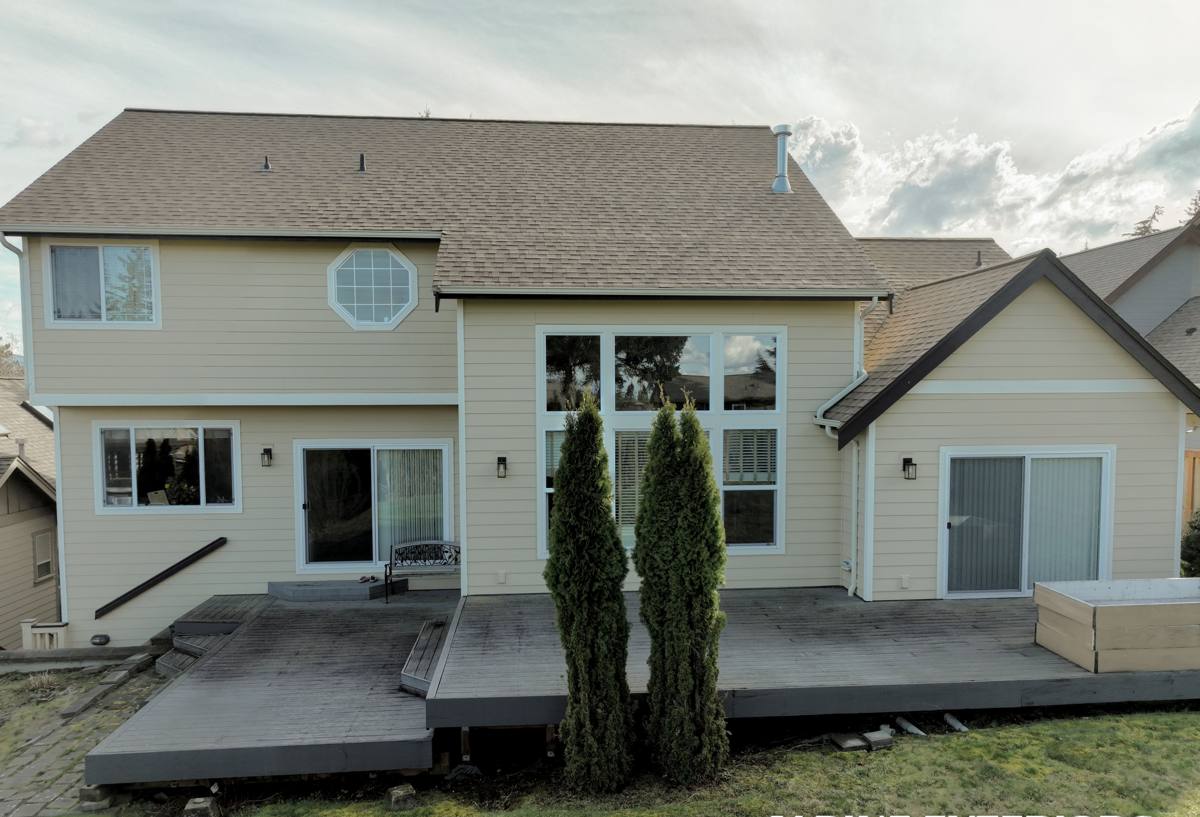
Signs a Deck Needs Replacing, Not Just Repair
Not every deck needs a full teardown. But there's a point where patching boards is just delaying an inevitable rebuild, and spending money on repairs past that point is money that should have gone toward a new deck instead. Here's how we tell the difference on a Maple Falls property:
- Soft or spongy spots on the deck surface, especially near the house or in shaded corners — usually rot that's already spread into the joists below
- Persistent green or black growth that comes back within weeks of cleaning, a sign the boards are staying wet longer than they're drying
- Gaps opening up between deck boards and the house siding or ledger board, which lets water behind the structure
- Railing posts that wiggle at the base — often the first place structural rot shows up
- Fasteners bleeding rust streaks down the boards, meaning the hardware is failing faster than the wood
- A deck more than 15-20 years old that's never had the substructure inspected
If you're seeing two or more of these, it's worth having someone look at the framing underneath, not just the walking surface.
What a Correct Deck Replacement Actually Involves
It starts underneath, not on top
A deck is only as good as what's holding it up. On a full replacement we remove the old decking and railing down to the frame, then evaluate footings, posts, beams, and joists. In a shaded, damp-prone area like Maple Falls, this step matters more than in drier parts of the county — rot in ground-contact posts or under-sized footings is common on older decks that were built without accounting for how slowly the ground here drains.
Ledger flashing is where most failures start
The ledger board — where the deck attaches to the house — is the single most common source of hidden water damage on any deck in this region. If it's not properly flashed to shed water away from the house framing, moisture works its way in behind the siding and rots both the ledger and the wall structure it's fastened to. We treat ledger flashing as non-negotiable on every replacement, not an upgrade.
Joist protection and airflow
Bare joist tops absorb water every time it rains and hold it. We protect joist tops and beam tops before decking goes down, and we build in enough gap and airflow underneath the deck so the framing has a chance to dry out between storms instead of staying wet through the whole fall and winter.
Fasteners and hardware rated for the exposure
Mismatched or under-rated fasteners are a quiet failure point — the wrong screw in treated lumber corrodes from the inside out long before the boards look bad. We use hardware rated for the lumber and exposure we're building into, not whatever's cheapest at the yard.
Choosing the Right Decking Material for a Shaded, Wet Lot
Every decking material handles Maple Falls' shade-and-moisture combination a little differently. There's no single "best" choice — it depends on how much sun the deck gets, how much upkeep you want to do, and your budget.
| Material | How it handles shade & moss | Maintenance | General lifespan |
|---|---|---|---|
| Pressure-treated lumber | Needs regular cleaning in shaded spots or moss takes hold fast | Annual cleaning, periodic sealing | 15-20 years with upkeep |
| Cedar | Naturally rot-resistant but still needs airflow underneath and periodic sealing in low-sun areas | Cleaning and re-sealing every 1-2 years | 15-25 years with upkeep |
| Composite/PVC boards | Resists rot and moss growth better on the surface, but still needs a properly built, well-ventilated frame underneath | Occasional washing, no sealing | 25-30+ years, varies by manufacturer |
We don't push one product on every job. A composite board makes a lot of sense on a low, shaded deck where moss has been a recurring headache. A well-built cedar deck can look great and hold up fine if it gets enough seasonal maintenance and the framing underneath is done right. The honest trade-off with composite is upfront cost and a more limited color/texture range; the honest trade-off with wood is that it asks more of the homeowner year after year. We'll walk through what fits your specific lot and how much shade it gets before you commit.
Permits and Local Requirements
Deck work in and around Lynden and unincorporated Whatcom County generally needs to meet current building code for footing depth, structural attachment, and guardrail height, and many replacements require a permit — particularly if the deck is elevated, attached to the house, or being rebuilt to a different size or footprint than the original. Requirements can vary depending on your exact parcel and whether it falls under county or city jurisdiction. We handle the permit process as part of the job rather than leaving it for the homeowner to sort out, and we build to current code even in cases where the old deck was grandfathered in under older rules.
Our Process for Maple Falls Deck Replacements
- On-site assessment — we look at the existing deck, the ground conditions, drainage, and how much sun exposure the location actually gets before recommending anything
- Material and design discussion — honest pros and cons for your specific spot, not a one-size pitch
- Permit handling — we pull what's required and coordinate inspections
- Demo and framing — old structure removed, footings and framing inspected and rebuilt to current code
- Flashing, protection, and decking installation — the parts that determine whether this deck lasts 10 years or 25
- Final walkthrough — we go over care and maintenance specific to the material you chose and the amount of shade your deck gets
Keeping a Maple Falls Deck Healthy Once It's Built
A correctly built deck still needs some seasonal attention in this climate — that's true of every material, not a defect. A short list that actually makes a difference:
- Sweep leaves and debris off the deck regularly through fall, especially in shaded corners where they hold moisture against the boards
- Clean moss and algae growth as soon as it appears rather than waiting until it's established
- Check that gaps between boards stay clear so water keeps draining instead of pooling
- Trim back overhanging branches to let more light and air reach the deck surface
- Have the substructure looked at every few years, especially near the ledger board and post bases
- Re-seal wood decking on the schedule appropriate to that product — don't wait for it to look obviously weathered
Why It Matters That We Already Work in Maple Falls
Building a deck that holds up here isn't the same as building one on an open, sunny lot elsewhere in the county. A crew that hasn't spent time on shaded, wooded properties in this area can miss the details that actually matter — under-flashing the ledger, skipping joist protection, or picking a material without accounting for how little direct sun a given deck will see. We've built and replaced decks throughout the Lynden area, including properties with the same tree cover, drainage, and moisture patterns you're dealing with in Maple Falls, and we build every job to handle that reality, not just to look good on install day.
If your deck is showing its age or you're just not sure whether it's a repair or a replacement, we're happy to take a look. Reach out for a free, no-pressure estimate using the form below.