 Lynden Exterior
 Ferndale's Siding Has a Harder Job Than Most
Ferndale sits close enough to Bellingham Bay and the Salish Sea that homes here deal with a version of coastal weather that inland Whatcom County doesn't get quite as bad. Salt-laden air moves in off the water, driving rain comes sideways during winter storms, and the combination of moisture and shade on a lot of properties keeps moss and algae going strong for most of the year. None of that is dramatic on its own, but stacked together over years, it's exactly the kind of exposure that separates siding installed correctly from siding installed to just look good on closing day.
We install James Hardie fiber cement siding exclusively, and we've done enough work in Ferndale and the surrounding Lynden area to know which details actually matter here versus which ones are just manufacturer boilerplate. This page is about that specific pairing: this product, in this town, under this climate.
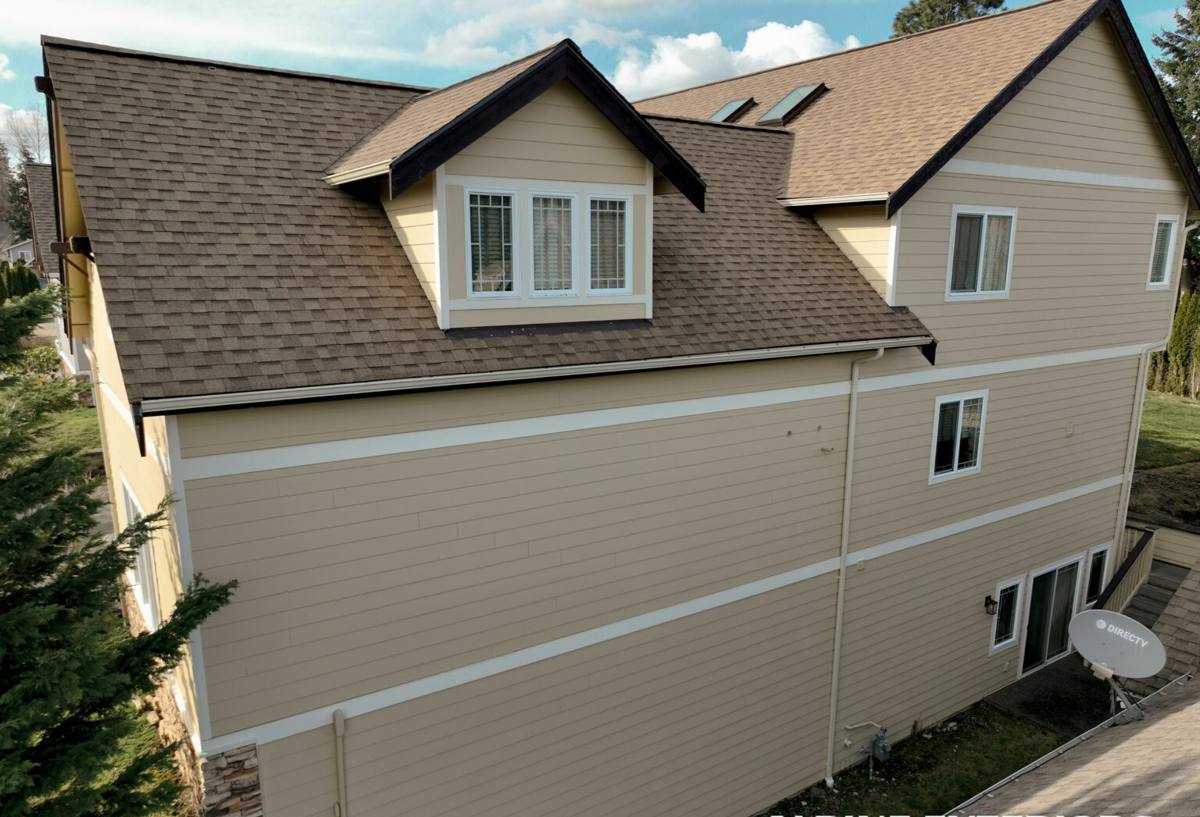
What Salt Air and Driving Rain Actually Do to Siding
Salt Air
Salt doesn't just sit on a surface — it's hygroscopic, meaning it pulls moisture out of the air and holds it against whatever it's resting on. On wood-based products, that means longer periods of elevated moisture content right at the surface, which is where rot and coating failure start. On metal fasteners and trim, it accelerates corrosion if the wrong hardware was used. Fiber cement doesn't feed on that moisture the way wood-based sidings can, but the fasteners, flashing, and finish system around it still need to be chosen with salt exposure in mind.
Driving Rain
Rain that falls straight down is a much smaller problem than rain that's being pushed sideways by wind off the water. Wind-driven rain gets forced up under laps, into butt joints, and around penetrations that would stay dry in a calmer climate. This is a water-management problem more than a material problem — it's solved with correct lap exposure, proper flashing at every penetration, and a drainage plane behind the siding that actually drains instead of trapping water against the sheathing.
Moss and Algae Season
Shaded north and west-facing walls in Ferndale can stay damp for weeks at a stretch, especially where trees or neighboring structures block sun and wind. That's a growing environment moss and algae are happy to move into. On some siding types, that means recurring soft-wash cleaning and, eventually, repainting to keep coatings from failing under the growth. A factory finish that's engineered to resist that buildup changes the maintenance conversation considerably.
Why We Only Install James Hardie
We made a deliberate call to stop installing vinyl, LP SmartSide, and other fiber-cement alternatives, and to install James Hardie exclusively. That's not a marketing position — it's the product we trust to hold up to the moisture load and salt exposure this area sees, without the maintenance creep that comes with wood-based or lower-grade siding systems. Hardie's fiber cement is non-combustible, dimensionally stable in wet climates, and available in HZ5 formulations engineered for the exact damp, moderate-freeze conditions the Pacific Northwest produces. The ColorPlus factory finish is baked on under controlled conditions rather than field-applied, which matters a lot in a climate where you don't get long dry stretches to properly cure paint on site.
We're not going to tell you every other product is bad — vinyl and engineered wood have their place, and homeowners on a tight budget sometimes need those options. What we will say is that once we saw the callback patterns on those products in this climate — moisture intrusion at seams, coating failure under persistent shade and damp, and warranty language that didn't hold up the way homeowners expected — we stopped installing them. Hardie is what we put on homes now, and we stand behind that.
What a Correct Hardie Install Looks Like in Ferndale
The board itself is only part of the system. In a climate with this much wind-driven rain and sustained dampness, the installation details are what actually determine whether the siding performs for its full service life.
- Weather-resistive barrier installed continuously, lapped correctly shingle-style so water sheds outward at every seam
- A drainage gap or rainscreen behind the siding so any water that gets past the surface can drain and the wall can dry
- Correct lap exposure per Hardie's published specs — not stretched to save material
- Flashing at every window, door, and penetration, installed to shed water onto the WRB, not behind it
- Stainless or hot-dip galvanized fasteners rated for coastal exposure, driven to the correct depth (not overdriven, which cracks the board's edge)
- Properly caulked and primed cut ends, since factory ColorPlus finish doesn't extend into field cuts
- Clearance maintained between the siding's bottom edge and grade, decks, and roof lines so it isn't sitting in standing water or splash-back
Skipping any one of these doesn't usually cause a visible problem in year one. It shows up in year five or eight, as a soft spot near a window, a stain trailing down from a butt joint, or paint failure that starts exactly where a detail was cut short.
Our Process for a Ferndale Job
1. On-Site Assessment
We look at more than the siding that's failing. We check the walls that catch the most wind-driven rain (usually west and southwest exposures), the shaded sides prone to moss, and any existing moisture damage at trim, penetrations, or the water table.
2. Product and Color Selection
We walk through Hardie's plank, shingle, and panel lines along with the ColorPlus palette, and talk through which profile fits the home and which HZ formulation is right for this specific site — a fully exposed lot near the water gets treated differently than a sheltered, tree-covered one.
3. Tear-Off and Sheathing Check
Old siding comes off and we inspect the sheathing underneath before anything new goes up. Any rot or soft sheathing found at this stage gets addressed — installing new siding over a compromised substrate just hides the problem for a while.
4. Water Management First, Siding Second
WRB, flashing, and drainage details go in before a single piece of Hardie board is hung. This is the step that's easiest to rush and most expensive to fix later.
5. Installation to Spec
Boards, fasteners, and exposures follow Hardie's published installation instructions, not shortcuts. This is also what keeps the manufacturer's warranty valid — Hardie's warranty terms assume the product was installed correctly.
6. Final Walkthrough
We go over caulking, trim, and touch-up paint at cut ends with the homeowner before calling the job done.
Comparing Siding Options for a Ferndale Home
| Factor | James Hardie Fiber Cement | Vinyl | Engineered Wood (e.g. LP SmartSide) |
|---|---|---|---|
| Moisture behavior in wet/coastal climate | Dimensionally stable, doesn't rot | Doesn't rot but can warp/buckle with heat cycling | Wood-based core is moisture-sensitive if seams or coating fail |
| Salt air / coastal exposure | Engineered HZ formulations available for this exposure | Generally tolerant but fasteners/trim still at risk | More sensitive; coating failure exposes the wood substrate |
| Moss/algae resistance of finish | Factory ColorPlus finish resists fading and buildup | Color molded through, but surface still hosts growth | Field-applied coatings need more frequent recoating |
| Fire resistance | Non-combustible | Combustible | Combustible (treated, but still wood-based) |
| Typical repaint/refinish cycle | 15+ years on ColorPlus finish | Doesn't need paint but can chalk/fade | Shorter recoat intervals in wet climates |
What It Costs — In Ranges, Not Promises
Total project cost depends on the home's size, how much of the existing siding and any damaged sheathing needs to come off, trim complexity, and which Hardie product line and profile you choose. Broadly, fiber cement runs higher upfront than vinyl and is comparable to or somewhat above engineered wood siding, but it carries lower long-term maintenance costs given the repainting and repair cycles those alternatives tend to need in this climate. We give exact numbers only after seeing the house — anyone quoting a firm price over the phone hasn't looked at your walls yet.
Why a Crew That Already Works Ferndale Matters
Whatcom County covers a lot of microclimates — a job in Lynden's flatter, more inland setting doesn't see the same wind and salt exposure as a home closer to Ferndale's waterfront edges. A crew that's already worked this specific area knows which walls to worry about, which fastener spec holds up here, and how much drying time to plan around given the region's rain patterns. That's not something you get from a general installer working from a generic spec sheet — it's something you get from having actually done the work here before.
If you're weighing a full re-side or dealing with an existing siding failure on a Ferndale home, we're happy to take a look and walk you through what we're seeing, with no pressure to commit. Reach out through the form below for a free estimate.