 Lynden Exterior
 Siding Installation in Laurel: A Small Community With Real Weather Demands
Laurel is a small, mostly rural community along the Guide Meridian corridor between Bellingham and Lynden, made up of farmland, older farmhouses, and newer rural residential lots rather than a dense in-town grid. That open, flat character changes how weather actually hits a house here. With fewer trees and buildings to break it up, wind-driven rain and salt-tinged marine air move across Laurel properties with less resistance than they do on a sheltered, tree-lined lot in town. We're based just up the road in Lynden, and Laurel is regular territory for our crew — close enough that a siding job here doesn't mean guessing at conditions, and far enough into open farm country that we treat it as its own case, not an extension of in-town Lynden work.
This page is specifically about siding installation for Laurel homes — not roofing, not windows, not decks. On siding, we install James Hardie fiber cement and nothing else. That's a professional standard shaped by what we've seen hold up, and what hasn't, on real installations across this part of Whatcom County.
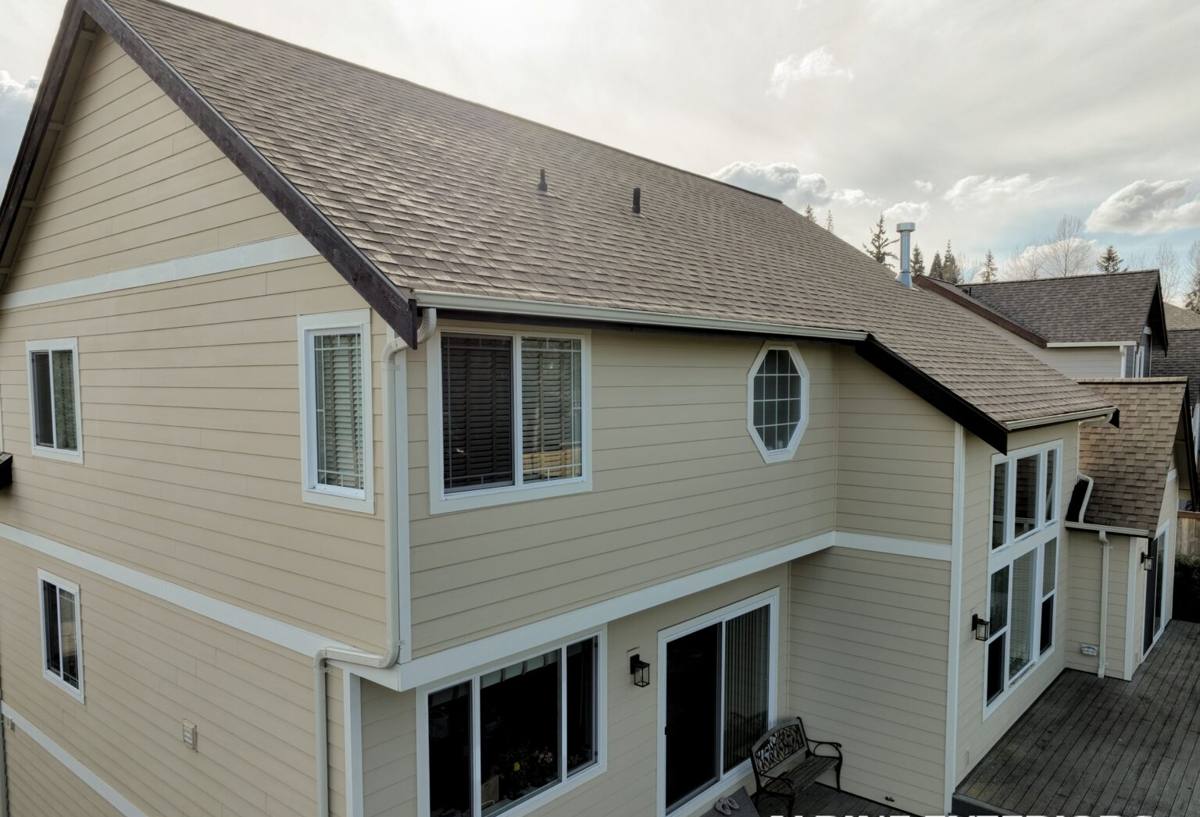
What Laurel's Climate Does to Siding
Salt-Tinged Marine Air
Even set back from the water, Whatcom County homes take on a steady dose of salt-laden marine air, and Laurel's open exposure doesn't give it much to stop against before reaching a wall. Salt accelerates corrosion in fasteners, flashing, and any exposed metal trim, and it wears down lower-grade finishes faster than a dry inland climate would. On a siding installation, that means fastener quality and finish durability aren't places to save money.
Driving Rain Across Open Farmland
Rain in this part of the county rarely falls straight down. Wind pushes it sideways into wall assemblies, and on Laurel's flat, open farmland — without the windbreak that tree cover or tighter neighborhood spacing provides — that sideways-driven rain can hit a wall with more direct force than it would on a sheltered in-town lot. Siding installed for calm, dry conditions can perform fine on a still day and still let water in the moment wind gets involved, which in Laurel is often.
A Long Moss Season
Mild temperatures and near-constant moisture add up to a moss and mildew season that runs most of the year on shaded or north-facing walls, and any siding material with even slight surface porosity gives it a place to grip. Laurel's mix of open pasture and pockets of mature trees around older farmhouses means moss pressure varies more from property to property here than it does in a uniform in-town subdivision — some walls dry out fast in open sun, others stay damp for weeks at a stretch.
Why We Only Install James Hardie Fiber Cement
We used to install a wider range of siding products. We stopped, and the reason came from what we kept finding on tear-offs and service calls across Whatcom County's wetter, more exposed properties — Laurel's open farmland included — not from a supplier relationship or a sales pitch.
- Non-combustible core: Fiber cement doesn't feed a fire the way wood-based siding products can, which matters for both safety and insurance considerations on a rural property.
- Factory-applied ColorPlus finish: The color is baked on under controlled factory conditions rather than brushed on in the field, so it holds up longer against fading, chalking, and salt-driven moisture than site-applied paint.
- Climate-engineered HZ product lines: Hardie's HZ5 formulation is built for regions with sustained moisture exposure and freeze-thaw cycling, which describes Whatcom County's farmland and coastal-influenced towns alike.
- Dimensional stability: Fiber cement doesn't swell, cup, or warp the way engineered wood products can after repeated wetting, which matters on open lots that take rain with less shelter than a tree-covered property.
- Strong transferable warranty: Hardie backs the product with one of the stronger warranty structures in the industry, provided the installation follows their published spec.
We won't install LP SmartSide, vinyl siding, Cemplank, Allura, primed spruce, or cedar. Each of those products has a place in the market and homeowners elsewhere who are satisfied with them. But we've made a professional call that on properties exposed to this much wind-driven rain and salt-tinged air, we'd rather install one system we fully stand behind than offer something cheaper that quietly shifts maintenance risk onto the homeowner a few years down the road.
What Correct Installation Requires
Hardie siding only performs the way it's engineered to when the installation follows the manufacturer's spec, and on an exposed Laurel lot, skipping a step shows up faster than it would on a sheltered in-town property.
- Rain screen gap: A drainage cavity behind the siding lets any moisture that gets past the exterior surface drain and evaporate instead of sitting against the wall sheathing.
- Correct fastener type and spacing: Hardie specifies fastener placement and corrosion-resistant fastener grades for a reason — loose spacing or the wrong fastener is one of the more common causes of early failure we find on tear-offs.
- Properly lapped house wrap and flashing: Every seam and penetration needs to shed water downward and outward, which matters more on a wall that takes wind-driven rain with little windbreak in front of it.
- Sealed butt joints and trim transitions: Open or poorly sealed joints are where salt-laden moisture finds its way behind the siding first.
- Correct clearance from grade and roof lines: Siding installed too close to the ground or a roof edge stays wet longer and invites rot at the bottom courses.
Tear-Off vs. Installing Over Existing Siding
A number of Laurel properties are older farmhouses that have already been re-sided once, sometimes more, and the honest answer on tear-off versus installing over existing material depends on what's underneath. If the sheathing and wall assembly behind the current siding are dry and sound, there are cases where installing over an existing layer is a reasonable option. But we won't make that call without opening things up to look first. Older farmhouse construction sometimes hides moisture damage, undersized or missing house wrap, or wall assemblies that were never built to modern water-management standards, and installing new siding over a problem like that just buries it for another decade. On any property where we have real doubt, a full tear-off is the more honest recommendation, even though it costs more upfront, because it lets us actually see and fix what's underneath instead of guessing.
Our Installation Process for Laurel Homes
We start with an on-site walk of the property, looking at the existing siding condition, wall orientation relative to prevailing wind and rain, and any visible signs of past moisture intrusion — more common on older farmhouse construction than on a newer build. From there we put together a clear, written scope and price before any work starts, so there's no ambiguity about what's included.
Once work begins, tear-off (where called for) comes first, followed by an inspection of the sheathing and framing underneath — this is where hidden problems on an older home actually surface, and we'll stop and talk through repair options with the homeowner before covering anything back up. Next comes a properly lapped weather-resistive barrier and rain screen system, then the Hardie siding itself, installed to the manufacturer's fastening and clearance spec rather than a shortcut version of it. Trim, flashing, and joint sealing get the same attention as the field of the wall, since those are the details that actually determine how the installation performs in a storm. We finish with a walkthrough covering what the finished siding needs going forward, which for a correctly installed Hardie system is minimal.
Cost Factors for Siding Installation in Laurel
| Factor | What Drives It | Laurel-Specific Consideration |
|---|---|---|
| Home size and wall complexity | Square footage, number of stories, dormers and trim detail | Larger farmhouse lots sometimes carry more elevation and outbuilding siding than a standard in-town home |
| Tear-off vs. install-over | Condition of existing siding and substrate | Older farmhouses more often need substrate repair once old siding comes off |
| Trim and architectural detail | Corner boards, window and door trim, fascia treatment | Farmhouse-style trim profiles can add labor time versus a simple modern elevation |
| Substrate and sheathing repair | Extent of hidden moisture or rot found during tear-off | More likely on multi-decade farmhouse construction than newer rural builds |
| Site access | Distance from road, driveway length, equipment staging | Larger rural lots can mean longer material staging and haul distances than a tight in-town lot |
These are general cost drivers, not a quote. Every Laurel property sits a little differently relative to wind exposure, tree cover, and the age of the existing siding, so we walk the property before putting a real number on the work. Two homes on the same road can need very different scopes once old siding actually comes off.
Signs a Laurel Home Is Due for New Siding
- Moss or dark staining that returns quickly after cleaning, especially on shaded or north-facing walls
- Soft or spongy siding, particularly low on the wall or around window and door trim
- Visible warping, cupping, or cracking on wood-based or engineered siding products
- Peeling or chalking paint on a wall that's been repainted more than once in recent years
- Rust staining or corroded fasteners and trim, more noticeable on fully exposed elevations
- Gaps opening at butt joints, corner boards, or trim transitions
- Rising heating or cooling costs with no other obvious cause, which can point to a wall assembly that's no longer sealing properly
Why a Crew That Already Works Laurel Matters
A siding crew based further away can still do competent work, but Laurel has variables that don't come up on every job elsewhere in Whatcom County — open, unsheltered wind exposure, a real mix of decades-old farmhouse construction and newer rural builds, and moss pressure that swings more from lot to lot depending on tree cover than it does in a uniform in-town neighborhood. Working this area regularly, out of our base in Lynden, means we're not guessing at those conditions on your project. We've seen which wall orientations take the worst of the wind-driven rain here, which older farmhouse assemblies tend to hide moisture problems, and which fastener and flashing details are worth the extra time rather than an upsell.
Get a Free, No-Pressure Estimate
If your Laurel home needs new siding, or you're not sure whether what's on the walls now is doing its job, we're glad to walk the property and give you a straightforward, honest read on what it actually needs. Reach out using the form below to schedule a free estimate — no pressure, no upsell script.