 Lynden Exterior
 Deck Building in Sumas: Why Local Weather Changes the Job
Sumas sits at the edge of Whatcom County's border prairie, close enough to Lynden that we run crews through the area on a regular basis. It's flat, low-lying ground with heavy clay-and-silt soil in places, marine-influenced air moving in off the Sound, and a rain season that runs long and steady rather than dropping everything at once. A deck built here has to handle standing moisture at ground level, driving rain that gets under railings and ledger boards, and a moss season that can stretch from October into May. None of that is exotic — it's normal Whatcom County weather — but it means a deck built to a generic national spec often underperforms within a few years. Fastener corrosion shows up early. Ledger flashing that was "good enough" somewhere drier starts leaking into the rim joist. Composite boards installed without enough airflow underneath grow algae faster than the manufacturer's brochure suggests.
We build decks in Sumas the way we build them everywhere in our service area: sized and detailed for the actual ground and actual weather, not a catalog default. That's the whole difference between a deck that looks fine at handoff and one that's still solid in year fifteen.
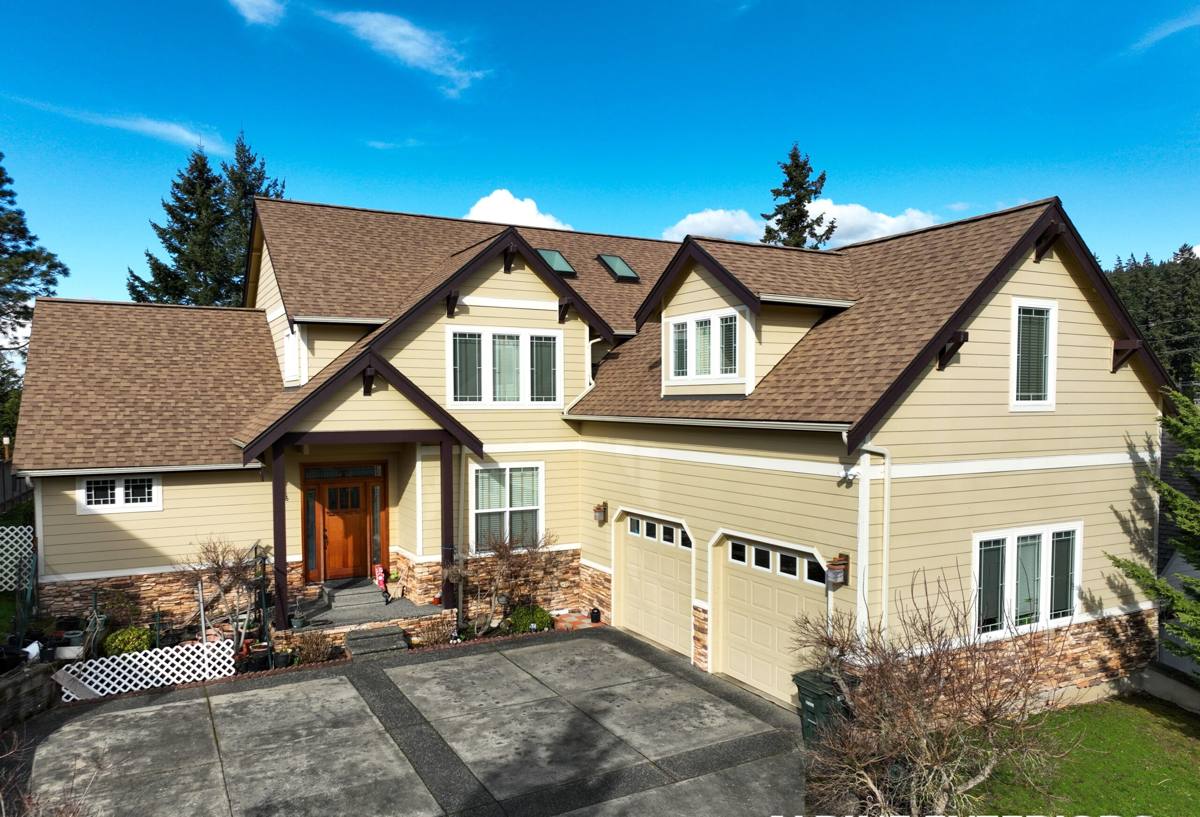
What Sumas-Area Homes Actually Need From a Deck
Ground moisture and footings
Low-lying lots near Sumas often sit on soil that drains slowly. If footings aren't set to the correct frost depth and diameter for the load, and if the post base isn't kept clear of standing water, you get movement — a deck that develops a slight lean or squeak within a few winters. We check drainage at the footing locations before we pour, not after.
Driving rain and wind-driven moisture
Rain here doesn't fall straight down most of the season; it comes at an angle off the wind. That matters at the ledger board (where the deck attaches to the house), at stair stringers, and at any spot where two materials meet. Flashing details that would be optional in a drier climate aren't optional here.
Moss, algae, and shade
A long wet season plus any amount of tree cover means moss and algae growth on horizontal surfaces — decking boards, stair treads, and rail caps. Board spacing, airflow underneath the deck, and surface texture all affect how fast that growth shows up and how hard it is to keep ahead of.
Marine air and metal hardware
Whatcom County's marine-influenced air carries enough moisture and salt content to accelerate corrosion on lower-grade fasteners and connectors over time. It's a slower process than at the immediate coastline, but it's real, and it's one of the most common causes of premature deck hardware failure we see on older builds.
What a Correct Deck Build Involves
A deck is a structure first and a surface second. The parts nobody sees are what determine whether it lasts.
- Footings sized and set to the required frost depth, on soil checked for drainage — not just poured wherever's convenient
- A ledger board properly flashed and through-bolted (never just nailed) to the house rim joist, with a water diverter above it
- Joist spacing matched to the decking material — composite typically needs tighter spacing than wood
- Corrosion-resistant, code-rated fasteners and structural connectors throughout — hangers, hurricane ties where called for, and hot-dip galvanized or stainless hardware
- Proper clearance and airflow underneath the deck to slow moss, mildew, and wood rot
- Railings and stairs built to current code height and baluster spacing, not whatever the old deck happened to have
- A permit pulled where required, with the framing inspected before decking goes down
Skipping any one of these doesn't usually show up on day one. It shows up in year three or four, as a soft spot near the ledger, a wobbly rail post, or rust streaks bleeding through composite boards from failing fasteners underneath.
Choosing Decking Material for This Climate
There's no single "best" decking material — there's a best fit for your budget, maintenance appetite, and how much shade and moisture the deck will see. Here's how the common options actually perform in Whatcom County conditions:
| Material | Moisture & Moss Behavior | Maintenance | Typical Lifespan |
|---|---|---|---|
| Pressure-treated lumber | Sheds water well if gapped and sealed correctly; can hold moisture if boards are laid too tight | Needs re-sealing or staining every 2-3 years to resist moss and graying | 15-20 years with upkeep |
| Cedar | Naturally moisture- and insect-resistant, but surface still grows moss in shaded, wet spots without cleaning | Periodic cleaning and oiling to keep color and resist weathering | 15-25 years with upkeep |
| Composite (capped) | Very resistant to rot; can still grow surface algae in deep shade without airflow underneath | Occasional washing; no staining or sealing | 25-30+ years, manufacturer-warrantied |
| PVC decking | Fully moisture-proof surface; performs well in wet, low-airflow spots | Lowest maintenance of the group | 25-30+ years, manufacturer-warrantied |
For homes in and around Sumas with mature trees or shaded yards, we lean toward capped composite or PVC on the walking surface where budget allows, paired with pressure-treated or engineered framing underneath — the framing doesn't need to look good, it needs to stay dry and stay strong. For homeowners who want the look and feel of real wood and are willing to keep up a cleaning-and-sealing schedule, cedar or treated lumber is still a sound, honest choice. We'll walk through the real trade-offs for your yard rather than pushing whatever has the best margin.
Our Process
1. On-site assessment
We walk the yard, check drainage at the proposed footing locations, look at how the house's roofline and gutters will shed water near the deck, and talk through how you actually plan to use the space — cooking, entertaining, a quiet spot off a bedroom, hot tub support, whatever it is.
2. Design and material selection
We size the structure to the actual load (furniture, hot tub, gathering size) and help you choose decking, railing, and fastener systems that fit your budget and your maintenance tolerance — not just the cheapest option that'll pass inspection.
3. Permitting
Most new decks above a certain height or attached to the house require a permit through the applicable jurisdiction for your address near Sumas. We handle that paperwork and schedule the framing inspection so nothing gets buttoned up before it's checked.
4. Build
Footings, framing, flashing, and structural connections go in first and get inspected before any decking is installed. Decking, railing, and stairs go on last.
5. Final walkthrough
We walk the finished deck with you, point out any maintenance items specific to the material you chose, and make sure you know what a healthy deck looks like versus a warning sign.
Signs an Existing Deck Needs Attention
A lot of our Sumas-area calls aren't new builds — they're repairs or rebuilds on decks that were fine for years and are now showing their age. Worth checking for:
- Soft, spongy, or discolored decking near the house — often a sign the ledger flashing has failed
- Rust streaking from screws or bolts, especially on composite boards
- A rail post that flexes or wiggles when you lean on it
- Persistent moss or dark staining that comes right back after cleaning
- Visible gaps or movement where the ledger meets the house
- Stair stringers that feel bouncy or uneven underfoot
Any one of these is worth a second look before it becomes a safety issue rather than a maintenance item.
Why a Crew That Already Works Sumas Matters
Deck framing that works in a dry inland climate doesn't automatically work here. A crew that regularly builds and repairs decks around Lynden and Sumas already knows which soil conditions call for deeper or wider footings, which fastener grades actually hold up through a full Whatcom County wet season, and how much airflow a deck needs underneath to keep moss from taking over by the second winter. That's not something you learn from a spec sheet — it's something you learn from going back to jobs a few years later and seeing what held up and what didn't. We'd rather build it right the first time than get a callback in three years.
Get an Estimate
If you're planning a new deck or dealing with an aging one near Sumas or anywhere around Lynden, we're happy to take a look and give you an honest read on what it needs. Use the form below to request a free, no-pressure estimate.