 Lynden Exterior
 Why Birch Bay Windows Take More Punishment Than Most
Birch Bay sits right where Whatcom County's coastline meets the open water, and that location changes what a window has to survive. Salt-laden air corrodes exposed metal faster than it does even a few miles inland. Wind off the water drives rain sideways into wall assemblies that were never designed for horizontal water pressure. And the long, damp Pacific Northwest winter keeps north-facing trim and sills wet enough, long enough, that moss and algae get a foothold on anything that doesn't shed water cleanly.
None of that means Birch Bay homes need exotic solutions. It means the basics — flashing, sealant selection, hardware, and drainage — have to be done correctly every time, because this environment doesn't forgive shortcuts the way a drier, sheltered site might. A window that performs fine in Lynden's inland neighborhoods can fail years earlier a few miles away on the water.
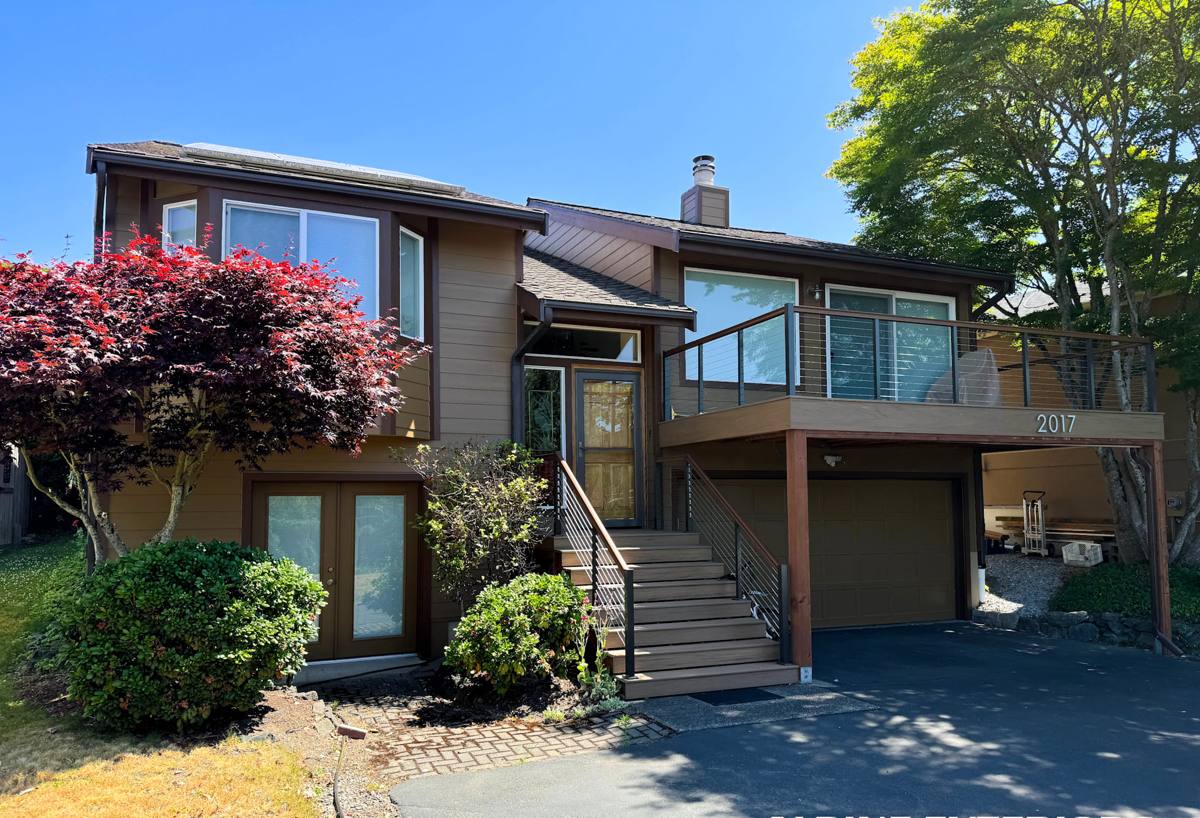
Signs Your Current Windows Are Losing the Fight
Coastal wear shows up in fairly predictable ways. If you're noticing any of the following, it's worth having the windows and the wall around them looked at before it turns into a bigger repair:
- Fogging or a milky look between the panes of a double-pane window — the seal has failed and the gas fill is gone
- White or greenish corrosion on aluminum frames, hinges, or cranks
- Soft or discolored wood at the sill or bottom corners of the frame
- Moss or dark streaking building up on the sill, brickmold, or trim below the window
- Drafts or a noticeable temperature drop near the window on windy days
- Windows that stick, won't latch fully, or have started sagging in the frame
Any one of these on its own might just mean the window needs attention. Several at once, especially on the walls that face the water or take the worst of the weather, usually means the window and possibly the framing behind it are due for replacement.
What a Correct Installation Actually Involves
Setting a new window into an opening is the easy part. What determines whether it lasts is everything around it — the parts that get covered up and never seen again once the trim goes back on.
Flashing and Water Management
In a wind-driven rain environment, water doesn't just run down a wall — it gets pushed sideways and up under trim and siding edges. That means the sill pan, head flashing, and side flashing all need to overlap in the right order (bottom to top, like shingles) so water is always directed out and away from the wood framing, never trapped behind it. A sill pan with a back dam is not optional on an exposed elevation here. We also check that the weather-resistive barrier behind the siding is properly integrated with the window flashing rather than just taped over it, since that's one of the most common gaps we find on older installations.
Hardware and Fasteners That Won't Corrode
Salt air attacks bare or lower-grade metal fastest. That means stainless steel or coated fasteners at the exterior, corrosion-resistant hinges and locking hardware, and avoiding dissimilar metals in direct contact where possible, since that combination speeds up corrosion through galvanic reaction. It's a small detail on an invoice but it's the difference between hardware that still operates smoothly in ten years and hardware that seizes up or stains the siding in three.
Choosing Materials That Actually Hold Up Here
Frame material matters more on the water than it does a few miles inland. We steer most Birch Bay projects toward vinyl or fiberglass for this reason — both resist corrosion and moisture absorption in ways bare or thinly clad aluminum and unprotected wood frames don't. Where a homeowner wants a wood interior look, we recommend aluminum- or fiberglass-clad wood so the exterior face — the part actually exposed to salt air and rain — is a low-maintenance material, while the wood stays protected on the interior side.
| Frame Material | Salt Air / Moisture Behavior | Maintenance | Typical Fit for Birch Bay |
|---|---|---|---|
| Vinyl | Won't corrode or rot; handles moisture well | Low — occasional cleaning | Strong all-around choice, especially budget-conscious replacements |
| Fiberglass | Very stable in temperature swings and moisture; resists corrosion | Low | Best long-term durability for exposed, wind-facing walls |
| Aluminum-clad wood | Clad exterior resists weather; interior wood needs protection from any breach | Moderate | Good where a wood interior look is wanted; clad face must stay sealed |
| Bare/unclad wood | Absorbs moisture, vulnerable to rot in this climate | High — regular repainting/sealing | Generally not our recommendation for exposed coastal elevations |
| Uncoated aluminum | Prone to pitting and corrosion in salt air over time | Moderate to high | Only where budget or code requires; expect earlier hardware wear |
We're not telling homeowners any of these materials are junk — every one of them has a place. Our standard is simply matching the material to the exposure the window will actually face, because a frame that's fine on a sheltered inland wall can wear out fast when it's taking direct salt spray and driving rain year-round.
Glazing and Weatherstripping Choices That Matter on the Water
Beyond the frame, the glass package and seals do a lot of the work. A good dual-pane, Low-E unit with an argon fill cuts down on condensation and improves comfort near the glass, which matters when cold, damp air is a near-constant on this stretch of coast. Weatherstripping should be a durable, UV- and moisture-stable compression seal rather than a thin foam strip that compresses permanently after a season or two of being flexed by wind. We also make sure weep holes — the small drainage channels at the bottom of the frame — are clear and functioning, since a blocked weep hole is one of the most common causes of water pooling inside a "new" window within the first couple of years.
Our Installation Process
The steps don't change much from house to house, but the attention to detail at each one is what separates a window that lasts from one that doesn't:
- Assessment — we look at the existing window, the wall assembly behind it, and the specific exposure (wind direction, water runoff, moss buildup) for that opening
- Removal — old window and any compromised trim or sheathing comes out; we check the framing underneath for hidden rot or water damage before going further
- Prep and repair — any soft framing gets replaced, the opening is squared and leveled, and the weather-resistive barrier is repaired or extended as needed
- Flashing and sill pan — installed in the correct shingle-lap order so water is directed out, not trapped
- Setting the window — shimmed, leveled, and fastened per manufacturer spec, checked for square and smooth operation before sealing
- Sealing and insulation — low-expansion foam or backer rod and sealant around the frame, exterior sealant at trim joints rated for this climate
- Trim and cleanup — interior and exterior trim reset or replaced, site cleaned, old materials hauled off
- Final walkthrough — we operate every window with the homeowner present and check the seal and finish before calling the job done
What Affects the Cost of a Window Project in Birch Bay
Every quote is specific to the house, but the same handful of factors drive most of the variation we see on coastal jobs:
| Factor | Why It Changes the Price |
|---|---|
| Number and size of windows | More openings and larger units mean more material and labor |
| Frame material | Vinyl, fiberglass, and clad-wood price differently, and exposure often justifies the upgrade |
| Condition of the framing behind the old window | Rot or water damage found during removal adds repair time before the new unit can go in |
| Access and elevation | Upper-story or hard-to-reach windows take longer and may need staging or lifts |
| Full-frame vs. insert replacement | Full-frame replaces flashing and sill pan too — more work, but the right call when there's water damage or the old flashing is failing |
| Glazing package | Upgraded Low-E coatings or gas fills add a modest per-window cost |
As a general rule, a straightforward insert replacement in good framing costs noticeably less than a full-frame replacement that includes repairing water-damaged sheathing or re-flashing the opening. We'll always tell you which situation you're actually in before work starts, not after.
Keeping New Windows Performing for the Long Haul
A correctly installed window in this climate still benefits from a little seasonal attention. A short annual routine goes a long way:
- Rinse salt residue and grime off frames and glass a few times a year, especially after storms
- Check and clear weep holes at the base of the frame so water can drain out
- Knock moss and algae off sills and trim before it builds up and holds moisture against the surface
- Inspect exterior caulk lines each fall and touch up any that have cracked or pulled away
- Operate locks and hardware periodically so they don't seize from disuse plus corrosion
- Watch for any soft spots forming at the sill or bottom corners and address them early
Why Hiring a Crew That Already Works Birch Bay Matters
A lot of window problems we get called out to fix aren't the window's fault — they're an installation that didn't account for this specific coastline. A crew based inland, or one that mostly works drier climates, doesn't always think through how much water pressure a windy, water-facing wall actually sees, or how fast unprotected metal corrodes this close to salt water. We're a Lynden-based crew that works Whatcom County's coastal and inland communities alike, so we're not guessing at how Birch Bay's weather behaves — we're accounting for it in the flashing detail, the hardware spec, and the material recommendation before the first window ever comes out. We also carry the licensing and insurance a homeowner should expect from anyone working on their home's exterior, and we're glad to walk through that with you directly.
If your windows are showing their age, or you're planning ahead for a remodel, we're happy to take a look and give you a straightforward, no-pressure estimate — no obligation, just an honest read on what your home actually needs. Use the form below to get started.